
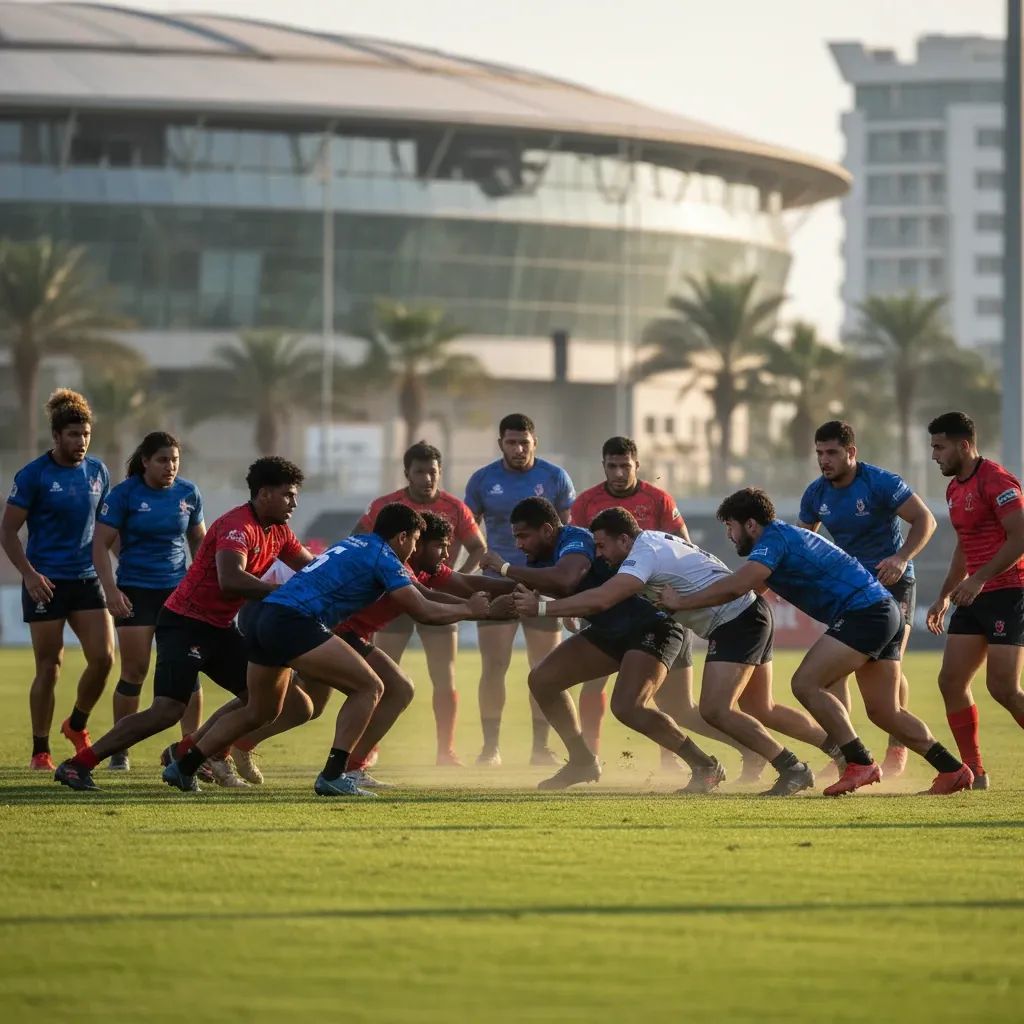
A Backyard Dream Finds Its Paris Connection
When Dr. Abdulrehman Kazim flipped through television channels one evening, a rugby match captured his attention. That casual moment between football broadcasts transformed into something far more consequential: the founding of Dubai Knights, a club that has just secured what many consider an improbable partnership with Stade Francais, one of France's most decorated rugby institutions.
What makes this arrangement remarkable is not the affiliation itself—international rugby partnerships are commonplace—but the timing and ambition behind it. Here is a club that has existed for barely 12 months, still preparing for its inaugural league match in the UAE Division 2, yet already operating at a scale and sophistication that typically takes far longer to achieve. The partnership signals a shift in how rugby develops in the United Arab Emirates: no longer will clubs wait years to gain international exposure.
Why This Matters
• Direct European pathway: Dubai Knights players now have access to coaching expertise, training facilities, and potential opportunities at a club that has won the French championship 14 times and reached the European final twice.
• Acceleration of local talent: Emiratis and other UAE-based players can transition from weekend rugby to structured professional development without leaving the region first.
• Redefining entry barriers: Newcomers to rugby in the UAE gain entry through a club backed by world-class infrastructure, not just grassroots enthusiasm.
The Man Behind the Movement
Dr. Kazim's journey into rugby reads almost like a deliberate parable about discovering unexpected passion. An Emirati physician by profession, he stumbled onto the sport without any prior connection. His initial fascination with what he saw on screen evolved into something consuming. Within months of that serendipitous discovery, he assembled a small group of friends for informal matches in his backyard. This casual arrangement quickly evolved into something more formal—and remarkably more ambitious.
Today, Dubai Knights operates as an official entity with approximately 47 playing members. The roster reflects the diversity of the UAE's expat and local population: Emiratis sit alongside athletes from Pakistan, Sri Lanka, Jordan, South Africa, and beyond. This composition matters because it positions rugby—historically an expatriate-dominated activity in the Gulf—as increasingly accessible to Emirati citizens themselves.
The transition from informal backyard sessions to a formal club structure happened with striking speed. Within a year of registration, Dr. Kazim had orchestrated not just a playing squad but a coaching hierarchy. Sakiusa Naisau serves as Head Coach, bringing international experience and tactical knowledge. Yousef Thani directs training and performance protocols, ensuring that the club maintains professional standards despite its infancy.
The Stade Francais Arrangement: What Happens Behind the Scenes
The affiliation between Dubai Knights and Stade Francais operates on three distinct levels. The first concerns personnel movement: Knights coaches and players will access training camps and mentorship in Paris, while Stade staff may conduct masterclasses in Dubai. This bidirectional flow means knowledge transfer becomes ongoing rather than theoretical.
The second pillar involves operational infrastructure. Stade provides insight into how a professional rugby organization functions—from conditioning protocols to tactical development systems. For a club in its infancy, exposure to these processes accelerates internal development. Dr. Kazim recounted that after returning from the first Paris visit, the organization felt compelled to elevate its own standards dramatically. He described it as a moment of clarity: seeing what a fully realized rugby institution resembles provided a blueprint for ambition.
The third element touches on commercial identity. Stade Francais has cultivated a distinctive brand reputation—bold pink-and-blue kits, a fashion-conscious aesthetic, celebrity ownership history—that appeals to audiences unfamiliar with rugby's traditional imagery. For Dr. Kazim, this matters strategically. Rugby remains a niche sport in the UAE, and attracting new participants and fans requires breaking through preconceived notions about what rugby is. Stade's contemporary brand positioning offers that entry point.
To facilitate this arrangement, Dr. Kazim traveled to Paris four separate times over the past year, personally negotiating terms and understanding what partnership could accomplish. This hands-on approach distinguishes his vision from more distant, administrative affiliations. He sought not just a nameplate agreement but a genuine working relationship.
Context: International Partnerships in UAE Rugby
The concept of UAE clubs partnering with established European institutions is neither new nor uncommon. Previous arrangements have linked local sides with the London-based clubs Harlequins, Wasps, and Saracens, as well as the Wellington-based Hurricanes. These partnerships typically include player placements, coaching exchanges, and technical consultation.
What distinguishes the Dubai Knights situation is the developmental stage at which such an affiliation has been negotiated. Most clubs secure international partnerships only after establishing a domestic track record—multiple seasons of competitive play, roster stability, and demonstrated financial viability. The Knights are doing this before their league debut, which suggests either exceptional confidence from both parties or a recognition that new models of rugby development require earlier international scaffolding.
The UAE Rugby Ladder and Where the Knights Fit
Rugby governance in the United Arab Emirates operates through a tiered structure overseen by the UAE Rugby Federation (UAERF). At the apex sits the West Asia Premiership, a regional seven-team competition featuring clubs from the UAE, Bahrain, Oman, and Saudi Arabia. Below that, the UAE Premiership comprises five domestic clubs: Dubai Exiles, Jebel Ali Dragons, Dubai Hurricanes, Abu Dhabi Harlequins, and Al Ain Amblers.
The First Division (previously known as the UAE Conference League) functions as the domestic second tier, featuring 11 clubs competing from September through April. Matches follow a round-robin structure before playoff phases.
This is where Dubai Knights will debut during the 2025-2026 season. The Second Division (formerly the UAE Community League) was introduced in 2015-2016 specifically to accommodate developing players, those returning from injury, and individuals seeking rugby participation without the intensity of upper divisions. Games are played bi-weekly, giving less experienced squads manageable fixture calendars and allowing for both competitive and social engagement.
The Knights enter a division that includes established community clubs like RAK Rocks and Arabian Knights, as well as the all-Emirati UAE Shaheen XV, which represents a significant milestone in making rugby accessible to local players rather than relying solely on expatriate participation.
What This Means for Residents
For expats and Emiratis contemplating rugby involvement, Dubai Knights presents an unusual opportunity. Most community rugby clubs in the UAE operate as social organizations with varying levels of coaching support. The Knights, backed by Stade Francais consultation and Dr. Kazim's professional standards, offer something different: professional-grade coaching access at the grassroots entry level. This combination rarely exists.
The club's emphasis on Emirati recruitment also carries cultural significance. Rugby in the UAE has historically been organized around expatriate networks, leaving many local citizens unfamiliar with the sport despite it being available for decades. The Knights' core Emirati membership and Arabic-speaking leadership provides cultural familiarity alongside participation, lowering psychological barriers to entry.
More ambitiously, participation offers players a tangible pathway: succeed locally, gain exposure through the Stade partnership, and potentially transition to professional rugby in Europe. This prospect was largely abstract before the Knights' emergence. Young athletes in the UAE could theoretically pursue rugby professionally, but the mechanisms for doing so remained unclear. The Knights provide that structural clarity.
The 10-Year Roadmap and Realistic Ambitions
Dr. Kazim has articulated a decade-long plan to position Dubai Knights within the West Asia Premiership—rugby's top tier in the Gulf region. This progression requires not just competitive success but sustained funding, player retention, and community engagement.
The club's first international engagement—a short-format tournament in Bangkok featuring competition from Japan, India, and Thailand—served multiple purposes. Competitively, it tested the squad against international opposition. Culturally, it introduced younger players to rugby traditions and rituals, particularly the British & Irish Lions custom where the squad's youngest member assumes responsibility for safeguarding a team mascot. For the Knights, this was a stuffed elephant, entrusted to Zambian fullback Luyando Dominique.
Dr. Kazim observed that such experiences embed organizational identity. Players begin viewing themselves not as individuals attending training sessions but as members of an institution they help build. The Bangkok tour reportedly deepened this sentiment significantly.
Broader Rugby Development in the Gulf
Dubai Knights' ambitions align with a larger regional strategy. Saudi Arabia, the United Arab Emirates, and Qatar have jointly announced an intention to bid for hosting the 2035 Rugby World Cup. Such a bid requires demonstration of established grassroots infrastructure and competitive domestic leagues—precisely the areas where clubs like Dubai Knights contribute by offering legitimacy to local rugby development.
This global platform would represent unprecedented recognition for Middle Eastern rugby. World Rugby has never held the World Cup outside the established rugby nations of Europe, the Southern Hemisphere, and Asia. A Gulf hosting would signal rugby's geographic expansion and the region's rising sporting infrastructure.
Within the UAE specifically, rugby participation continues expanding beyond the traditional expatriate base. The Empire Rugby Academy, launched in April 2025, established the nation's first female-only performance rugby program, reflecting broader gender inclusion efforts. Women's participation in the Emirates Dubai 7s tournament increased by 21% between 2022 and 2025. The UAE Women's 7s team won the Rugby Trophy in Doha, while the men's national squad advanced to World Cup qualification playoffs for the first time in July 2025 after finishing runner-up in the Asia Rugby Championship.
What Happens Next
The true test arrives when UAE Division 2 fixtures commence in September 2025. If Dubai Knights performs competitively and retains its roster, promotion to Division 1 by the 2026-2027 season becomes realistic. More importantly, success will signal whether the Stade Francais exchange model delivers tangible advantages or operates primarily as a branding exercise.
For the UAE rugby community, the Knights' trajectory will influence whether other clubs pursue European partnerships and how younger organizations structure their development strategies. If Dr. Kazim's model proves sustainable, it could reshape how rugby clubs operate across the region.
For residents curious about joining, the timing offers opportunity. A club in its formative stages, backed by professional infrastructure, presents rare conditions: low-pressure environment combined with high-quality coaching access. For Emiratis specifically, it offers entry into a sport historically organized around expatriate social networks.
The underlying question remains whether a physician's accidental discovery of rugby—and his willingness to pursue it seriously—can crystallize into an institution capable of genuinely competing at the region's highest levels over the coming decade. The Stade Francais partnership provides a head start, but sustainable success requires navigating UAERF regulatory requirements, competing against clubs with decades of institutional history, and maintaining community engagement across the UAE's diverse population.
For now, Dr. Kazim and his team prepare for their Division 2 debut. The backyard beginnings seem distant, yet the ambition they represent—to establish professional rugby in the United Arab Emirates through local leadership and international partnership—has only intensified since those early informal matches.


