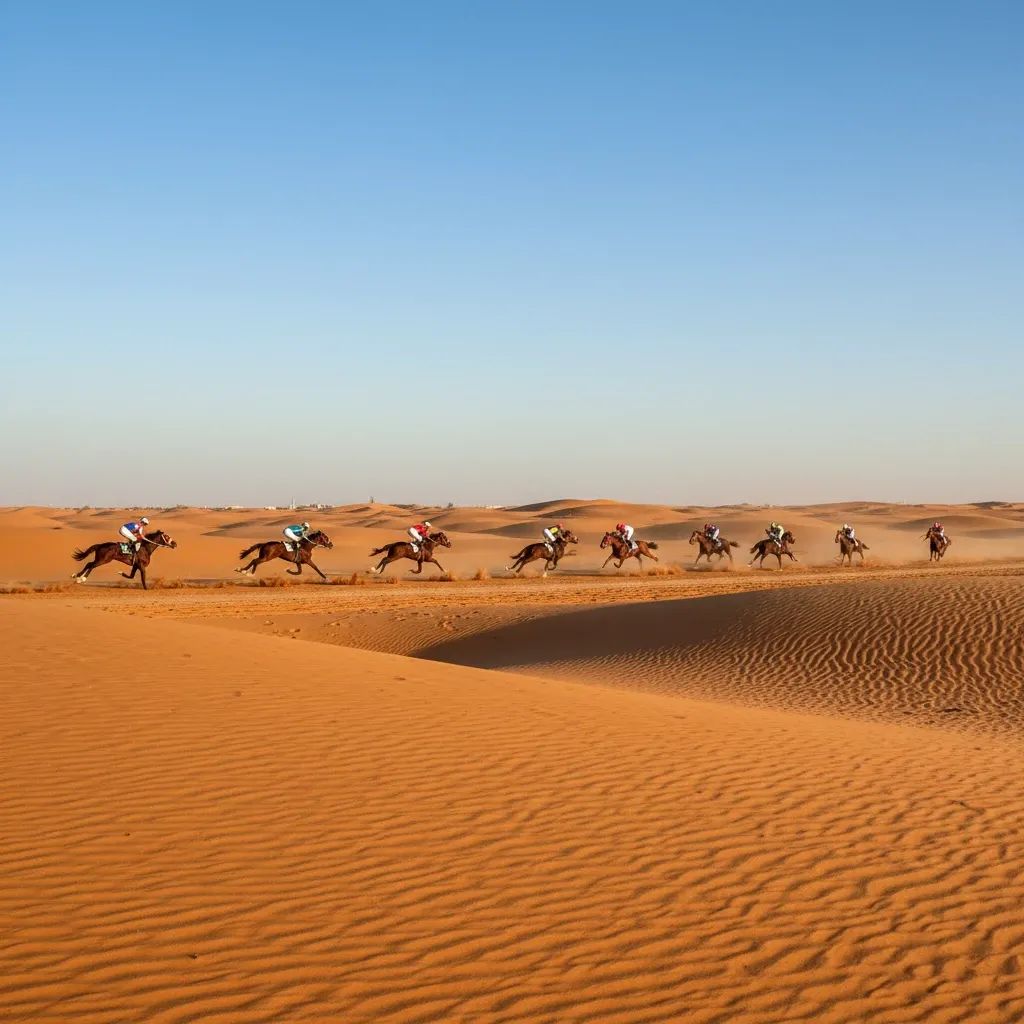
This Sunday, May 10, 2026, at ParisLongchamp, the United Arab Emirates President's Cup returns to Europe as the first leg of the 33rd edition, bringing elite Arabian horses to one of the continent's most prestigious racing venues. The 2,000-meter Group 1 race, contested for horses aged four and older with a €350,000 purse, represents far more than a sporting fixture. It signals the UAE's systematic expansion of Arabian racing infrastructure beyond its home market, anchoring what was once a purely regional endeavor into the institutional fabric of major European racing centers.
Why This Matters
• Gateway moment: The Paris leg follows success at Churchill Downs (Kentucky Derby, $400,000 purse) and represents the Cup's continuing integration into premier international venues, establishing a permanent global racing circuit for Arabians.
• Cultural preservation meets strategic expansion: The race reflects Sheikh Mansour bin Zayed Al Nahyan's three-decade commitment to preserving Arabian racing as a living cultural practice within modern infrastructure, now with €350,000 in purse money at stake.
• Post time: 2:25 PM Paris time Sunday (5:25 PM UAE time), as part of the Emirates French Guineas (Poule d'Essai) card alongside Thoroughbred classics, introducing Arabian racing to audiences unfamiliar with the breed and demonstrating UAE soft power through equestrian diplomacy.
Strategic Significance for UAE Residents
For the United Arab Emirates, this expansion achieves multiple objectives: preserves Arabian heritage within modern international infrastructure, projects regional influence through equestrian soft power, maintains racing as a living cultural practice rather than historical artifact, and demonstrates sustained commitment to breeds and disciplines that Western commercial racing has largely abandoned. Longchamp's inclusion of the President's Cup on its racing calendar—a venue that hosts the Qatar Prix de l'Arc de Triomphe and other major international fixtures—represents global recognition of UAE leadership in Arabian racing stewardship.
The Longchamp Selection: Why Paris, Why Now
The choice of ParisLongchamp carries deliberate strategy. France has established racing infrastructure and media reach, making the country a logical venue for the 33rd edition of the President's Cup Series.
The partnership with France Galop (the French racing authority) anchors the Arabian circuit within a recognized institution, lending legitimacy that independent promotions cannot replicate. Programming matters equally: the Arabian President's Cup shares Sunday's card with the traditional Colts Guineas (€650,000, 13 runners) and Fillies Guineas (€550,000, 15 runners), positioning Arabian racing as a complementary offering rather than a competing fixture. That tactical placement acknowledges hard reality—Thoroughbred racing generates €20.3 billion annually across Europe and commands television audiences exceeding 1.5 million viewers for flagship events like the Cheltenham Gold Cup, while Arabian racing operates as a dedicated niche.
The venue's historical significance strengthens the case: Longchamp's established roll of honor for the President's Cup—including winners Luceil (2025), Al Doha (2024), Ch'ezza (2023), Hattal (2021-2022), and Deryan (2020)—demonstrates the race's proven institutional fit within European racing calendars.
The Field: Gulf Capital's Equestrian Footprint
This edition's entries reflect the economic realities sustaining Arabian racing across Europe: deep patronage from Gulf stables willing to fund competitive programs despite prize levels that would be considered modest in Thoroughbred circles.
RB Kingmaker, owned by Hilal Alalawi and trained by Leonardo Daniel Raco, carries the strongest credentials as morning favorite. Sired by Baseq Al Khalediah and ridden by Cristian Demuro—a pairing that exemplifies how Arabian racing has increasingly professionalized through recruitment of Thoroughbred-caliber jockeys—the colt represents the private wealth that bankrolls competitive Arabian programs. His lineage traces breeding excellence, yet his odds reflect a fundamental constraint: the Arabian registry's closed stud book concentrates genetic material, limiting talent depth compared to Thoroughbred competition.
Al Shaqab Racing, the Qatari operation with expansive European holdings, deploys Al Zeeb (sired by Azadi out of Zheeba) under jockey Fabrice Veron and the filly Hajmah (out of Easter de Faust) with Christophe Soumillon. Both carry the training signature of Thomas Fourcy, whose Paris-based stable has positioned itself as the preferred European hub for Gulf-owned Arabian competitors. The stable's presence across multiple entries illustrates how European infrastructure increasingly concentrates Arab horse training within professional operations rather than dispersed regional efforts.
Wathnan Racing fields a formidable triple assault across three generations of pedigrees: Lebeau du Carrere ridden by James Doyle, Muneer with Mickael Barzalona, and Muraheb partnered with Augustin Madamet. This concentrated entry strategy mirrors investment patterns from entities like the Qatar Racing and Equestrian Club, which operates across both Arabian and Thoroughbred racing—essentially hedging exposure across breed disciplines while maintaining strategic involvement in Arabian preservation.
Completing the field are HM Majdallah (owner Mohammed Al Hazami) and Lacaro du Croate (owner Mansoor bin Khalil Al Shahwani), both reflecting the broader Emirati and Gulf ownership structure sustaining competitive Arabian racing in Europe.
The Bloodline Constraint: Why Arabian Racing Remains Structurally Different
The Arabian President's Cup roll of honor reveals how closed-registry breeding simultaneously strengthens and limits the sport. Winners recur across years because the genetic pool remains intentionally restricted. Al Mourtajez, appearing as a sire in multiple entries across Sunday's field, wields outsized influence precisely because the breeding population is managed for genetic purity rather than competitive depth.
This structural difference from Thoroughbred racing—which operates with an open stud book and global breeding markets—creates two competing effects. Genetic preservation maintains the Arabian breed's authenticity, honoring Bedouin tradition and cultural heritage that constitute the event's true purpose. Yet that same preservation constricts competitive talent availability. Where Thoroughbred racing produces successive generations of fresh competitive talent through unrestricted breeding, Arabian racing must work within established bloodlines. The result: excellence remains achievable, but at smaller scale and with deeper reliance on patron investment rather than market-driven commercial returns.
The Economics: Patronage Over Market Forces
The €350,000 purse positions this race among Europe's richest Arabian fixtures. Yet comparative context is instructive. The Qatar Prix de l'Arc de Triomphe (contested on the same ParisLongchamp turf later in the racing calendar) distributes €5 million, a ratio underscoring Arabian racing's financial positioning within European racing hierarchy.
Arabian racing operates on a fundamentally different economic model than Thoroughbred competition. Thoroughbred prize money derives from betting tax revenue, corporate sponsorships, hospitality, and media rights—multiple revenue streams that support self-sustaining commercial ecosystems. Arabian purses rely predominantly on direct patron subsidy. Sheikh Mansour bin Zayed Al Nahyan provides ongoing backing for the President's Cup circuit globally. The Qatar Arabian World Cup (€1 million) and Qatar International Stakes (£400,000) function within similar patronage frameworks: direct investment from Gulf sovereigns motivated by cultural preservation and geopolitical positioning rather than market-driven commercial returns.
This distinction matters operationally. Thoroughbred racing authorities can project multi-year growth using betting forecasts and sponsorship commitments. Arabian racing authorities cannot. Every major international Arabian racing circuit depends on sustained political will and financial commitment from Middle Eastern patrons. That commitment demonstrates robustness—the 33rd edition spans 19 international legs across four continents, with total prize money reaching AED 10.8 million (approximately $2.9 million) for the full series—yet remains vulnerable to shifts in patronage priorities that lie entirely outside racing's institutional control.
What This Sunday Signals
The race represents the 33rd edition's international expansion, anchoring at globally recognized facilities. The Longchamp selection follows established strategy: partner with national racing bodies, maintain competitive legitimacy through elite field assembly, and strengthen the circuit's institutional footprint across major European racing centers.
From the United Arab Emirates perspective, this expansion achieves multiple strategic objectives simultaneously: preserves Arabian heritage within modern infrastructure, projects regional soft power through equestrian diplomacy, maintains racing as a living cultural practice, and demonstrates global leadership in Arabian racing stewardship that resonates far beyond sports enthusiasts in the UAE and across international racing communities.
From the European racing perspective, the question remains open: will Arabian racing eventually integrate more deeply into mainstream European equestrian programming, or remain a specialized offering sustained by Gulf patronage? This Sunday's attendance, media engagement, and audience response at ParisLongchamp provides data toward that answer.
The €350,000 purse awaits distribution. Post time approaches. For now, the convergence of Gulf-backed competitors, top-tier European facilities, and institutional racing authority legitimacy constitutes an afternoon where a 33-year-old regional initiative claims permanent presence on Europe's racing calendar.