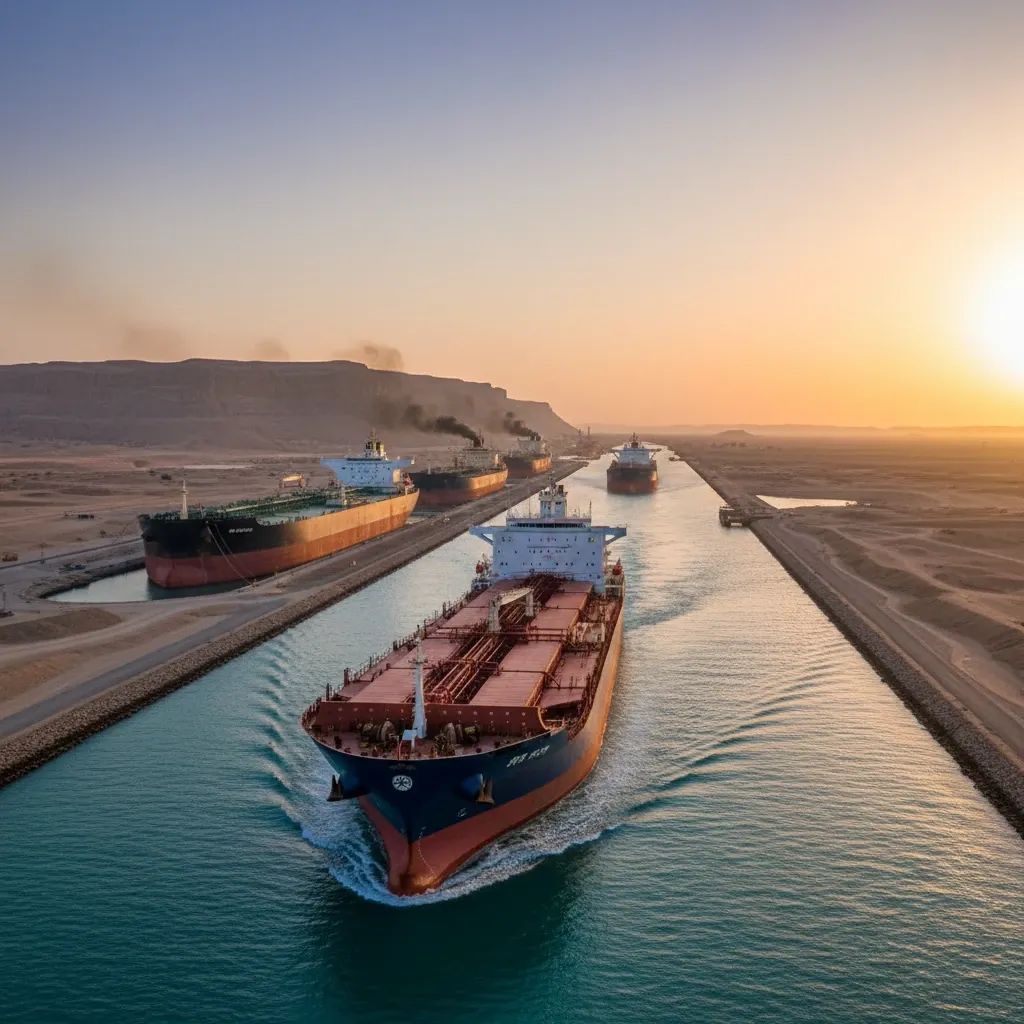
Equity markets across the Arabian Gulf suffered a sharp reversal on Wednesday as investors grappled with a worsening impasse over the Strait of Hormuz, overshadowing diplomatic efforts that had briefly raised hopes for resolution. Since late February 2026, Iran's Islamic Revolutionary Guard Corps has blockaded the waterway in retaliation for US and Israeli military actions in the region, effectively closing the world's most critical oil chokepoint. Despite extended ceasefires and international negotiations, the continued blockade has proven difficult to reconcile with the fundamental needs of regional economies, leaving traders with little choice but to reassess portfolio exposure amid deepening supply chain uncertainty. As of mid-April 2026, the crisis continues to deepen, with no clear reopening timeline in sight.
Why This Matters
• Immediate wealth erosion: The Dubai Financial Market index retreated 1.1% while Abu Dhabi Securities Exchange declined 0.8%, dragging down banking and property holdings across the region's major portfolios.
• Energy costs remain elevated: Brent crude hovered near $99.56 per barrel, with longer-term forecasts suggesting $130–$170 levels if the blockade persists—directly inflating costs for utilities, transport, and manufacturing throughout the United Arab Emirates.
• Export pipelines under capacity: Diversion routes through Fujairah and Yanbu absorb only partial traffic, leaving roughly 19 million barrels daily stranded or rerouted at premium cost.
Decoding Wednesday's Market Decline
The mathematics of the selloff became visible across sector-by-sector equity declines. Dubai's Emaar Properties, which anchors much of the emirate's construction agenda, shed 2.2% as investor confidence in real estate expansion faltered. Emirates NBD Bank, the financial backbone serving the trading community, fell 1.8%. In the capital, First Abu Dhabi Bank lost 2.6%—the steepest drop among major lenders—while conglomerate Alpha Dhabi retreated 1.4% and developer Aldar Properties slipped 1.8%.
The announcement that Aldar and sovereign wealth fund Mubadala had jointly acquired a 654-million-dirham development at Masdar City offered momentary distraction, but failed to reverse the broader bearish tide. Such dealmaking, typically celebrated as evidence of capitalization strength, was instead read as an attempt to deploy capital defensively—shifting resources toward completed assets rather than future expansion bets.
Across the border, Saudi Arabia's Tadawul index extended its loss streak to five consecutive trading sessions, dropping 0.9%. Al Rajhi Bank and ACWA Power both fell roughly 2%, with only Saudi Aramco posting a modest 0.4% gain. The oil giant's resilience likely reflected crude's intraday climb rather than operational optimism. In Qatar, the benchmark barely held, with Qatar National Bank down 1.5%, though Qatar Gas Transport bucked the trend to gain 1.1% after announcing stronger-than-expected first-quarter earnings.
The Blockade's Economic Toll
Traders face a stubborn reality: between late February and March 30, the six major Gulf oil producers—Iran, Iraq, Kuwait, Saudi Arabia, the United Arab Emirates, and Bahrain—witnessed export volumes collapse by 36.4%. In practical terms, that translates to roughly 15.3 billion dirhams ($4.2 billion equivalent) in lost oil receipts over a single month. When accounting for disrupted liquefied natural gas shipments, suspended shipping operations, and downstream industry shutdowns, cumulative regional losses exceeded 180 billion dirhams ($50 billion) by month's end.
The International Energy Agency has characterized the disruption as the most severe chokepoint failure in recorded energy market history. Approximately 21 million barrels transit the Strait daily under normal conditions, representing roughly one-fifth of global seaborne crude and one-fifth of the world's LNG supply. When that corridor effectively closes—as Iran's Islamic Revolutionary Guard Corps declared on March 27—the mathematical consequence is immediate and unforgiving.
Oil production outages across the Gulf Cooperation Council reached 7.5 million barrels daily in March, with some projections suggesting spikes toward 9.1 million daily in April. For perspective, that's equivalent to removing Saudi Arabia's total output from circulation. The impact ricocheted through wage structures (fewer production jobs, deferred hiring), infrastructure timelines (project funding constrained), and credit conditions (banks tighten lending against shrinking collateral values).
Why Oil Prices Reverberate Through Daily Life
The 1.2% climb in Brent crude futures to $99.56 per barrel on Wednesday followed fresh reports of confrontations in the Strait. Sustained blockade scenarios are modeled at $130–$170 per barrel over the next several months, a level not seen since the 1970s energy embargo. For residents and business operators in the United Arab Emirates, the implications extend well beyond fuel pump prices.
Fertilizer input costs have already surged, since the Gulf region supplies approximately 45% of the world's elemental sulfur—a core component in agricultural chemicals. Disrupted production translates directly to higher crop input costs, which supermarket supply chains eventually pass to consumers. Industrial metals like aluminum and helium, where the Gulf is a major supplier and intermediate processor, have experienced similar upward pressure. Airlines flying routes through regional airspace absorb fuel surcharges and route delays as premium insurance costs restrict corridor usage.
Import-dependent manufacturers and retailers face elevated logistics expenses. Shipping firms demand war-risk premiums for any vessel transiting contested waters, effectively tripling or quadrupling per-container costs. Businesses importing finished goods or raw materials absorb these surcharges or reduce inventory turnover, creating supply tightness for retailers and consumers alike.
Even sectors that appear insulated face indirect pressure. When Asian buyers—accounting for 75% of the region's oil exports and 59% of liquefied natural gas shipments—scramble for alternative energy sources, their capital flows shift. Investment capital that might have reached Gulf real estate development or infrastructure partnerships now funds energy security projects in competing jurisdictions. The result is a tightening of available funding for regional expansion and a recalibration of foreign investor appetite.
What This Means for Your Finances
For the millions of residents in the United Arab Emirates, this crisis carries direct personal consequences. Employment prospects face headwinds, particularly in construction, hospitality, and logistics sectors that depend on sustained economic growth. Companies across all industries are implementing hiring freezes and reviewing staffing levels, meaning job hunting will become more competitive over the coming months. Expect salary freezes or limited raises even in retained positions as employers navigate tighter cash flows.
Cost-of-living pressures will intensify gradually. Inflation in utilities, food, and transportation typically lags energy price increases by 4-6 weeks, so residents should expect noticeable price increases by late April and May. Grocery bills may rise 2-4% depending on import-heavy categories. Fuel and electricity costs will climb directly with crude oil prices, potentially increasing household expenses by 300-500 dirhams monthly for average families.
For expat workers—comprising approximately 90% of the UAE population—the economic contraction carries additional risks. Companies undergoing restructuring often review visa sponsorships and staffing levels, with the most vulnerable being those in junior roles or specialized positions with limited local demand. Begin reviewing your employment contract, visa status, and sponsorship conditions now. If restructuring occurs in your sector, expatriate staff are typically among the first affected. Consider strengthening your financial position by reviewing emergency savings (target three months of expenses minimum) and exploring whether your company offers healthcare or pension coverage that might be disrupted.
Investment portfolio recommendations depend on your risk tolerance and time horizon. Current market conditions favor capital preservation over growth; consider reducing exposure to regional equities and increasing holdings in international diversified funds or stable currencies. Avoid deploying capital into new UAE real estate ventures until the geopolitical situation clarifies. Energy sector stocks offer potential upside if the Strait reopens, but carry execution risk if blockade extends into 2027.
Visa and employment security: Monitor your company's quarterly earnings announcements and sector news carefully. Early warning signs of restructuring include hiring freezes, delayed salary payments, and postponed projects. If these emerge, accelerate any personal financial planning, explore alternative employment options proactively, and ensure your family's repatriation contingency is resourced adequately.
Temporary Fixes With Permanent Limitations
The United Arab Emirates and Saudi Arabia have responded pragmatically, rerouting export volumes through alternative corridors. The Abu Dhabi Pipeline to Fujairah and Saudi Arabia's East-West Pipeline to Yanbu on the Red Sea together bypass the Strait's closure—a logical response, but operationally constrained. Combined capacity falls substantially short of the 21 million barrels the Strait normally handles. Tankers must wait for pipeline availability, compressing throughput further and driving additional costs for producers.
The UAE Central Bank moved to bolster regional financial stability by signing a 20-billion-dirham ($5.4 billion) currency swap arrangement with Bahrain, designed to support the latter's currency peg over five years. This facility, unusual in its size and duration, reveals heightened anxiety about financial contagion. If disruption persists and hydrocarbon revenues collapse, even relatively sophisticated banking systems face deposit pressure and capital flight risks. The facility functions as an emergency backstop—a safety net no central banker wants to deploy.
Negotiation Status and Uncertain Horizons
The United Kingdom and France are currently hosting multilateral talks focused on mine clearance operations, maritime security frameworks, and safe passage mechanisms. According to sources monitoring negotiations, discussions have exposed "fundamental gaps" on security assurances and sanctions relief. No concrete reopening timeline has emerged.
Analysts are modeling three divergent outcomes. An optimistic scenario assumes the Strait reopens within weeks under international supervision, oil prices stabilize in the $80–$90 range, and equities rebound sharply. The baseline forecast projects a three-to-six-month closure, forcing Gulf states to draw substantially on sovereign wealth reserves and implement fiscal tightening measures. Oil would average $100–$120 per barrel, with equity markets grinding sideways. A worst-case outcome entails a prolonged blockade extending into 2027, fundamentally restructuring global energy trade corridors and pushing crude toward $180–$200 per barrel—conditions some regional economists describe as triggering a structural breakdown of the traditional GCC economic model.
The Earnings Test Ahead
Milad Azar, senior market analyst at XTB MENA, noted that "investors are weighing an uncertain geopolitical backdrop against fundamental earnings strength. While current conditions create pressure, the earnings season could provide a stabilizing force if regional firms demonstrate resilient non-oil revenues and sound operational execution."
Qatar Gas Transport's first-quarter profit report offered an early signal that operational discipline and revenue diversification remain viable hedges against commodities disruption. The critical question now is whether enough Gulf corporations can deliver credible guidance and earnings growth to establish a valuation floor. Deteriorating corporate guidance—inevitable if the blockade extends beyond the second quarter—would likely trigger additional equity declines and credit stress.
Action Items for UAE Residents: Three Steps to Navigate This Crisis
1. Strengthen your financial resilience now: Review your emergency savings immediately. Target at least three months of household expenses in liquid, accessible accounts. If you currently have less, prioritize building this buffer before taking on new financial commitments. This cushion protects against unexpected job loss, salary delays, or unplanned expenses.
2. Monitor key economic indicators weekly: Track crude oil prices, UAE equity index performance (especially DFM and ADX), and dirham exchange rates. Subscribe to alerts from UAE Central Bank or reputable financial news sources. Early signals of deterioration—such as oil dropping below $90 or equities declining more than 5% weekly—suggest worsening conditions requiring portfolio adjustments or employment contingency planning.
3. Review employment and visa security: If you are an expatriate or work in sectors vulnerable to contraction (construction, tourism, real estate), schedule a confidential conversation with your HR department about company restructuring plans. Understand your visa sponsorship terms, healthcare continuation provisions, and notice periods. Begin exploring alternative employment opportunities now, before any restructuring announcements emerge. For those with families, ensure repatriation plans are financially resourced and documented.
The Calculus for Residents and Investors
For people living in the United Arab Emirates, Wednesday's market correction serves as a concrete reminder of geographic vulnerability. The nation has invested heavily in economic diversification—tourism, financial services, real estate development, logistics—yet remains anchored to a chokepoint beyond its control. The Strait of Hormuz blockade was not engineered by UAE policymakers, yet its consequences ripple through employment prospects, infrastructure budgets, and investment returns across every sector.
Until commercial shipping resumes and sustained reopening becomes credible, regional equities face structural headwinds independent of corporate execution quality. The immediate priority is no longer expansion; it's financial runway, reserve sustainability, and how long GCC economies can fund routine operations and employment without compromise. By taking concrete financial and employment precautions today, residents can navigate the uncertainty ahead with greater confidence and security. That's the conversation April 2026 has forced, and it demands action—not just attention.