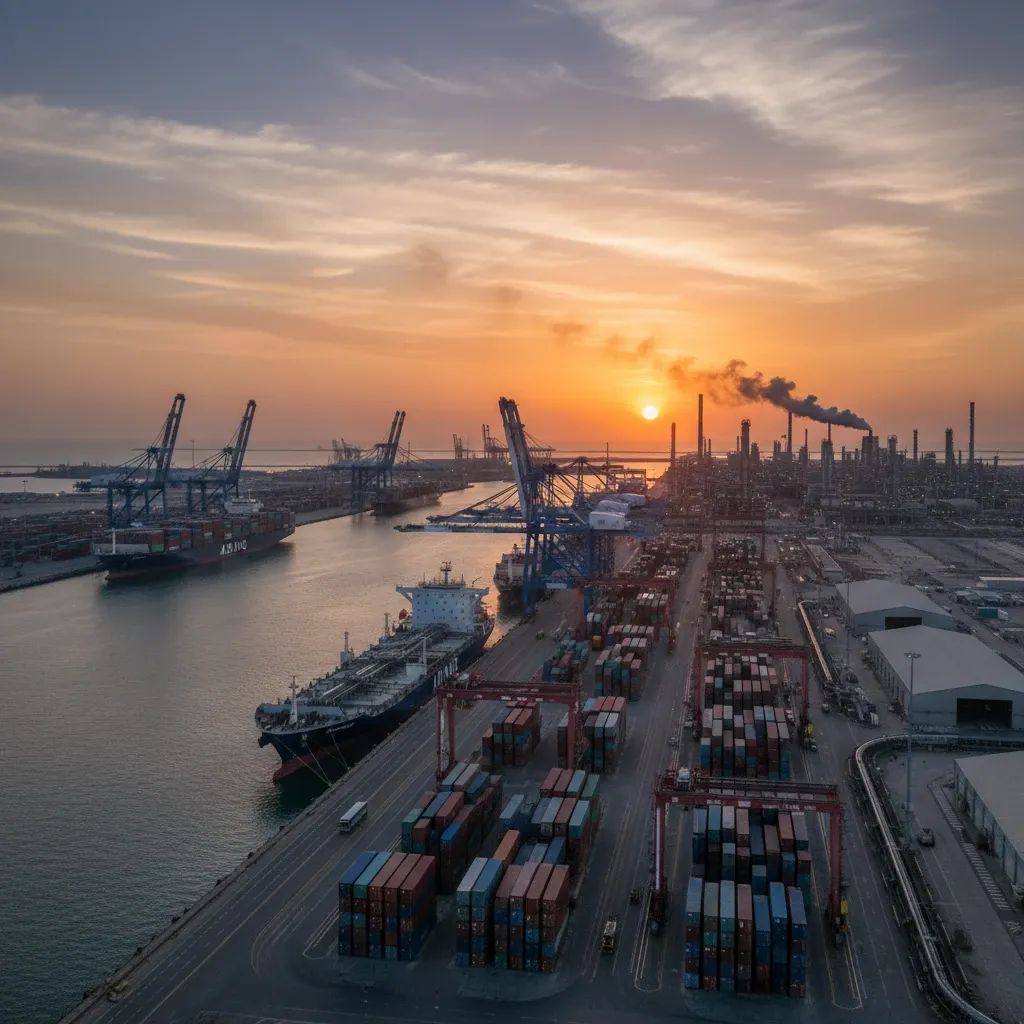
The United Arab Emirates-based oil markets witnessed a modest pullback on Thursday morning as global crude benchmarks retreated from a multi-day rally, a shift that signals ongoing volatility in energy markets shaped by geopolitical instability and critical supply constraints.
Why This Matters
• Energy costs: Oil price swings directly impact fuel costs across the UAE, affecting everything from diesel-powered logistics to jet fuel pricing at Dubai and Abu Dhabi airports.
• Market timing: The dip follows Wednesday's surge driven by escalating Middle East tensions and Iranian military actions in the Gulf region.
• Investment climate: For UAE-based traders and portfolio managers, crude volatility creates both hedging challenges and speculative opportunities.
• Regional stability: Prices near $97 reflect persistent uncertainty over Strait of Hormuz shipping routes critical to Gulf exports.
The Thursday Morning Pullback
Brent crude futures for August delivery slipped 0.69% to approximately $97.14 per barrel during early Asian hours, while US West Texas Intermediate crude dropped 0.65% to hover near $95.40 per barrel. The retreat broke a three-session winning streak that had pushed both benchmarks above psychologically important thresholds.
Market participants in Dubai and Abu Dhabi financial centers watched the correction unfold as commodity traders engaged in profit-taking, capitalizing on gains accumulated through Wednesday's volatile session. The Thursday decline represented a natural pause rather than a fundamental shift in market dynamics, according to regional energy analysts.
The pullback came despite underlying supply concerns that continue to support elevated pricing. Global oil inventories have been drawing down at record pace, with the International Energy Agency warning that middle distillate buffers—diesel and jet fuel—could reach operational stress limits by month-end to mid-July.
What Drove Wednesday's Sharp Rally
The previous session's price surge stemmed from a confluence of military escalation and diplomatic stalemate. Iran launched ballistic missiles toward Kuwait and Bahrain on Wednesday, though the projectiles failed to reach intended targets. In response, US military forces conducted retaliatory strikes on Iran's Qeshm Island, intensifying a conflict now entering its third month.
The military exchanges heightened fears over shipping disruption through the Strait of Hormuz, the narrow waterway that normally handles roughly 20% of global oil and liquefied natural gas trade. Shipping traffic through the strait has plummeted by over 90% from normal levels, effectively removing an estimated 14 to 20 million barrels per day from accessible supply routes.
Simultaneously, diplomatic talks between Iran and the United States showed minimal progress toward reopening the critical chokepoint. The negotiation deadlock fueled market speculation that supply disruptions could persist for months, even if a ceasefire agreement materializes soon.
Adding bullish momentum, the American Petroleum Institute reported a seventh consecutive weekly decline in US crude inventories for the week ending May 29. This data point reinforced perceptions that global supply tightness extends beyond Middle Eastern disruptions, encompassing fundamental demand-supply imbalances in major consuming nations.
Impact on UAE Markets and Consumers
For residents and businesses across the United Arab Emirates, the crude price turbulence translates into tangible economic pressures. Diesel prices in the US have risen 58% year-over-year, while jet fuel costs have surged 106%, metrics that ripple through to UAE-based airlines and logistics companies with dollar-denominated fuel contracts.
Emirates and Etihad Airways, both operating extensive long-haul networks from UAE hubs, face mounting fuel hedging challenges as crude benchmarks oscillate in wide daily ranges. Similarly, trucking companies serving Dubai's Jebel Ali Port—the Middle East's largest container facility—confront higher diesel costs that compress profit margins on freight contracts.
The broader UAE economy benefits from elevated oil revenues, with the government's fiscal position strengthening as Brent trades near $97. However, the price gains come with inflationary risks, particularly for imported goods that rely on diesel-powered distribution networks. The Central Bank of the UAE has signaled vigilance on imported inflation from energy-driven transport cost increases.
Investment portfolios managed by UAE-based wealth advisors are experiencing volatility in energy sector allocations. Dubai Financial Market energy stocks have tracked crude price movements closely, with some analysts recommending tactical overweights in integrated oil producers while remaining cautious on refiners squeezed by margin compression.
Divergent Analyst Outlooks Create Trading Uncertainty
Market forecasts paint starkly different scenarios depending on timeframe and assumptions. The US Energy Information Administration projects that persistent global oversupply from OPEC+ and non-OPEC sources will push WTI into the mid-$80s range over coming months as inventories accumulate and demand growth remains soft. However, for the immediate June period, some forecasts place Brent crude in the $105-$107 range, though current trading levels sit below these projections.
Contrasting views highlight geopolitical risk as the dominant variable. Some analysts project WTI could maintain a trading range around $100 per barrel through month-end, while more bearish forecasts place July WTI near $58 with a range of $55 to $65. The wide dispersion in professional estimates reflects genuine uncertainty about whether supply disruptions or demand weakness will prove the stronger force.
Goldman Sachs has identified weak oil demand in China and Europe as major downside risks, potentially reducing their Brent forecast by approximately $10 per barrel. However, the investment bank simultaneously acknowledges that persistent Middle East supply disruptions could push prices substantially higher. In extreme scenarios where the Strait of Hormuz remains critically constrained through Q3, some analysts warn that historically low inventory levels could drive crude to $150-$160 per barrel if the region experiences further escalation or diplomatic efforts collapse entirely.
The Strait of Hormuz Bottleneck
The partial closure of the Strait of Hormuz remains the central factor supporting elevated crude valuations. While some shipping traffic has resumed, volumes remain dramatically below pre-conflict norms. Exporters have shifted to pipeline routes across the Arabian Peninsula, but these alternatives lack the capacity to fully replace seaborne volumes that historically moved through the strait.
Even if diplomatic breakthrough occurs and the waterway fully reopens, energy market analysts expect a normalization timeline stretching several months. The delay stems from logistical complexities: renegotiating shipping contracts, securing maritime insurance at non-crisis premiums, restoring port operations, and coordinating tanker schedules across multiple Gulf producers.
The petrochemical sector, a significant crude consumer, faces disruptions potentially extending into 2027 even after shipping normalizes, according to Goldman Sachs projections. This reality carries particular relevance for the UAE's industrial zones, where petrochemical feedstock availability influences manufacturing output and export competitiveness.
OPEC+ Response Remains Modest
The Organization of the Petroleum Exporting Countries and allies agreed to modest production increases for June and July, adding approximately 188,000 barrels per day to global supply. The incremental volumes, while symbolically important, fall far short of offsetting the millions of barrels removed from accessible markets by Strait of Hormuz disruptions.
The measured OPEC+ response reflects competing priorities among member states. Gulf producers, including the UAE, possess spare capacity but remain cautious about flooding markets that could face sudden demand destruction if conflict escalates further. The balancing act between maximizing revenue at elevated prices and maintaining long-term market share shapes production policy decisions.
Labor Shortages Compound Supply Challenges
Beyond geopolitical factors, the global oil industry confronts persistent labor shortages for skilled technical roles. These workforce gaps are causing project delays and inflating operational costs, particularly for complex offshore developments and refinery expansions. The United Arab Emirates oil sector has navigated these challenges through selective recruitment of international talent, but wage pressures are mounting across engineering and technical disciplines.
The labor constraints inhibit the industry's ability to rapidly scale production in response to price signals, adding structural rigidity to supply responses that historical models assumed would be more elastic.
What Comes Next
For UAE residents monitoring fuel costs, investors managing energy exposure, and businesses planning logistics budgets, the crude market outlook remains clouded by contradictory signals. Thursday's modest pullback offers little indication whether fundamental oversupply concerns or geopolitical risk premiums will dominate pricing through month-end.
The key variables to watch include progress—or lack thereof—in Iran-US diplomatic channels, any further military escalation in Gulf waters, and weekly inventory data from the US and OECD nations. Chinese demand trends, currently showing weakness, could shift market dynamics if Beijing implements meaningful economic stimulus measures.
The UAE energy sector stands positioned to benefit from sustained elevated pricing, though the broader economy faces headwinds from import cost inflation and global growth uncertainty. For now, market participants are bracing for continued volatility as the tug-of-war between supply fears and demand concerns plays out in daily trading sessions.