
Dubai has positioned itself as an indispensable gateway for capital flows into the Middle East, a reality underscored by the recent engagement between the emirate's top finance official and one of the world's largest alternative asset managers. The strategic discussions signal that institutional investors—those managing hundreds of billions across multiple continents—are now treating the UAE's largest city not as an emerging opportunity but as a mature, essential node in their global deployment strategy.
Why This Matters
• Capital acceleration: Brookfield and similar institutional players are committing multi-billion dollar commitments across real estate, renewable energy, and logistics—sectors that directly shape where expats can afford to live and what jobs become available.
• Regulatory confidence: Dubai's rise to 7th place in the Global Financial Centres Index (March 2026) reflects investor trust in governance frameworks that protect capital and enforce contracts.
• Practical benefit: Increased institutional involvement typically drives construction quality, regulatory compliance, and long-term asset stability—meaning homes built by blue-chip developers retain value better than speculative projects.
The Institutional Pivot Reshaping Dubai's Real Estate
The meeting between Dubai's First Deputy Ruler and Finance Minister Sheikh Maktoum bin Mohammed and Brookfield Corporation CEO Bruce Flatt represents a subtle but significant shift in how Dubai attracts and retains foreign wealth. Rather than chasing speculative capital or retail investors seeking quick gains, the emirate is now anchoring itself to institutional capital—the kind that builds long-term positions, adheres to rigorous governance standards, and brings specialized expertise from mature markets.
Brookfield, headquartered in Toronto, operates one of the world's largest private asset platforms, managing infrastructure, renewable power, real estate, and alternative investments across six continents. In the UAE, the firm has already established operational depth through its partnership with Dubai's Investment Corporation (ICD) on the highly visible ICD Brookfield Place, a mixed-use complex that has become a defining landmark. The group's recent exploration of a follow-up development in Dubai Hills—a master-planned residential community designed for mid-income families and young professionals—signals confidence not just in Dubai's luxury market but in its ability to sustainably absorb institutional capital across multiple price points.
What distinguishes Brookfield's approach from traditional developers is risk appetite. The firm entered a $1 billion joint venture with Abu Dhabi's Lunate (announced mid-2025) specifically targeting "build-to-sell" and opportunistic acquisition strategies across the UAE, Saudi Arabia, and neighboring markets. This structure allows Brookfield to deploy capital flexibly—whether constructing new assets or acquiring stabilized properties—rather than committing exclusively to single speculative developments. For residents and investors in Dubai, this flexibility translates into a broader pipeline of housing options and more diverse ownership models.
How This Reshapes Dubai's Investment Landscape
Dubai's real estate cycle has reached an inflection point. After years of rapid appreciation in premium areas like Downtown Dubai and Palm Jumeirah—where prices surged 20-30% between 2020 and 2024—the market is transitioning into what analysts term sustainable expansion. Prime luxury segments are now projected to appreciate at 5-8% annually, while mid-market communities grow 4-6%. This deceleration is not weakness; it reflects market maturation. For institutional investors like Brookfield, maturity means predictability, lower volatility, and attractive risk-adjusted returns on capital-intensive projects.
The emirate has reinforced this shift through concrete policy measures. On April 1, 2026, Dubai's Executive Council implemented a targeted economic incentive package worth AED 1 billion ($272 million). The measures include deferred government processing fees, suspended tourism levies for hotels, extended customs grace periods, and expedited residency permit issuance—instruments designed to reduce friction costs for businesses during periods of rapid expansion. For property developers and investors, these measures lower operational overhead and accelerate project timelines.
Off-plan property sales continue to dominate volume, driven by flexible payment structures that allow buyers to fund purchases over construction phases rather than upfront. Capital appreciation potential remains tangible—completed properties typically see 8-15% gains from launch prices to handover—though the path is less volatile than in previous cycles. Rental yields remain globally competitive at 6-8% for apartments and 5-7% for villas, substantially outperforming mature markets like London (3-4%) or Singapore (2-3%).
Strategic Sectors Beyond Real Estate
While real estate commands attention, institutional capital is simultaneously flowing into parallel sectors that create employment and diversify economic risk. Blackstone Credit & Insurance partnered with Dubai Aerospace Enterprise in April 2026 to launch "Equator," a global aviation leasing program targeting $1.6 billion in annual capital deployment. Aviation leasing is capital-intensive, technical, and generates consistent cash flows—precisely the profile institutional investors seek. The program will finance commercial aircraft leased to global carriers, leveraging Dubai's positioning as a logistics and connectivity nexus.
Technology represents another magnet. The UAE National AI Strategy 2031 targets AED 335 billion in AI-generated economic value—approximately 5% of total GDP—with Dubai's AI Blueprint (DUB.AI) aiming to deliver AED 100 billion annually in AI contribution to the city's economy by 2031. This isn't marketing language; it reflects actual capital allocation. Global technology firms—IBM, Google, Huawei, Amazon, Cisco, Deloitte, and PwC—operate expanding regional hubs in Dubai, and they are funding local startups, acquiring talent, and building infrastructure. In March 2026 alone, 2,709 new companies registered with the Dubai Chamber of Commerce, the highest monthly total on record, suggesting that entrepreneurs and institutional sponsors alike view the emirate as a viable launchpad for ventures targeting Middle Eastern and African markets.
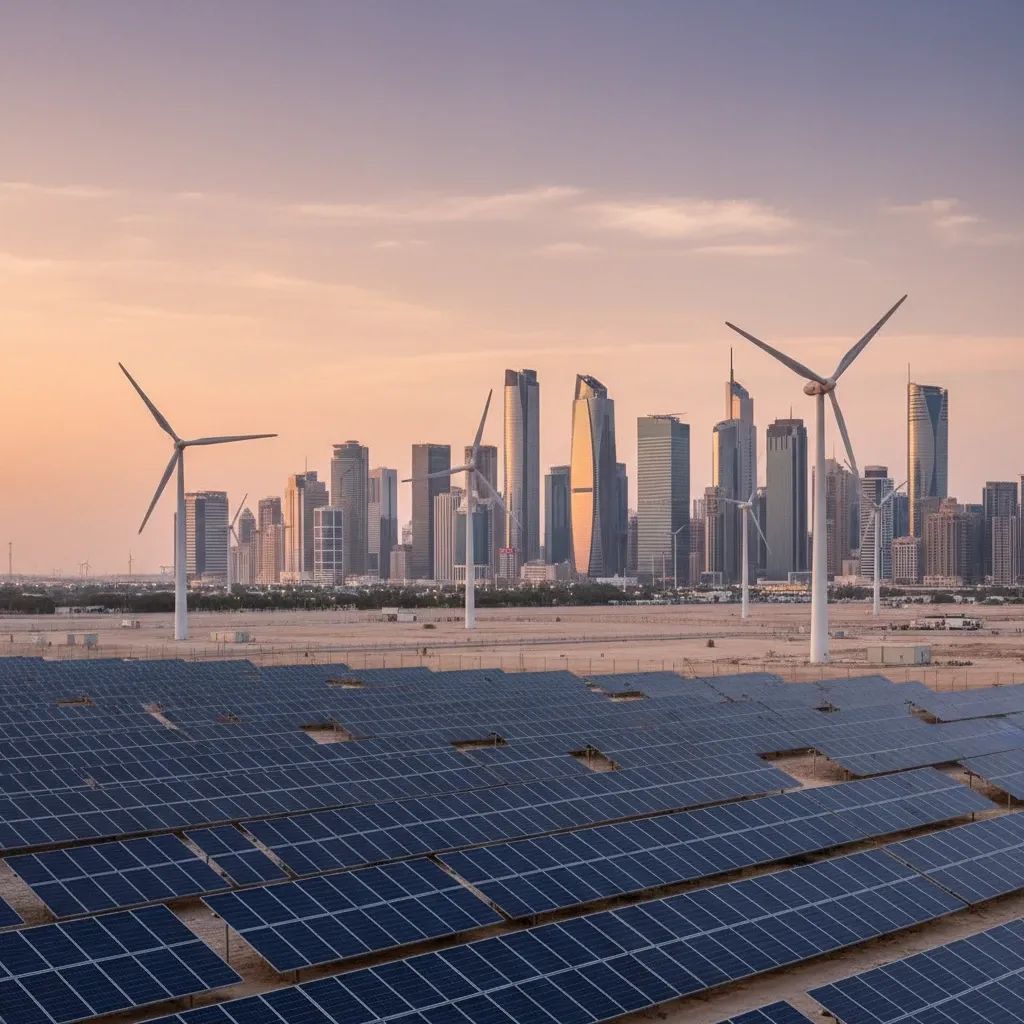
Renewable energy offers another vector. The UAE Net Zero 2050 Strategic Initiative commits AED 600 billion to clean and renewable energy infrastructure. Complementing this, the Dubai 2040 Urban Master Plan targets doubling green and recreational spaces while ensuring most residents live within 10 minutes of public transport. These aren't aspirational goals; they are capitalized infrastructure programs attracting institutional capital from global pension funds and ESG-focused investors. Unlike speculative property plays, renewable energy projects generate predictable, long-term contracted revenue streams—attractive to conservative institutional capital.
Sustainable Finance as Competitive Weapon
Dubai is actively repositioning itself as the Middle East's hub for sustainable finance—a deliberate strategy to attract ESG-conscious capital from Europe and North America, where regulatory pressure to integrate environmental, social, and governance factors into investment decisions is intensifying. The Dubai Financial Services Authority (DFSA) has issued comprehensive ESG guidance mandating regulated firms to integrate environmental and social factors into governance and risk frameworks, aligning with international standards like the Task Force on Climate-related Financial Disclosures (TCFD) and the Sustainability Accounting Standards Board (SASB).
Operationally, this means that fund managers, insurance companies, and pension funds operating from the Dubai International Financial Centre (DIFC) must demonstrate ESG compliance—a baseline that filters out lower-quality capital and attracts disciplined institutional players. The regulatory alignment with global standards reduces friction for international capital providers who otherwise face conflicting disclosure requirements across jurisdictions.
Green finance instruments are proliferating. Middle Eastern sustainable bond issuance is projected to reach $20-25 billion in 2026, with the UAE leading through green sukuk, blue bonds (funding marine and water infrastructure), and transition finance instruments. Emirates NBD launched a dual-tranche green and blue bond in January 2026, while DP World issued blue sukuk. The UAE government further sweetened incentives by exempting companies from listing fees when issuing green or sustainability-linked securities—effectively lowering the cost of capital for projects aligned with net-zero objectives.
For residents and investors evaluating property purchases, this matters concretely: developers funded through green finance instruments face regulatory scrutiny around construction standards, energy efficiency, and material sourcing. Properties built under ESG-compliant financing frameworks typically command rental premiums of 5-10% over conventional builds and face lower obsolescence risk as environmental regulations tighten globally.
Dubai's Competitive Positioning Against Global Rivals
In March 2026, Dubai achieved its highest-ever ranking in the Global Financial Centres Index, climbing to 7th place globally—a metric that reflects investor perception of regulatory quality, infrastructure, and long-term stability. This achievement is significant in context. Dubai competes directly with established hubs like Singapore (3rd), Hong Kong (5th), London (2nd), and New York (1st), as well as regional contenders like Riyadh and Doha. The climb to 7th place in less than a decade signals that institutional capital providers view Dubai's governance and operational frameworks as credible—not exotic or risky, but professional.
What differentiates Dubai's pitch? The combination of zero income tax on property investments, 100% foreign ownership in designated zones, and expanded Golden Visa programs creates a low-friction capital deployment environment unavailable in competing hubs. Singapore and Hong Kong impose wealth taxes; London and New York have capital gains levies. Dubai's tax architecture attracts capital from high-tax jurisdictions—a simple but powerful advantage when institutional investors evaluate deployment locations on an after-tax return basis.
Simultaneously, Dubai is not competing on tax arbitrage alone. The emirate has deliberately built infrastructure, regulatory frameworks, and connectivity that make it operationally indispensable. Etihad Rail, linking Abu Dhabi to Saudi Arabia, is advancing significantly in 2026, creating integrated logistics corridors for goods moving between the Gulf and beyond. Future Growth Corridors with Africa, Latin America, and Southeast Asia are expanding trade footprints. These projects are not marketing; they are hard infrastructure anchoring commercial relationships.
The Dubai Economic Agenda D33, unveiled in 2023, serves as a multi-year roadmap to double GDP by 2033 and secure a top-three ranking among global financial centers. Central planks include increasing foreign direct investment from AED 32 billion annually (past decade average) to AED 60 billion annually through 2033—requiring sustained capital inflows of approximately AED 650 billion ($177 billion) cumulatively. Brookfield's presence, Blackstone's aviation leasing venture, and the cascade of tech startups registering in March all contribute to this target. The strategy is not abstract; it is measurable and on track.
Employment and Professional Opportunity
For expatriates evaluating long-term residency in Dubai, institutional capital inflows translate into tangible employment multipliers. Large-scale developments like those Brookfield is considering require specialized talent: project managers, structural engineers, environmental consultants, legal advisers, financial analysts, and supply chain specialists. Institutional investors typically bring global expertise and demand local hires with international credentials—creating career advancement pathways for professionals otherwise competing in saturated Western markets.
The hospitality and tourism sectors, bolstered by 19.59 million visitors in 2025 and an industry valued at AED 236 billion, continue expanding pipeline activity. Airlines, hotel operators, and attraction developers are hiring internationally and offering competitive compensation packages tied to performance. The renewable energy and AI sectors—nascent but capital-intensive—are recruiting heavily at senior levels, offering entrepreneurs and technical professionals entry into emerging verticals with limited geographic competition.
Real estate professionals, wealth managers, and compliance officers benefit from increased institutional activity as well. Brookfield, Blackstone, and comparable firms establish regional offices with dedicated teams, directly employing residents and engaging local service providers—accountants, lawyers, consultants—who facilitate deal execution and regulatory compliance.
The Path Forward
Dubai's economic model—anchored in diversification, regulatory credibility, and strategic geographic positioning—is proving resilient precisely because it attracts capital across multiple dimensions simultaneously. Real estate stabilizes; technology accelerates; renewable energy scales; aviation leasing deploys capital; tourism grows. This diversification insulates the emirate from sector-specific downturns and attracts investors with varying risk appetites and return expectations.
The Brookfield engagement and parallel institutional commitments signal that Dubai has transitioned from an emerging market seeking capital to a mature hub managing capital deployment from global institutions. For residents navigating career decisions, investment choices, and long-term planning, this distinction matters enormously. It suggests market stability, employment continuity, and asset value retention—the practical foundations of successful expatriate life in a dynamic Gulf economy.


