
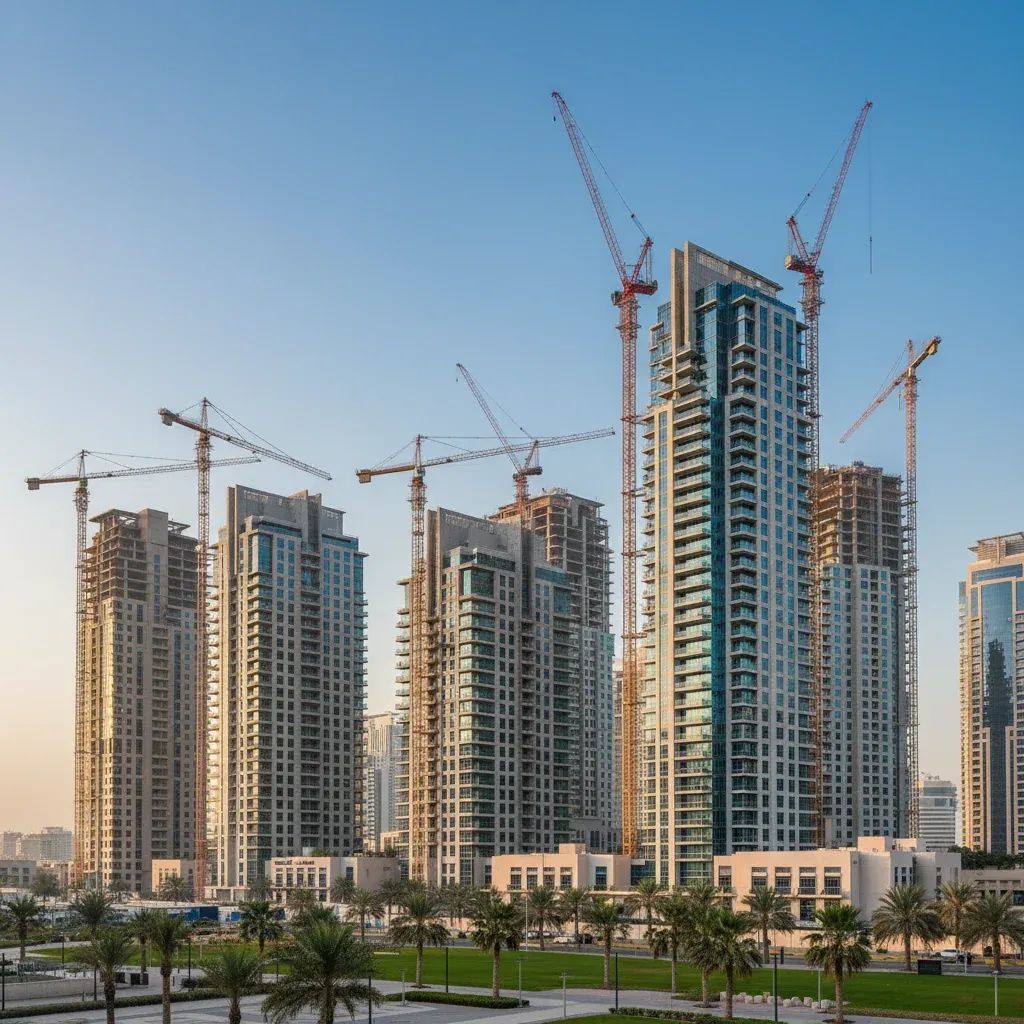
The Hidden Story Behind Sharjah's April Real Estate Surge
Sharjah just moved AED 3.5 billion through property transactions in a single month—but that number obscures what actually matters. Behind the statistics lies a market undergoing a deliberate transformation, where diversifying buyer nationalities and shifting transaction types reveal how the emirate is pivoting from a Dubai-spillover economy into a self-sustaining investment destination. For residents evaluating whether to stay, relocate, or invest, April's data exposes both genuine opportunity and emerging risks worth understanding before committing capital.
Why This Matters
• Transaction composition shifted toward stability: Over half of April's deals (55.6%) were full ownership transfers, not speculative contracts—a sign that long-term residents and serious investors are buying, not flipping.
• Geographic diversification reduces concentration risk: Activity spread across 115 zones signals no single neighborhood is experiencing bubble-like price acceleration; demand is methodical, not panic-driven.
• Affordability mechanics are widening: At roughly AED 10,000 per square meter, Sharjah continues underpricing Dubai by roughly 50%, but rental yield spreads are now large enough to warrant formal comparison analysis.
• Buyer-base internationalization is accelerating: 113 different nationalities participated in property transactions during Q1 2026, up from 97 a year earlier—indicating the market is transitioning from Gulf-centric to genuinely global.
The April Transaction Picture: What the Numbers Really Reveal
The Sharjah Real Estate Registration Department recorded 15,669 transactions in April—a figure that requires unpacking. Raw transaction counts mean little without understanding composition. Of those transactions, 8,710 were title deed transfers—genuine ownership changes where buyer and seller exchanged property with finality. This 55.6% share is critical: it means more than half the month's activity represents permanent capital allocation, not interim contract shuffles or mortgage refinancing games. The remaining transaction categories tell their own story: 5,291 involved ownership certificates (typically inherited properties or subdivided units), 936 were initial sales contracts (pre-construction commitments), and 443 were mortgage transactions valued at a collective AED 651 million.
What emerges from this breakdown is a market increasingly dominated by owner-occupier and medium-term investor behavior rather than speculative trading. The average mortgage transaction valued at approximately AED 1.47 million suggests participants are financing legitimate residential or commercial purchases, not leveraging small down payments into portfolio accumulation schemes. The median property price for sale transactions at AED 850,000 aligns precisely with affordability thresholds for dual-income expat families earning between AED 15,000 and AED 25,000 monthly—a profile far removed from the high-net-worth speculation that occasionally inflates Abu Dhabi or Dubai submarkets.
Where Capital Concentrated and Why It Matters
Within Sharjah City proper, Muwaileh Commercial dominated April's activity with 447 transactions generating AED 448.5 million in value. This former industrial zone has transformed into a specialized hub for small-scale warehousing, light manufacturing, and e-commerce fulfillment operations. The zone attracts two distinct buyer profiles: owner-operators establishing small businesses and institutional investors seeking long-term tenant income. This dual-buyer composition creates depth in the market—transactions don't rely on a single sentiment trend. When one buyer cohort pauses (for instance, if small business financing tightens), institutional investors still transact based on rental yield projections.
Al Menhaz recorded transactions worth AED 213 million—fewer deals than Muwaileh but higher average values, indicating a concentration of larger commercial or mixed-use properties. Al Sajaa Industrial contributed AED 205.7 million, positioning Sharjah's eastern industrial arc as the emirate's de facto logistics spine. What distinguishes these zones from Dubai's equivalent markets is pricing: comparable warehouse-office space in Dubai's Jebel Ali or Al Quoz trades at AED 400-plus per square foot, while Sharjah's equivalent averages AED 150 to AED 300 per square foot—a pricing advantage that persists even as Sharjah's demand strengthens.
The Central Region, encompassing inland residential suburbs and logistics corridors, absorbed 613 sales transactions. Al Belaida alone contributed 366 deals worth AED 176.4 million—evidence that middle-income residential clusters remain steady capital magnets for expat families prioritizing school access and rental affordability over waterfront amenities. The Eastern Region (Khorfakkan, Kalba, Dibba Al Hisn) recorded only 58 sales transactions but maintained AED 29.9 million in value through Al Mudeife, suggesting peripheral areas serve retirement buyers and extreme-affordability seekers rather than portfolio investors.
Subdivided Units and Built Land: Signals of Buyer Intent
The month's 790 subdivided unit transactions reveal persistent appetite for apartments within established communities. These properties typically trade between AED 800,000 and AED 1.1 million for two-bedroom units, pricing that remains within reach for families relocating from Dubai on cost-of-living grounds. The rental income potential—approximately AED 60,000 to AED 72,000 annually, or 7-8% gross yields—substantially exceeds Dubai's equivalent of roughly 5% for comparable neighborhoods like Jumeirah Village Circle.
The 1,537 land parcels sold and 348 built-in land transactions reveal something more nuanced about investor psychology. Built-in land—existing structures that buyers intend to demolish and redevelop—typically commands premium pricing precisely because buyers willingly absorb immediate demolition costs. They purchase these properties only if future redevelopment values justify the expense. The Industrial Area 4 transaction of AED 30 million exemplifies this category: the buyer likely plans repositioning the asset as modern cold-storage or logistics infrastructure, betting that commodity pricing for such facilities will justify the initial capital write-down.
This behavior signals positive investor sentiment on long-term appreciation, even within a market characterized as "stable" rather than explosive. Investors don't demolish and rebuild speculatively; they do so when they've calculated forward-looking valuations.
The Regulatory Foundation Holding Stability
Three regulatory shifts have fundamentally altered Sharjah's market mechanics since 2022. Executive Council Resolution No. 30 of 2022 expanded freehold ownership rights to non-GCC nationals across previously restricted zones. This single policy change opened market access to international investors who previously faced ownership restrictions or lease-termination risks. The parallel introduction of mandatory escrow accounts for off-plan purchases eliminated a chronic friction point: buyer anxiety around developer solvency or cash-call manipulation.
The Aqari digital platform, which unified property registry, cadastral records, and mortgage-approval workflows, reduced transaction approval timelines from approximately six weeks to roughly 10 business days. This procedural compression may seem technical, but it alters buyer psychology substantially. Reduced processing friction means buyers can close purchases within a manageable timeline, reducing financing uncertainty and enabling faster market clearing. When properties sell within 35-55 days in high-demand areas (and 55-90 days in suburban zones), buyer confidence isn't constrained by bureaucratic delays.
These regulatory innovations matter because they removed structural barriers to market liquidity. When buyers trust that ownership transfers will clear predictably and escrow protections exist, they participate with conviction rather than hedging.
Economic Fundamentals Anchoring the Growth
Sharjah's nominal GDP exceeds AED 145 billion, with forecasters projecting 6.5% to 7.5% growth for 2025-2026. Critically, this growth isn't speculation-driven; it reflects genuine economic diversification into logistics, manufacturing, and transport sectors. When warehouses fill and factories hire, residential demand follows organically. Young professionals and mid-tier families need apartments near job sites. This economic foundation insulates Sharjah from the boom-bust cycles that occasionally plague pure real estate speculation markets.
The impending Etihad Rail passenger network, commissioning in phases through 2027, will compress commute times from Sharjah to Dubai's Business Bay from roughly 45 minutes to under 25 minutes. That infrastructure improvement alone reshapes Sharjah's value proposition. Workers earning AED 12,000 to AED 18,000 monthly can purchase two-bedroom apartments at AED 850,000 in Sharjah, commute to Dubai-based employment via 20-minute rail transit, and achieve monthly cost-of-living savings of AED 3,000 to AED 5,000 compared to Dubai-based housing. The arithmetic is straightforward: infrastructure investment is converting Sharjah from a discount alternative into a rational economic choice.
Q1 Performance Sets the Broader Trajectory
April's AED 3.5 billion sits within a stronger quarterly context. Sharjah's entire Q1 2026 generated AED 18.5 billion in real estate transactions—a 40.7% increase compared to Q1 2025's AED 13.2 billion. Total transaction count climbed 18.9% year-over-year to 29,235 deals. Critically, sales transactions specifically increased 22.8% to 9,978 deals worth AED 14.3 billion, indicating that end-user purchases (not speculation) are driving the momentum.
Residential properties contributed 78% of total sales value, confirming that owner-occupiers and residential investors—not commercial speculators—are anchoring demand. The 13 million square feet of traded area in April alone equals roughly 230 football pitches of transacted property, representing the steady reallocation of capital that occurs when a market matures into functionality rather than frenzy.
Comparison: Sharjah Versus Dubai Versus Ajman
For residents evaluating market positioning, the comparative picture matters. Dubai's average property price stands at AED 1,850 per square foot, with median apartments around AED 1.55 million. Sharjah averages AED 10,000 per square meter (approximately AED 930 per square foot), making it roughly half Dubai's equivalent pricing. Ajman, the most affordable emirate, offers studio apartments below AED 200,000, but lacks Sharjah's commercial infrastructure depth and expatriate service ecosystem.
Rental yields tell a similar story. Dubai apartments average approximately 7% gross yields; Sharjah ranges from 5% to 10% depending on location; Ajman often exceeds 10%. For investors prioritizing yield consistency alongside property liquidity, Sharjah occupies a deliberate middle ground: affordable enough to generate attractive entry valuations, but developed enough to attract stable tenant-quality residents.
Dubai's price growth is moderating to an anticipated 5% to 8% annually after double-digit gains, while Sharjah forecasters project 3.5% to 5% appreciation through year-end and 5.1% long-term through 2030. These are modest, inflation-aligned figures—more indicative of fundamental market maturation than speculative fever.
Embedded Risks Worth Monitoring
Sharjah's momentum masks three developing concerns. First, infrastructure delivery timelines remain vulnerable. The Etihad Rail, originally scheduled for 2025 commissioning, is now expected through mid-2027. Each delay of 12 months dampens demand in zones marketed as "soon-to-be commuter corridors," potentially creating temporary oversupply in areas like Al Nahda or Muwaileh.
Second, over 104 off-plan projects will deliver approximately 12,000 new units through 2027. If absorption underperforms, specific neighborhoods could experience pricing pressure. Buyers considering off-plan purchases should verify escrow compliance and developer payment history through the Sharjah Real Estate Registration Department's public portal before committing.
Third, commute fatigue remains structural. From Muwaileh or Al Nahda to Dubai Media City, peak-hour travel routinely exceeds 75 minutes. Sharjah's affordability advantage erodes if residents accumulate 10 additional weekly commuting hours. The Etihad Rail theoretically solves this; actual execution will determine whether advantage is realized or remains aspirational.
The Practical Takeaway for Decision-Making
For Dubai-based professionals, Sharjah now offers an asymmetric value proposition: purchase a freehold two-bedroom apartment for AED 850,000 to AED 1.1 million, generate AED 60,000 to AED 72,000 in annual rental income (7-8% yields), and reduce weekly commute time via rail infrastructure from 90 minutes to 40 minutes. A comparable Dubai purchase requires AED 1.4 million to AED 1.8 million with inferior yields. The arbitrage exists mathematically and operationally.
For small business operators, zones like Al Sajaa, Muwaileh Commercial, and Industrial Area 4 offer warehouse-office combinations at roughly half Dubai's equivalent per-square-foot pricing, enabling operational expansion that Dubai's fully developed industrial zones can no longer support affordably.
For institutional investors, the convergence of regulatory maturity, transaction depth (443 mortgage deals in one month), and buyer diversification (113 nationalities) suggests Sharjah's financial infrastructure has evolved beyond speculative lending into income-verification models, where mortgage terms increasingly reflect rental yield projections rather than property appreciation fantasies.
April's data doesn't reveal explosive growth; it reveals sustainable market function. And for residents and investors seeking stability over speculation, that distinction carries tangible value.


