
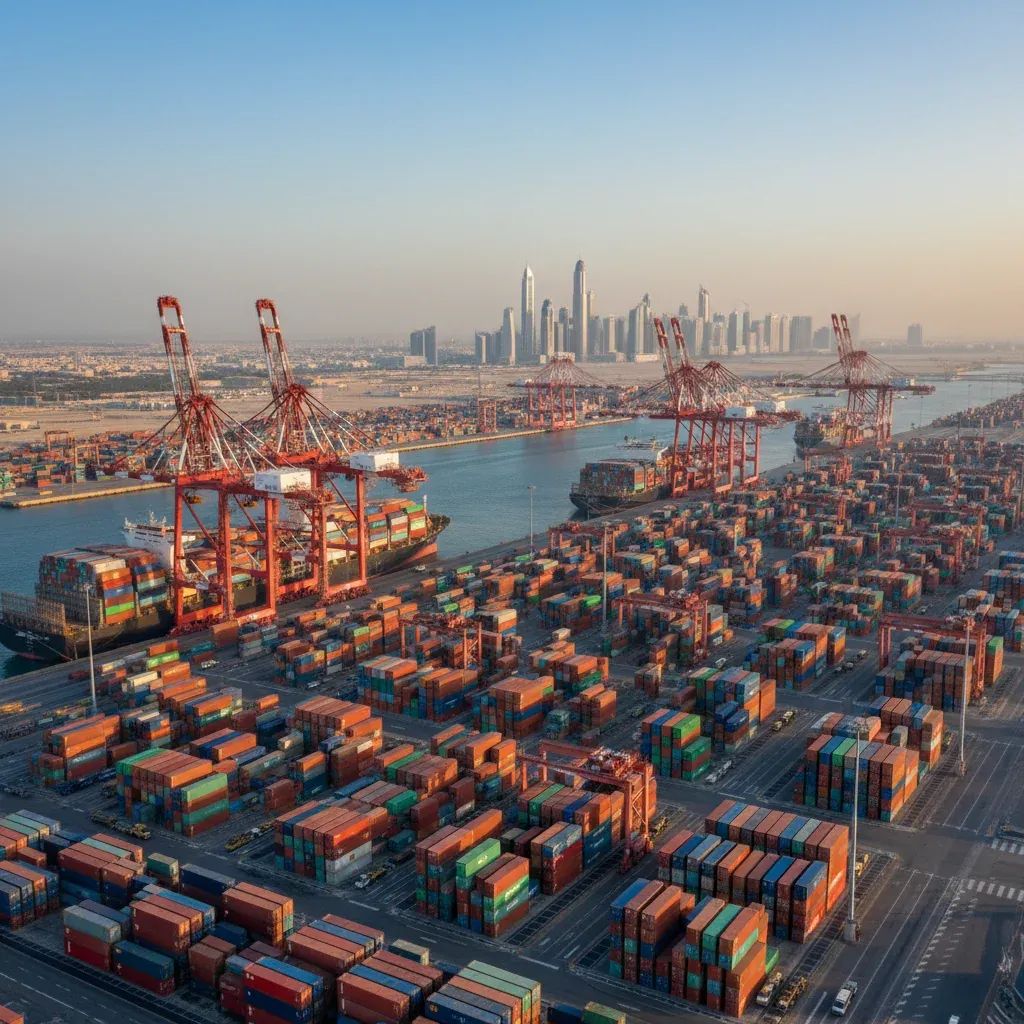
When geopolitical friction tightens shipping lanes and global supply chains wobble, the United Arab Emirates has quietly engineered a logistics system built for survival—one that moves goods through redundant corridors, swaps routes in real time, and keeps supermarket shelves stocked regardless of regional turbulence.
Why This Matters
• No immediate shortages expected: Integrated monitoring systems track essential commodity inventories continuously, with priority lists updated regularly to anticipate demand
• Stable pricing for imports: Predictable cargo movement prevents the artificial scarcity that drives up retail costs for everyday goods
• Business-friendly flexibility: Transport licensing now streamlined; companies can shift between maritime and overland options without bureaucratic delays
The Architecture Behind Uninterrupted Commerce
The machinery powering supply stability sits in the hands of The Supply and Transport Committee, chaired by Suhail Mohamed Al Mazrouei, the Minister of Energy and Infrastructure. This body functions as something between a war room and a logistics command post—not a ceremonial planning body, but an operational entity that actively monitors shipment flows, redirects cargo between routes, and maintains continuous contact with port operators and private freight companies.
A permanent national team now oversees freight movement across the Emirates. Their job isn't ceremonial coordination; they actively strengthen backup corridors, track market conditions hourly, and identify potential bottlenecks before they strangle the supply chain. Federal and local governments connect through this framework, meaning decisions can cascade quickly when circumstances shift.
What separates this from ordinary port management is the posture of anticipation rather than crisis response. Rather than waiting for disruption to strike and then improvising solutions, the system runs constant scenario planning, maintains excess capacity at strategic points, and choreographs private operators to sustain buffers throughout the network.
The Eastern Coast as Strategic Insurance
When political tensions or military activity disrupt Gulf shipping, the United Arab Emirates possesses a geographical advantage that most competitors lack: an entire maritime infrastructure facing the Indian Ocean and separated from western hemisphere complications.
Ports along the eastern coast—particularly Fujairah and those serving the Gulf of Oman—operate as deliberate redundancy built into the national system. If western-facing harbors experience congestion or temporary closures, cargo flows eastward without material delay. Port operators from across the Emirates contribute to this capacity pool, meaning the system doesn't depend on any single facility.
Advanced vessel management systems allow precise coordination of this traffic. Ships arrive according to pre-calculated priorities rather than first-come, first-served chaos. Periodic operational reports flow to authorities, maintaining security while enabling efficiency. The committee monitors all maritime movement in UAE territorial waters, ensuring neither safety nor commerce gets sacrificed to the other.
The practical result: businesses relying on shipping timelines can absorb uncertainty that would cripple competitors. A company with suppliers dependent solely on western-coast routes faces the possibility of inventory gaps. One with access to alternative eastern corridors maintains continuity.
How Government Creates Space for Private Efficiency
The public sector excels at strategy and oversight; private companies excel at daily execution. The United Arab Emirates has structured its supply system around this division of labor.
The government provides regulatory direction and strategic coordination through the committee. Port authorities maintain safety standards and maritime security. But the actual movement of cargo—the truck driving, the container handling, the inventory management—belongs to private operators. This separation prevents the bureaucratic sluggishness that plagues purely state-managed logistics in other nations.
To maintain this efficiency during uncertainty, authorities have introduced flexible licensing frameworks for transport companies, both maritime operators and land-based trucking firms. Bureaucratic friction points have been systematically removed at a moment when operational agility matters most. Support programs directed at logistics service providers aim to sustain continuity without requiring companies to absorb losses during volatile periods.
This public-private architecture acknowledges a constraint of human organization: government agencies optimize for long-term stability and national priorities, while commercial entities optimize for daily efficiency. Layer them properly, and you get strategic resilience plus operational speed.
Reorganizing Land Transport to Prevent Cargo Paralysis
Maritime terminals represent only one vulnerability point in supply chains. An integrated operational plan now addresses road and rail networks through careful route reorganization and adjusted truck operating schedules.
The committee has restructured movement through inland corridors specifically to reduce congestion and accelerate the flow from port to final storage facility. Operating hours for commercial vehicles have been shifted to optimize traffic patterns. Storage centers now function as strategic nodes, connected to ports and distribution points through enhanced logistics pathways.
This matters because containers clearing harbors quickly but facing delays during inland movement represent a common bottleneck. When a truck leaves a port and sits in traffic for hours, it ties up an expensive asset that should be cycling through multiple deliveries daily. Faster ground transport means containers move through the entire supply chain efficiently, reducing costs that companies would otherwise pass to consumers through price increases.
The coordination between maritime and inland operations prevents the cascading failures that ripple through retail networks. Supermarkets can't restock quickly if goods sit in warehouses waiting for transport. Factories depending on imported components can't meet production schedules if delivery becomes unpredictable.
Why Residents Feel This Stability in Daily Life
Container volumes tell one story: the United Arab Emirates handled over 25,000 containers during March 2026 alone, reflecting sustained operational tempo despite regional pressures. But what does this mean for someone buying groceries or managing a business?
The committee maintains updated priority lists assessing what the nation requires—not abstract theory, but specific commodities designated as essential based on population needs and economic continuity. This inventory management, combined with integrated protocols covering port operations, inland transport, and warehouse storage, creates buffer capacity throughout the system.
Consumers notice this as product availability without sudden price spikes. Businesses notice it as predictable delivery timelines and stable logistics costs—two factors that determine whether a company can commit to regional operations with confidence.
When supply chains break, retail prices spike. When imports become unpredictable, businesses price uncertainty premiums into their offerings. The United Arab Emirates has invested in infrastructure and coordination specifically to prevent these scenarios.
Regional Cooperation Extends the System Beyond Borders
The United Arab Emirates doesn't manage supply in isolation; it coordinates actively with Gulf Cooperation Council member states to smooth cross-border goods movement and create redundancy at the regional level.
This collaboration enables information sharing when one nation faces disruptions, allowing neighbors to implement preventive measures or redirect cargo through alternative routes before supply shocks materialize. It harmonizes regulatory approaches, reducing the compliance complexity that slows intra-regional trade.
For multinational businesses operating across multiple Gulf markets, this coordination translates into more predictable operations and reduced compliance friction—practical factors that influence where companies locate distribution centers and investment commitments.
The Competitive Advantage of Supply Chain Reliability
Global trade increasingly concentrates in regions offering operational predictability. Companies choosing between locations for manufacturing, distribution, or supply chain management examine which jurisdictions can guarantee reliable goods movement.
The United Arab Emirates positions itself as precisely such a location: a nation that has anticipated supply chain vulnerabilities, invested in redundant infrastructure, and established operational protocols that absorb regional pressure without cascading into commercial disruption.
The system's architecture—advanced monitoring, flexible capacity, coordinated oversight, and private-sector efficiency—creates resilience that competitors struggle to replicate. Whether this framework faces significant stress in coming months remains uncertain, but current volumes and operational continuity demonstrate the system's capacity to maintain commerce through regional turbulence.
For residents and businesses, this means continued availability of essential goods, stable retail prices, and predictable logistics timelines. For the national economy, it means the competitive advantage of a jurisdiction where supply chain risks have been systematically mitigated.


