Why This Matters
• Export-first model is working: The United Arab Emirates now sells defense equipment to more than 100 countries, with roughly 70% of EDGE Group's revenue flowing overseas, establishing an export pipeline the country never had a decade ago.
• Emirati engineers design and build everything on display: Every armored vehicle, aircraft, and missile system shown in Kuala Lumpur originated in UAE facilities, not licensed from foreign suppliers, marking a fundamental shift toward indigenous capability.
• Southeast Asia is the growth frontier: The Asia-Pacific defense market remains undersaturated with UAE products, making this exhibition critical for opening procurement channels across the region's expanding military budgets.
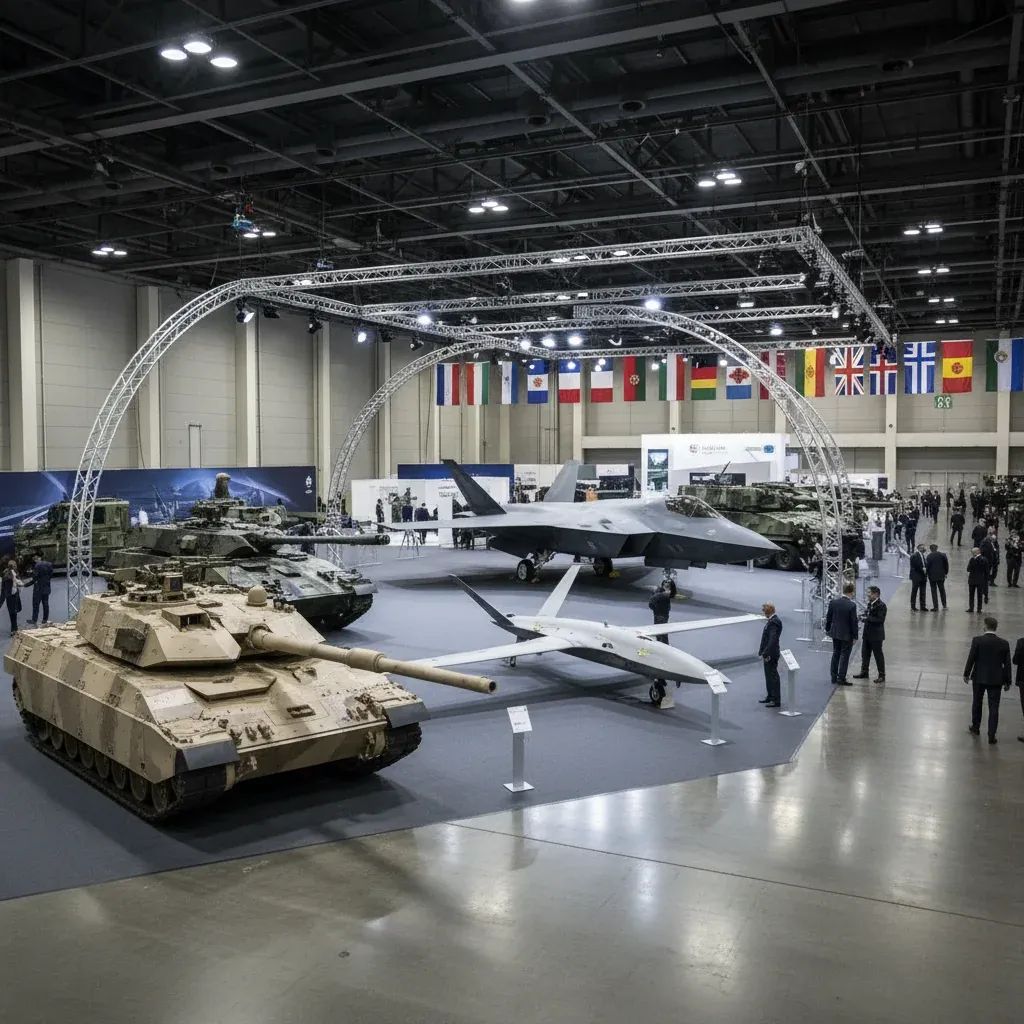
Abu Dhabi's defense manufacturing ecosystem took center stage this week in Malaysia, as Calidus Holding Group deployed a comprehensive portfolio of locally-engineered combat systems at one of Asia's most influential military procurement forums. The company's presence at the Defence Services Asia (DSA) Exhibition and Conference 2026 signals a deliberate push into a region where the UAE has thus far maintained minimal export footprint.
The four-day exhibition, running through April 23 at Malaysia International Trade and Exhibition Centre, positions Calidus alongside other exhibitors within the UAE National Pavilion, a coordinated showcase supported by the UAE Ministry of Defence and Tawazun Council for Defence Enablement. The latter organization functions as the Emirates' sole procurement authority for military equipment, ensuring that participation aligns with broader national defense acquisition strategy.
What This Means for UAE Residents
For people living in the UAE, this defense export expansion represents far more than corporate achievement. The country's transformation from one of the world's largest defense importers to an emerging exporter directly supports national economic diversification—a critical priority as the UAE reduces dependency on oil revenues. The defense sector now employs thousands of Emirati engineers, technicians, and manufacturing specialists, with continued growth projecting significant career opportunities in high-skilled roles.
EDGE Group and its subsidiaries like Calidus are becoming major employers for UAE nationals, particularly in Abu Dhabi and Dubai's industrial zones. A successful export trajectory could generate billions in annual revenue by 2030, creating a stable, long-term economic pillar comparable to other sectors. For UAE residents, this means strengthened job security, higher-wage employment opportunities, and confidence in the national economy's diversification strategy beyond traditional sectors.
Additionally, the UAE Armed Forces operate many of the systems being marketed internationally—the Mezyad and Sweihan vehicles, for instance, serve in local operations. This dual purpose strengthens national security capabilities while simultaneously validating platforms for export, creating a synergistic benefit that enhances both military readiness and economic competitiveness on the global stage.
The Strategic Calculus Behind the Pavilion
Southeast Asia's defense spending is accelerating. Regional militaries across Malaysia, Indonesia, Thailand, the Philippines, and Vietnam are modernizing platforms, upgrading command systems, and strengthening maritime capabilities in response to evolving geopolitical pressures. Yet purchasing decisions remain fragmented—no single supplier dominates, and many nations continue relying on aging platforms acquired decades ago.
For Calidus, the window is open. Most Southeast Asian procurement officials lack direct familiarity with Emirati engineering, making this exhibition an opportunity to shift perception. The UAE's defense industry entered 2026 with an estimated annual budget of USD 27 billion, with EDGE Group—the country's largest conglomerate in the sector—maintaining an order book surpassing $5 billion, over half derived from international sales. These figures underscore financial capacity and operational scale that younger competitors cannot match.
Yet the UAE faces a perception challenge: is indigenous manufacturing sufficient to compete globally, or does it require proven combat deployment? Calidus executives have spent the past year addressing this directly. The company participated in Defence & Security 2025 in Bangkok last November, and more recently showcased advanced systems at UMEX and SimTEX 2026 in Abu Dhabi during January. Each appearance tested receptiveness and identified procurement pathways. This month's DSA 2026 engagement represents a calculated follow-up, narrowing the field to serious buyers.
What's on the Exhibition Floor
Calidus is displaying scaled models and full-scale platforms across three operational domains, each reflecting the company's approach to integrated, modular defense engineering.
Land Platforms: Mobility Meets Protection
The Mezyad 001 commands center stage. This 4x4 multirole armored vehicle delivers superior mobility compared to comparable global platforms, achieving speeds of 120 km/h on paved surfaces with a 700 km operational range. The vehicle climbs steep 70% gradients and fords water obstacles up to 850 mm—specifications that position it alongside proven competitors like the Oshkosh M-ATV, though with marginally superior mobility metrics.
The Sweihan, an 8x8 light infantry fighting vehicle, represents a more ambitious engineering achievement. Built on an evolved Wahash chassis but reconfigured for non-amphibious operations, the Sweihan seats three crew and eight to ten troops. The platform enables a 130 km/h top speed and maintains the 700 km range, competing directly with Finland's Patria AMV—arguably the world's most successful modular 8x8 vehicle—and Germany's Boxer APC. The variant displayed integrates a 30 mm autocannon and passive/active protection options, addressing contemporary threats posed by loitering munitions and anti-tank guided weapons.
Additional platforms include the Mezyad 005 multi-role variant, the MCAV multi-purpose carrier, the Al Wahash standard-bearer, the Al Washag reconnaissance platform optimized for intelligence collection, and the LAHAB 155 mm L52 howitzer—a precision artillery system indicating the UAE's expansion into direct-fire strike capabilities.
Maritime: Coastal Protection Reimagined
The PV38 patrol vessel occupies the maritime section. Engineered for coastal surveillance, interdiction, and maritime security missions, the platform reflects regional demand for cost-effective naval presence in littoral environments. With maritime tensions recurring across the Arabian Gulf and the Strait of Hormuz, the PV38 targets navies seeking alternatives to larger, costlier frigates while maintaining adequate endurance for extended patrols.
Aerospace: Light Attack and Training
The Badr-250 (B-250) light attack aircraft stands as perhaps the most significant achievement of the UAE's aerospace sector. The airframe combines operational flexibility with close air support capability, addressing a specific gap in global defense markets: cost-effective, reliable light attack platforms capable of operating from austere airfields. The B-250T training variant provides an integrated solution for pilot qualification to international standards, allowing buyers to acquire both operational and training systems from a single supplier.
While no export contracts for the B-250 beyond the UAE Armed Forces' initial order have materialized publicly, defense sector analysts confirm that multiple air forces—particularly from Indonesia, Malaysia, Thailand, and the Philippines—have initiated informal discussions with Calidus Aerospace. The interest stems partly from pricing discipline (the B-250 undercuts Western competitors like the Beechcraft AT-6 Wolverine and European EADS Airbus derivatives) and partly from regional alignment preferences.
Strike Precision: Integrated Missile Systems
The AlHeda missile systems represent a distinct competitive advantage. Unlike standalone missile platforms offered by many competitors, Calidus integrates AlHeda into modular land vehicles. The Mezyad 004, for instance, functions as a mobile missile carrier, transforming a conventional armored chassis into a networked strike platform. This approach reflects modern combined-arms doctrine: mobility + protection + firepower housed in a single, logistically coherent system.
Market Challenges and Strategy
Calidus operates in an arena dominated by entrenched players. General Dynamics, BAE Systems, Rheinmetall, and Patria command extensive global presence, proven combat records, and mature logistics ecosystems. They have delivered thousands of vehicles to dozens of nations, accumulated operational data spanning decades, and built trusted relationships with procurement officials worldwide. Displacing even a fraction of their market share demands more than technical specifications.
The Oshkosh M-ATV has equipped U.S. forces, NATO allies, and security agencies across Africa and Asia for over a decade. The Patria AMV boasts over 1,600 units in service globally, with satisfied operators across Europe, Asia, and the Middle East. The Boxer APC serves eight nations with a combined military footprint spanning multiple continents. Each competitor brings not just hardware, but ecosystem advantage: spare parts pipelines, field service networks, training infrastructure, and demonstrated reliability under combat stress.
Calidus counters with indigenous design philosophy and modular adaptability. Its platforms prioritize integration with next-generation sensors, weapon stations, and drone interfaces—capabilities increasingly demanded by militaries adopting network-centric warfare approaches. The company's willingness to pursue co-production and technology transfer arrangements also differentiates it. The January 2026 Memorandum of Understanding with General Atomics Aeronautical Systems for prospective joint manufacturing of the MQ-9B remotely piloted aircraft and Gambit Collaborative Combat Aircraft in the UAE exemplifies this strategy: rather than simply buying foreign technology, the UAE aims to internalize manufacturing and then export both systems.
For Southeast Asian militaries, the Calidus portfolio offers a pragmatic alternative narrative. Malaysia, Indonesia, and Thailand—the three largest ASEAN defense spenders—face budget pressures while modernization demands intensify. A Mezyad 001 or Sweihan 8x8 priced 15-25% below comparable Western vehicles, manufactured with transparent supply chains, and backed by regional service hubs in Abu Dhabi, becomes genuinely competitive. Add the option for technology transfer or licensed local assembly, and the proposition shifts from simple acquisition to industrial partnership. Yet concrete export orders remain elusive. As of April 2026, no publicly announced direct contracts exist for Calidus platforms from Southeast Asian nations. Success will be measured by qualified leads, technical evaluation invitations, and scheduling of follow-up assessments in the quarters ahead.
The Broader National Narrative
Calidus' participation at DSA 2026 functions simultaneously as a commercial exercise and a strategic signal about UAE defense ambition. The country has compressed a decade-long transformation into a remarkably short timeframe: from one of the world's largest defense importer (purchasing $20+ billion annually in foreign equipment throughout the 2010s) to a self-reliant manufacturer and emerging exporter.
This shift reflects both security doctrine evolution—the UAE increasingly prioritizes strategic autonomy over reliance on external suppliers—and economic diversification strategy. With oil revenues subject to price volatility, developing a defense export industry generating billions annually represents a stabilizing revenue stream. EDGE Group currently generates $5 billion+ in order value, with growth trajectory suggesting $8-10 billion potential by 2030 if export momentum sustains.
The transformation also enables technology sovereignty. Rather than waiting for foreign suppliers to deliver updated platforms, the UAE now designs and manufactures internally, compressing development cycles and enabling rapid iteration based on operational feedback. This capability strengthens the UAE's international positioning, creating diplomatic leverage and establishing the country as a trusted technology partner for regional and global stakeholders.
Looking Ahead
The DSA 2026 exhibition runs through April 23. By that date, Calidus will have logged hundreds of conversations with regional defense stakeholders. Industry observers suggest sustained momentum depends on three variables: (1) sustained R&D investment to keep platforms technologically current; (2) competitive pricing discipline as production volumes increase; and (3) demonstrated operational performance from early customers, whose positive experiences drive peer adoption.
For now, the UAE national pavilion in Kuala Lumpur represents what it always does at defense exhibitions: an invitation to explore, a demonstration of capability, and a signal that Abu Dhabi's defense industry is no longer a nascent experiment but an emerging force in global military technology markets. For UAE residents, it's a tangible representation of national economic ambition and strategic autonomy being realized through homegrown innovation and manufacturing excellence.