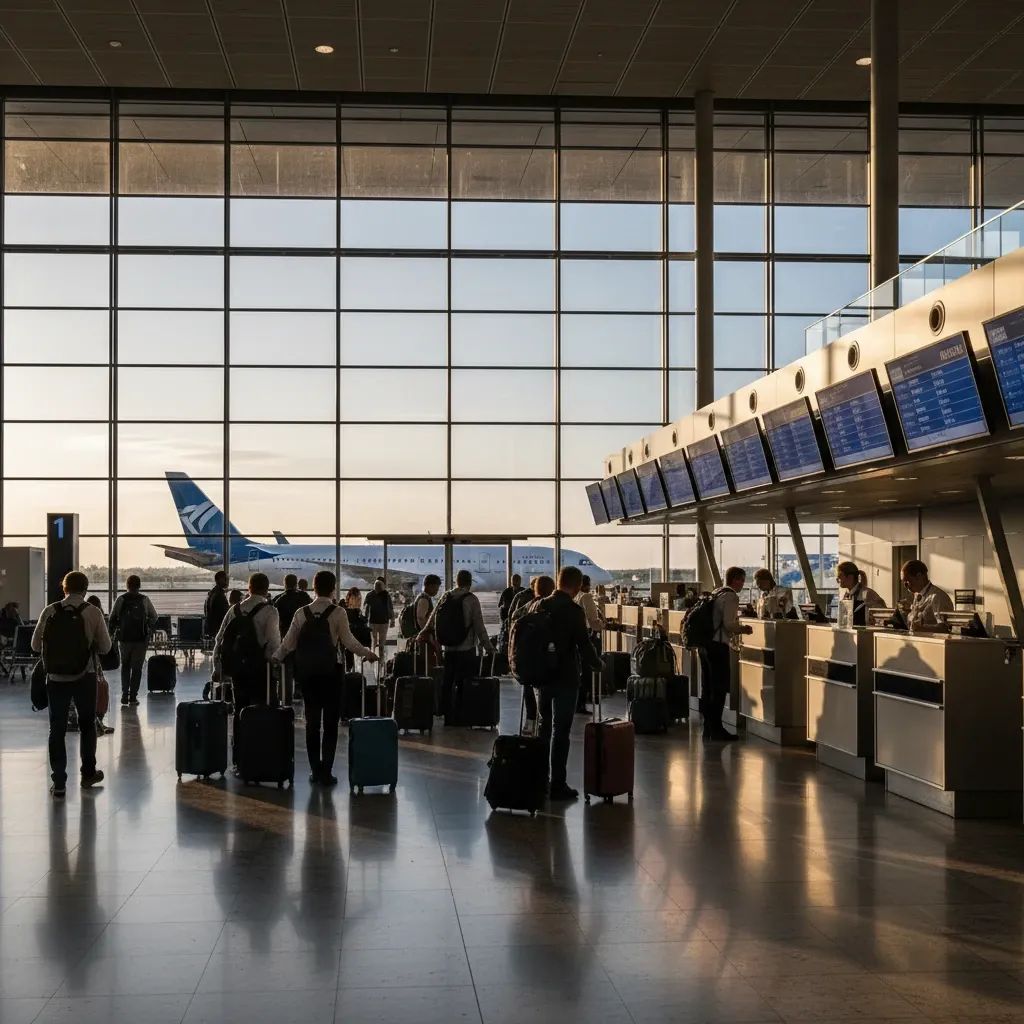
European aviation absorbed its first passenger contraction in five years during April 2026, a 0.7% decline that marked a genuine inflection point for an industry that had seemed immune to setbacks since the post-COVID rebound. Yet the story beneath the headline is neither apocalyptic nor straightforward — it reveals an aviation sector far more resilient and adaptive than the numbers alone suggest.
Why This Matters
• Direct impact on UAE travelers: The significant collapse in Middle East-Europe connectivity means fewer convenient transit options and higher ticket prices, with fuel surcharges impacting long-haul routes through European hubs.
• Recovery is already underway: By late May, daily flights across Europe rebounded to levels approaching 2025 comparisons, and fuel prices stabilized notably below April peaks, signaling the acute crisis phase may be passing.
• Government intervention is working: The European Commission's AccelerateEU plan has helped prevent fuel shortages at major airports and supported supply chain stability for the summer season.
What Triggered the Downturn
Hostilities that commenced on February 28, 2026 forced the closure of airspace across multiple nations — Bahrain, Iran, Iraq, Israel, Jordan, Kuwait, Lebanon, Oman, Qatar, the United Arab Emirates, and Saudi Arabia. The European Union Aviation Safety Agency formally recommended operators avoid these zones due to missile and air-defense risks. Simultaneously, the closure of the Strait of Hormuz in late February severed Europe's direct fuel pipeline, sending jet fuel prices significantly higher by April.
This wasn't merely an inconvenience. The geopolitical shockwave eliminated substantial numbers of daily flights between Europe and the Middle East — a significant reduction in what had been one of aviation's most reliable traffic corridors. By March 25, cumulative cancellations across European airports surpassed tens of thousands.
The Geography of Pain
Airports in Vienna, Paris, and across France bore the heaviest losses. Vienna Airport experienced a significant passenger drop, with Middle East traffic collapsing substantially — a virtual erasure of connectivity to markets the airport had cultivated for decades. Paris-Charles de Gaulle and Paris-Orly combined saw declines in passenger traffic, with exposure to Middle Eastern routes particularly affected.
Basel-Mulhouse Airport in France recorded a significant passenger drop during this period, though runway renovations amplified what was already a conflict-driven downturn. Across France as a whole, commercial passenger air transport declined measurably during April.
Industrial action compounded these geopolitical disruptions. Lufthansa pilots walked out, disrupting Frankfurt and Munich. Air traffic controller strikes paralyzed 14 Spanish airports, including Lanzarote and Fuerteventura. London Stansted Airport was hit by workforce action. These labor actions combined affected hundreds of thousands of passengers across the European network.
How Airlines Responded: The Capacity Question
European carriers faced a grim arithmetic: fuel prices had more than doubled, alternative routing added substantial extra distance to flights across the network, and demand signals remained uncertain. Airlines employing fuel hedging strategies protected themselves to varying degrees, while unhedged carriers faced greater vulnerability.
The response was decisive capacity reduction. Lufthansa Group made adjustments to its fleet deployment, with several intercontinental routes temporarily impacted and further adjustments planned. KLM cancelled flights from its Amsterdam hub in May, suspending some Middle East service temporarily. Norse Atlantic suspended long-distance routes, affecting connections through major European hubs. Transavia France cancelled multiple flights across May and June.
Overall, European carriers reduced planned capacity in subsequent months, concentrating resources on higher-margin routes. The rerouting required to avoid conflict zones affected numerous daily flights, with environmental and operational implications.
The EU's Supply-Chain Intervention
Rather than watching the situation deteriorate, the European Commission adopted the AccelerateEU plan in April, establishing mechanisms that supported industry stability. The EU Fuel Observatory began monitoring supply and stocks, coordinating alternative sourcing and optimizing distribution networks. The Commission also reviewed strategic reserves.
The outcome: major European airports avoided critical fuel shortages, a fact confirmed by industry bodies. The institutional architecture prevented what could have been a cascading supply crisis. Industry groups simultaneously urged member states to consider temporary suspensions of aviation taxes to buffer ticket price increases and protect demand, though uptake varied.
One policy discussion emerged: aviation authority bodies discussed the balance between maintaining allocation rules and preserving scheduled connectivity versus allowing carriers flexibility during the crisis period.
The Recovery Phase: May and June Signals
By mid-May, recovery indicators emerged. Reported flight numbers during the week of May 18-24 showed increases compared to the prior week and comparisons to 2025 levels. Traffic between Europe and the Middle East, though still depressed, showed signs of narrowing declines as airspace gradual reopenings occurred.
Jet fuel prices stabilized at measurably lower levels than April peaks, easing the operational burden on carriers. Airlines were able to maintain most summer schedules while continuing to avoid the least profitable routes.
A notable redistribution of traffic occurred: direct Europe-Asia passenger flows increased in April, as both passengers and airlines rerouted around Middle Eastern hubs entirely due to necessity. This represented a reallocation rather than absolute growth.
What This Means for United Arab Emirates Residents
For people in the UAE using European airports as transit hubs, the April disruption translated to a narrowing of options. The reduction in Middle East-Europe connectivity meant fewer one-stop itineraries and greater reliance on either direct Asia-Europe routes or alternative transit points in Turkey and non-conflict Gulf states. Flight times increased, and fuel surcharges added material cost to already expensive long-haul bookings.
The disruption is expected to reduce international arrival growth from initial 2026 forecasts, a meaningful adjustment. Airlines serving the UAE market adjusted schedules accordingly, with some routes suspended and others consolidated.
However, the stabilization visible by late May suggests the most acute phase has passed. Global network traffic remained resilient despite April's contraction. Industry observers did not anticipate severe peak-summer disruptions unless significant new fuel shortages emerged — a scenario the AccelerateEU measures were designed to prevent.
Forward Outlook: Resilience With Caveats
Earlier in 2026, European airports had demonstrated robust momentum, with passenger increases recorded in early year periods despite the conflict's emergence in late February. April represented a genuine slowdown, but one interrupted by labor action and geopolitical shock rather than structural demand collapse.
Forward schedule data indicates airlines will maintain adjusted capacity through mid-2026 as they balance elevated fuel costs with fluctuating demand signals. Recovery forecasts depend significantly on geopolitical developments, Strait of Hormuz reopening, and fuel supply chain normalization.
Institutional coordination through the AccelerateEU framework has proven its value. Without real-time fuel monitoring, reserve mobilization, and collaborative supply optimization, the April crisis could have metastasized into a summer capacity crunch. Instead, European aviation absorbed the shock, adjusted operations, and positioned for recovery.
For residents and travelers in the United Arab Emirates, the lesson is neither optimistic nor pessimistic — it is practical. Summer 2026 connectivity to Europe should improve from April lows, though it will remain constrained and more expensive than 2025 baseline. Alternative routing through non-conflict airspace has become operationally normalized. And the aviation industry's demonstrated ability to coordinate institutional response suggests future supply disruptions are unlikely to cascade as severely as they might have a decade ago.