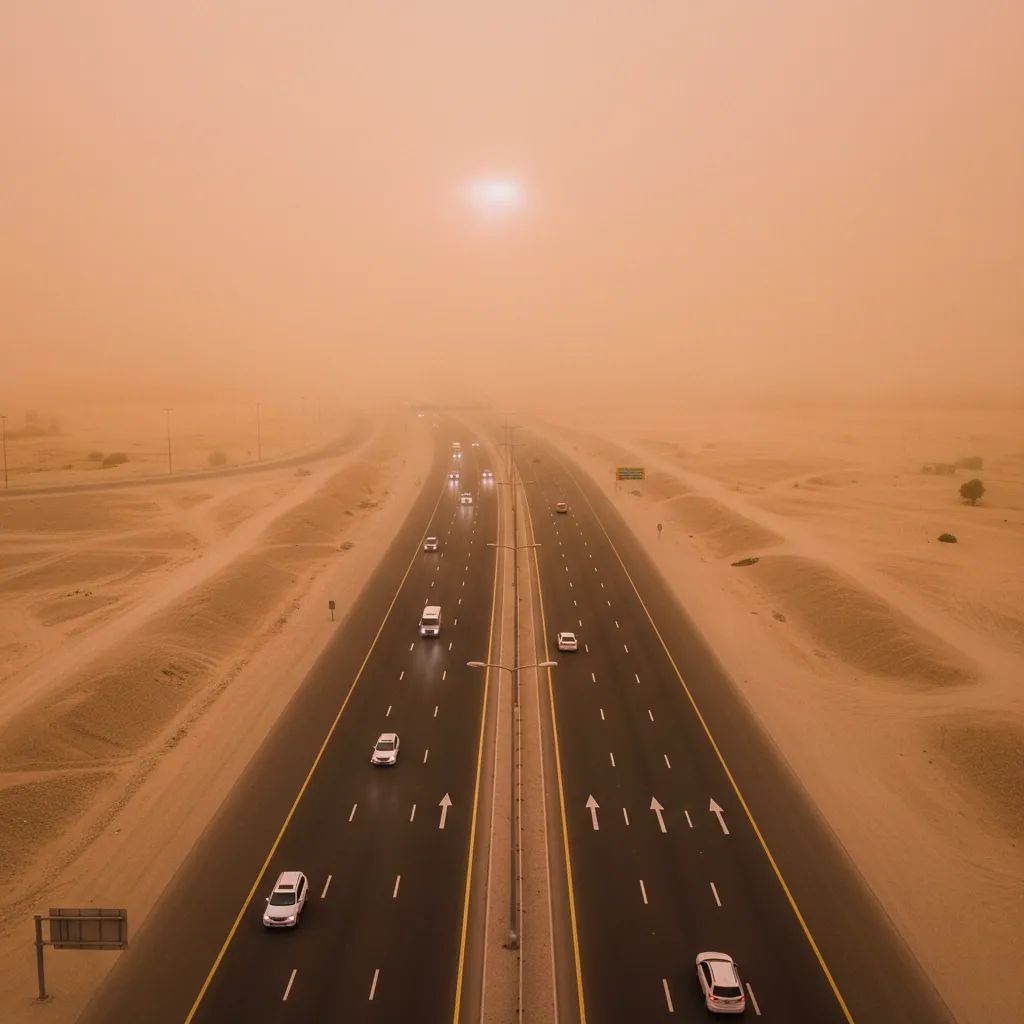
The United Arab Emirates National Centre of Meteorology is tracking a three-day sequence of atmospheric instability that will reshape daily routines across the Emirates, bringing together dust escalation, temperature swings, and sporadic precipitation—a combination that warrants attention from drivers, outdoor workers, and anyone managing respiratory sensitivities.
Why This Matters:
• Dust visibility will drop sharply on highways Tuesday and Wednesday, requiring headlight discipline and speed reduction to avoid accidents and fines up to AED 500.
• Coastal temperatures will drop noticeably this week, particularly in western regions—an unusual mid-spring cooling that affects comfort planning and utility costs.
• Respiratory risks increase, especially for those over 65, children with asthma, or people with heart conditions—the spike in PM2.5 particles poses documented health concerns during dust events.
• Wednesday brings unexpected rainfall, an April anomaly worth monitoring since precipitation will likely cause temporary challenges on roads already compromised by dust.
How the Week Unfolds
Monday morning began with fair skies and partial cloud cover by afternoon. The NCM noted that evening would shift the picture—cloud banks thickening over coastal strips and islands, winds remaining manageable between 10 and 25 km/h with occasional gusts reaching 35 km/h. This represents the last straightforward weather window before an unstable 72-hour period begins.
Tuesday introduces the turbulent phase. Dust clouds will intensify as winds climb to 15–30 km/h, gusting to 40 km/h. This creates a visibility challenge that demands serious attention. Light rainfall is possible in coastal zones and scattered islands. Inland, the western coastline will experience notable temperature drops, departing from the typical mid-30s Celsius that define April. By evening, the Arabian Gulf transitions from moderate to rough seas in some areas, disrupting ferry schedules and leisure marine operations.
Wednesday extends the unsettled pattern. Overcast skies will persist alongside continued dust movement, with heightened chances of showers across western and eastern regions. Winds maintain their intensity, ensuring airborne particles remain suspended and visibility stays compromised. The Arabian Gulf remains rough at times, particularly westward where maritime traffic and island services face continued operational strain.
What Residents Must Do Now
Motorists should prioritize safe driving practices. The United Arab Emirates Ministry of Interior and local police forces have established clear protocols for driving through reduced-visibility conditions. When dust reduces sight lines below 100 meters, activate low-beam headlights and front/rear fog lamps—this is essential for safety and legal compliance. Driving without proper lighting can cost AED 400 and four demerit points. High beams accomplish the opposite of their intended purpose, scattering light off suspended particles and reducing visibility for both your vehicle and oncoming traffic.
A widespread violation deserves particular attention: using hazard lights while the vehicle remains in motion. Many residents mistakenly believe this signals caution to other drivers, but it prevents oncoming motorists from recognizing lane changes and generates confusion in traffic situations. The United Arab Emirates penalizes this practice with an AED 500 fine and four black points. Hazard lights belong only on stationary vehicles. If dust becomes genuinely severe—below 100 meters—the safest action is to exit the highway at a petrol station, rest area, or service road, turn off your lights to signal a stationary vehicle, and wait for conditions to improve.
Practically, ensure all windows remain sealed during the drive. Use windshield wipers aggressively to clear accumulated sand. Stick to main highways, which benefit from better maintenance and debris removal compared to secondary roads. After Wednesday's dust passes, perform a thorough vehicle inspection: clean the air filter, check tire tread, and have the windshield re-treated if necessary.
Aviation passengers should expect delays rather than cancellations. Dust clouds of this intensity don't typically close Dubai International or Sharjah International, but they do trigger holding patterns—aircraft circling at altitude until visibility improves sufficiently for safe landing. This cascades into connection delays and schedule compression. Travelers with tight layovers should build in extra transfer time or contact airlines directly for real-time departure status.
Health-vulnerable populations should take precautions. Fine particulate matter—the PM2.5 category—penetrates deep into lung tissue during dust events. For anyone with pre-existing asthma, COPD, heart disease, or age above 65, Tuesday and Wednesday represent periods when air quality will be compromised.
Practically: stock necessary inhalers or cardiac medications before visibility deteriorates, as pharmacies in remote areas may face delivery delays. Keep children indoors during peak dust hours—schools may cancel outdoor activities or implement indoor-only recess policies. Parents juggling remote work with childcare disruption should communicate with employers now about flexibility. Those experiencing chest tightness, shortness of breath, or persistent coughing should contact their healthcare provider rather than waiting for dust to clear.
Employers should consider operational adjustments. Asking non-essential personnel to work remotely Tuesday and Wednesday materially reduces road congestion and accident exposure during the most challenging window. Emergency responders will face increased call volume for traffic accidents during dust events, straining resources for genuine medical crises.
Why April Remains Meteorologically Unpredictable
The UAE experiences a distinctive weather phenomenon in April: a transitional period between winter systems retreating southward and summer heat advancing northward. This creates what meteorologists term a "wildcard month," vulnerable to sudden atmospheric shifts. Historical records from the UAE and wider Gulf region have documented variable dust activity patterns. Regional climate analysis shows that April presents heightened uncertainty for weather disruptions compared to more stable months.
Recent years have demonstrated this volatility. April events in 2024 and 2025 both produced significant dust and precipitation disruptions across the region, underscoring how this month can generate unexpected weather challenges. Current forecasts for this week align with the region's known April variability rather than representing an exceptional outlier. However, the compressed timing—dust, rain, and temperature drops within 72 hours—underscores why residents should prepare accordingly.
Monitoring and Official Guidance
The NCM will issue yellow or orange alerts if rainfall intensifies beyond current projections or if wind speeds exceed 40 km/h for extended periods. Residents should monitor official government channels—WAM (Emirates News Agency), the NCM website, and police social media accounts—rather than relying on social media feeds, which frequently amplify unverified reports.
By Thursday, conditions are expected to stabilize. Typical April daytime highs around 33°C (91°F) will reassert themselves, with overnight lows returning to the mid-20s Celsius. Rainfall remains statistically rare in April, with monthly averages of just 2 precipitation days and 7 millimeters total. Any showers this Wednesday will therefore qualify as noteworthy, though unlikely to match previous records.
The practical takeaway: preparedness without panic. Keep windows sealed, maintain safe following distances, charge your mobile device, and remain informed through official channels. The weather will pass by Thursday.