
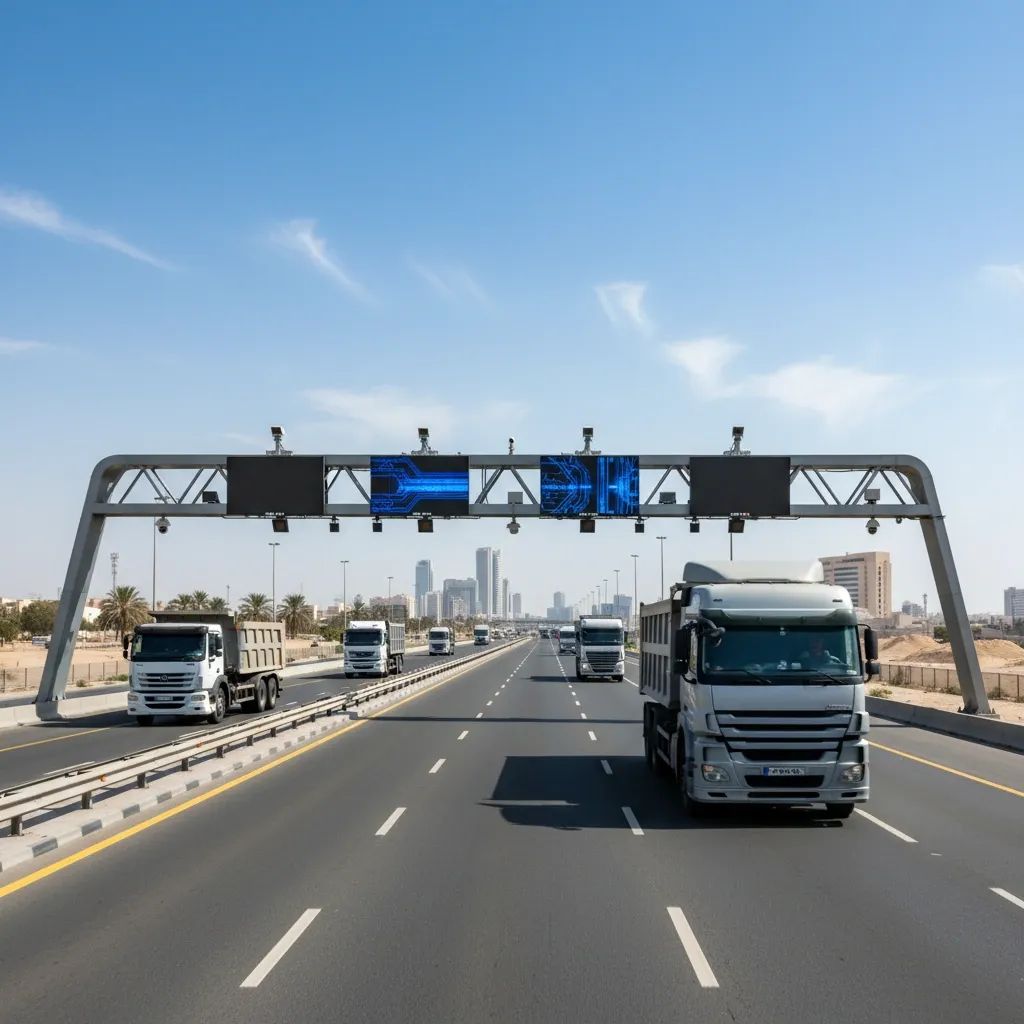
The United Arab Emirates Sharjah Roads and Transport Authority (SRTA) has switched on its new Masar electronic toll gates for heavy trucks, a decision expected to trim waiting times, lower logistics costs and ease rush-hour congestion on the emirate’s busiest corridors.
Why This Matters
• No more cash queues: From now on, truck fees are deducted automatically through the Tahseel digital wallet, eliminating on-site payment stops.
• Delivery windows tighten: SRTA predicts up to 40 % faster gate clearance, giving freight operators more predictable schedules.
• Cleaner air: Smoother flow means fewer idling engines and an estimated 4,000 tonne annual CO₂ cut, the equivalent of taking 850 cars off Sharjah’s roads.
• Fleet compliance warning: Unregistered trucks will face automatic fines beginning 1 April; owners should link plates to Tahseel before that date.
How the Smart Gate Actually Works
Unlike older checkpoints that relied on paper slips and manual guards, Masar pairs high-resolution plate scanners with AI-driven weight sensors. As a vehicle passes beneath the gantry:
Cameras capture the plate at highway speed.
Sensors verify axle weight and category in under half a second.
The fee is pulled from the operator’s Tahseel e-purse and a digital receipt lands in the fleet manager’s dashboard.
Because the system is cloud-based, SRTA can recalibrate tariffs or add gates without laying extra cabling—a model borrowed from Dubai’s Salik and Abu Dhabi’s Darb, but tuned specifically for multi-axle rigs.
What This Means for Residents & Small Businesses
Sharjah’s industrial areas depend on midnight trucking to avoid daytime tailbacks. SRTA’s transport modelling shows the new gates will let hauliers reroute some journeys to daylight hours, easing strain on night-shift drivers. Fewer late-night engine brakes should also quiet residential zones bordering truck corridors such as Emirates Road E611. For shop owners and SMEs, faster customs clearance at emirate borders should reduce stock-out risks—particularly for perishable food shipments entering from Jebel Ali.
Impact on Fleet Owners & Drivers
• Cash-flow clarity: Daily, weekly and monthly toll statements now arrive in real time, helping accountants reconcile costs instead of waiting for paper invoices.• Fuel savings: SRTA’s pilot data show an average 7 minute drop in gate dwell time, translating to roughly AED 20 per trip in diesel and driver wages for a 40-tonne lorry.• Penalty automation: Any truck that attacks the gate without a funded Tahseel account will be flagged instantly; fines start at AED 500 and escalate for repeat offences.• Inter-emirate plans: The authority is already in talks with Ajman and Umm Al Quwain to honour Masar tags on their freight corridors, hinting at a future GCC-wide interoperable truck pass.
Environmental & Traffic Pay-off
Sharjah’s Department of Statistics recorded 15 % of urban emissions coming from heavy vehicles. By converting stop-and-go checkpoints into free-flow lanes, SRTA forecasts a 12 % cut in particulate matter along the Al Dhaid road corridor. The authority will publish live air-quality dashboards starting June, giving residents the first public glimpse of toll-related pollution data.
Regional Context: How Sharjah Stands Out
While Dubai’s Salik charges every vehicle AED 4 per gate, Sharjah has opted for weight-tiered pricing—light lorries pay AED 5, 3-axle rigs AED 10, and super-heavies AED 15. Industry groups say the sliding scale is fairer and encourages companies to consolidate loads rather than dispatch half-empty trailers. In addition, Masar is the GCC’s first truck-only toll system equipped with edge-based AI, enabling on-the-spot anomaly detection such as plate tampering or axle overloading.
What Comes Next
SRTA will monitor KPIs—average gate speed, emissions per lane, and on-time cargo arrival—for the next six months. If the numbers track forecasts, secondary gates will appear near Khor Fakkan Port and the Sharjah-Dubai boundary before year-end. A public consultation on tariff adjustments is slated for September, so fleet owners keen to influence the pricing matrix should register feedback on the SRTA Masar portal.
Bottom line for anyone living or doing business in Sharjah: the emirate’s trucking arteries just went digital, promising quicker deliveries, quieter nights and cleaner air—provided all heavy-vehicle operators plug into the new system before fines hit next month.


