
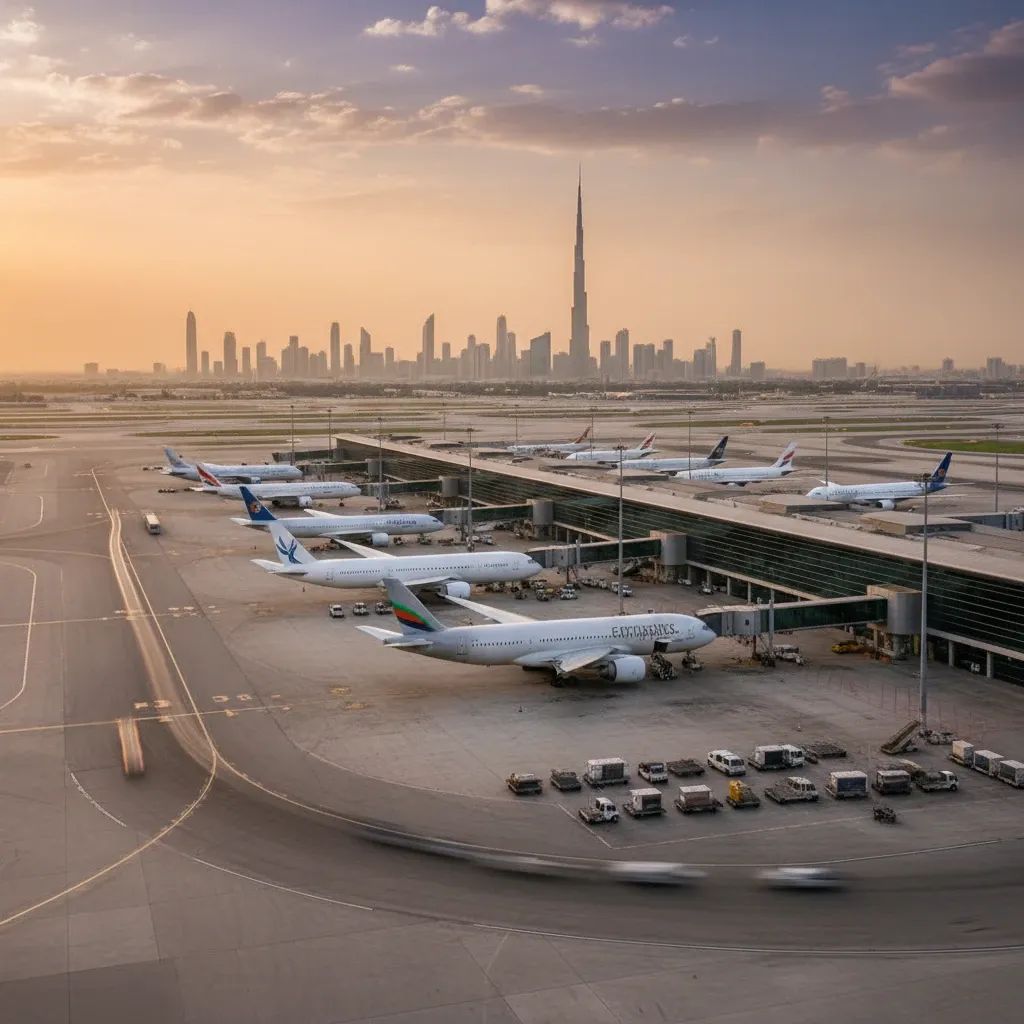
The United Arab Emirates airport operator Dubai Airports has revealed that Dubai International is on course to serve 99.5 million travellers in 2026, a level that not only cements the hub’s world-beating status but also presses every part of Dubai’s transport ecosystem—metro, roads, hotels—to keep pace.
Why This Matters
• Peak-hour crowding will intensify: Expect record traffic during winter holidays and Eid, so early check-ins and flexible flight times become more valuable.
• Faster security, fewer liquids rules: AI scanners rolling out through 2026 let you keep laptops and bottled water in your bag, cutting queue times.
• Property & logistics windfall: The AED 128 billion expansion of Al Maktoum International turbo-charges demand for homes and warehouses in Dubai South.
• Green fees ahead? DXB’s push for net-zero by 2050 hints that airlines could pass new sustainability charges to flyers.
Running at Redline, Yet On Time
Dubai International (DXB) ended 2025 with 95.2 million passengers, edging past its own 2019 pre-pandemic record. December alone saw 8.7 million people, roughly the entire population of Austria funnelled through DXB in 31 days. Despite operating at **the edge of its physical capacity—454,800 aircraft movements last year—**the airport still delivered immigration waits under 10 minutes for nearly every departing traveller. That reliability, officials say, is the handiwork of the “oneDXB” taskforce: airlines, ground handlers, immigration and police sharing live data to pre-empt snags.
New Tech Meant to Keep Queues Short
Six next-generation scanners already let passengers sail through security without unpacking liquids or electronics. By year-end, 100+ AI-powered machines will cover every DXB checkpoint, mirroring the passport-free e-gates that read faces instead of stamps. For frequent flyers, the upgrade could shave 15–20 minutes off door-to-gate time—the difference between a relaxed coffee and a sprint to Concourse B.
Environmental Scorecard — and the Bill
Record traffic inevitably expands the carbon footprint. To blunt the impact, the airport is installing 62,904 solar panels that will provide 6.5 % of DXB’s electricity and 20 % of DWC’s. A continent-worth of 330,000 LED lights is replacing legacy bulbs, while airside vehicles switch to a biodiesel mix that already cuts 3,500 tonnes of CO₂ each year. Industry analysts warn that as the aviation sector internalises these costs, ticket prices could nudge higher by AED 10–20 per long-haul seat over the coming seasons.
A Second Hub in the Desert
With DXB boxed in by city limits, the emirate’s long game is the Al Maktoum International Airport (DWC) mega project near Jebel Ali. The government has ring-fenced AED 128 billion to scale DWC to 150 million passengers within a decade, eventually hitting 260 million—about twice Heathrow, JFK and Changi combined. Airlines short of DXB slots can already request DWC operations; Emirates is quietly relocating crew housing and maintenance sheds to the area, signalling where the centre of gravity will sit post-2032.
What This Means for Residents
Plan extra travel time: Road traffic around Terminal 3 is forecast to rise 12 % on peak days. The Roads & Transport Authority is adding shuttle buses between the metro and outer car parks, but motorists should factor in longer drop-off queues.
Watch fare patterns: As capacity maxes out, airlines will deploy larger jets rather than add slots, which can create last-minute fare volatility. Booking early remains the cheapest hedge.
New job corridors: Aviation, logistics and hospitality firms are in hiring mode—particularly in Dubai South, where warehouses and hotels are breaking ground monthly.
Sustainability surcharges: If you run a business reliant on air freight, budget for incremental green levies linked to DXB’s net-zero roadmap.
Looking Ahead
Chief Executive Paul Griffiths says 2026’s target of 99.5 million passengers is “ambitious but achievable” provided the oneDXB alliance stays tight and no external shock—think volcanic ash or geopolitical airspace closures—throws sand in the gears. By 2032, the final hand-off to a fully built-out DWC should give Dubai breathing room for another generation of growth. Until then, residents can expect the city’s airports to remain both a point of pride and an early-morning challenge: get to the gate fast, breathe easy once inside, and watch the skyline of Dubai South climb higher with every take-off.


