
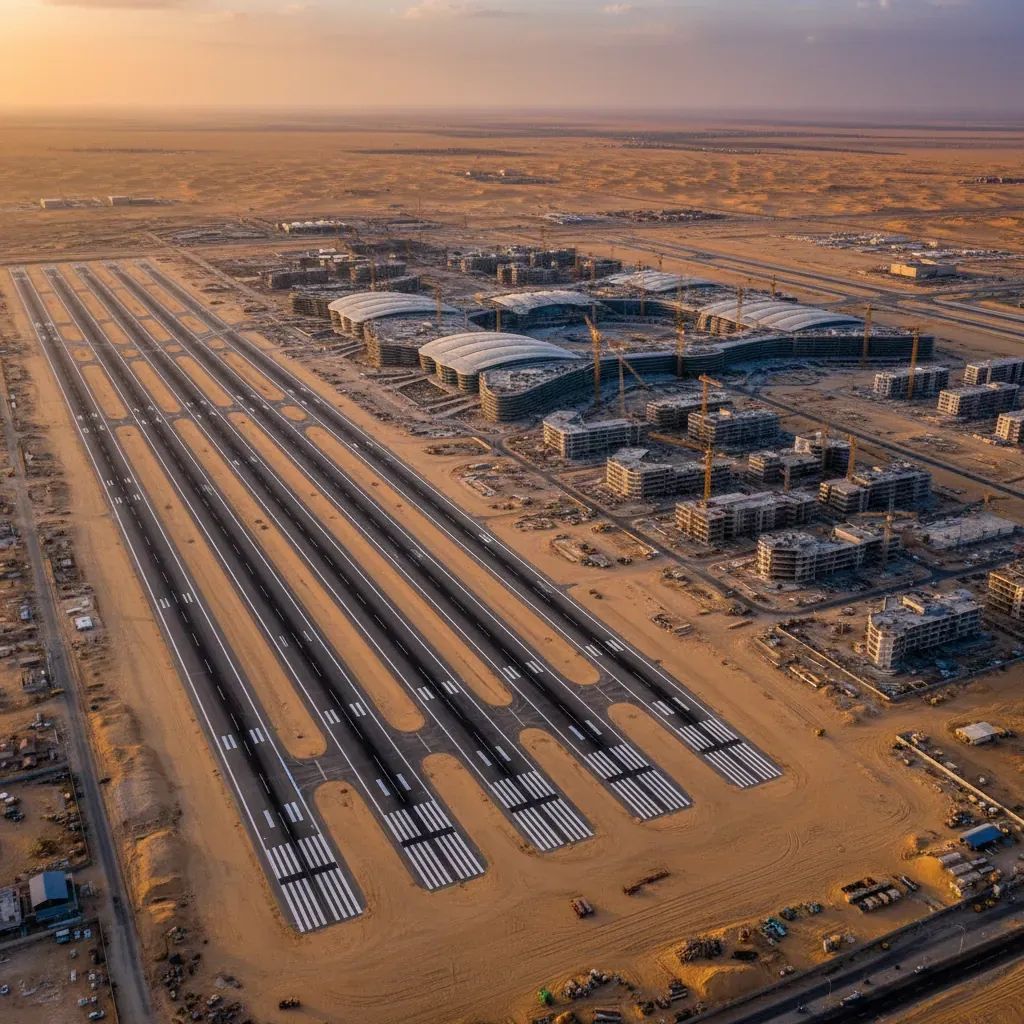
Saudi Arabia’s King Salman International Airport Development Company has inked seven fresh real-estate memoranda of understanding, a move that will redraw GCC aviation logistics and open new revenue lanes for contractors, financiers and service firms headquartered in the United Arab Emirates.
Why This Matters
• More nonstop routes – Riyadh’s new hub targets 120 million passengers by 2030, creating alternative connections for UAE-based travellers and cargo shippers.
• AED 26 billion in spin-off spending – The airport city is projected to add SAR 27 billion a year to Saudi non-oil GDP, the equivalent of roughly AED 26 billion, fuelling cross-border contract opportunities.
• Logistics price pressure – Six parallel runways and a dedicated e-commerce zone could force Dubai South and Abu Dhabi’s KIZAD to sharpen rates and incentives.
• Green procurement pipeline – Sustainability clauses in the MoUs invite UAE cleantech suppliers to bid on LEED-Platinum-level materials, waste-to-energy systems and smart-mobility tech.
Riyadh’s Airport City Takes Shape
The 57 sq km masterplan—larger than Dubai International and Al Maktoum International combined—reserves 12 sq km for mixed-use real estate. Design architect Foster + Partners calls the district an “aerotropolis”, stitched together by the Wadi Loop, a landscaped spine linking terminals, malls, hotels and residential blocks. By 2029, the first two of six runways and a terminal sized for 40 million passengers are scheduled to open; full build-out targets 185 million travelers by 2050.
Inside the Seven New Agreements
While financial terms remain confidential, officials provided broad scopes:
• Waste-management pact with the National Centre for Waste Management to embed circular-economy protocols from ground-breaking through operations.
• Digital-infrastructure deals with SDAIA, Elm and Cluster2 to weave AI-driven passenger services and predictive maintenance into the campus.
• Construction-and-design frameworks with Foster + Partners, Jacobs, Mace and Nera covering everything from airspace optimisation to low-carbon materials and on-site renewable energy.
• E-commerce zone exploration with private-equity firm ewpartners, aiming to lure global fulfilment brands with bonded-warehouse incentives.Collectively, the accords lock in expertise across design, sustainability, logistics, and data science, positioning the project as the Middle East’s most technologically advanced airport city.
Link to Saudi Vision 2030 — and Why the UAE Cares
The mixed-use push is a pillar of Vision 2030’s non-oil diversification. Riyadh wants to rank among the world’s top-10 city economies, mirroring ambitions long held by Dubai and Abu Dhabi. For UAE observers, the plan signals:
• Friendlier regulatory alignment inside the GCC single-market roadmap, simplifying cross-border operating licences.
• Healthy competition that could catalyse faster upgrades at UAE ports—think biometric corridors, robotics in warehousing and sustainable aviation fuel supply chains.
• Tourism spill-over, as multi-city packages bundle Riyadh with Abu Dhabi’s cultural sites or Dubai’s leisure ecosystem.
Opportunities for Emirati Firms
Analysts at the United Arab Emirates-based Logistics Council flag four niche openings:
Modular housing and prefab units for 10,000 on-site construction workers.
Smart-waste tech—from sensor-enabled compactors to anaerobic digesters—meeting the airport’s zero-landfill pledge.
FinTech payment rails for duty-free and hospitality outlets tapping regional e-dirham wallets.
Carbon-accounting software to validate Scope 3 emissions across the supply chain.Several UAE contractors have already registered interest; tender packages are expected to drop in Q2 2026 via Saudi Arabia’s Etimad procurement portal.
What This Means for Residents
For everyday UAE residents—whether frequent flyers, business owners or investors—the ripple effects are tangible:
• Cheaper fares on Saudi routes as carriers position for the new hub’s volume commitments.
• Faster parcel delivery to the Kingdom’s vast consumer market once the e-commerce zone is operational.
• Equity stakes in REIT-style vehicles funding the airport’s hotels, offices and rental apartments—open to GCC investors under passporting rules.
• Job mobility across the border, with up to 103,000 roles forecast, many in high-skill fields like cyber-security and green-building engineering.
Competitive Pressure on UAE Hubs?
Executives at Dubai Airports privately welcome the development, arguing that greater regional capacity alleviates slot congestion and supports code-sharing. Still, consultants at Kearney Middle East warn that cargo operators could shift some Asia-Europe trans-shipments to Riyadh if turnaround times undercut Jebel Ali Free Zone rates by even 5 %. Expect Emirati free zones to counter with longer grace periods on warehousing rent and expedited customs.
Expert View: Global Benchmarks
Industry veterans point to Hong Kong’s SkyCity, Singapore’s Jewel and Amsterdam’s Schiphol-Zuidas as closest analogues. KSIA’s leadership says the lessons are clear: bake in multimodal connectivity from day one, keep retail activation landside as well as airside, and ensure the public realm feels like a city district, not an afterthought. For the United Arab Emirates, the rise of a sophisticated neighbor underscores just how critical continuous reinvestment is if Dubai South and Abu Dhabi Midfield are to sustain their first-mover advantage.


