
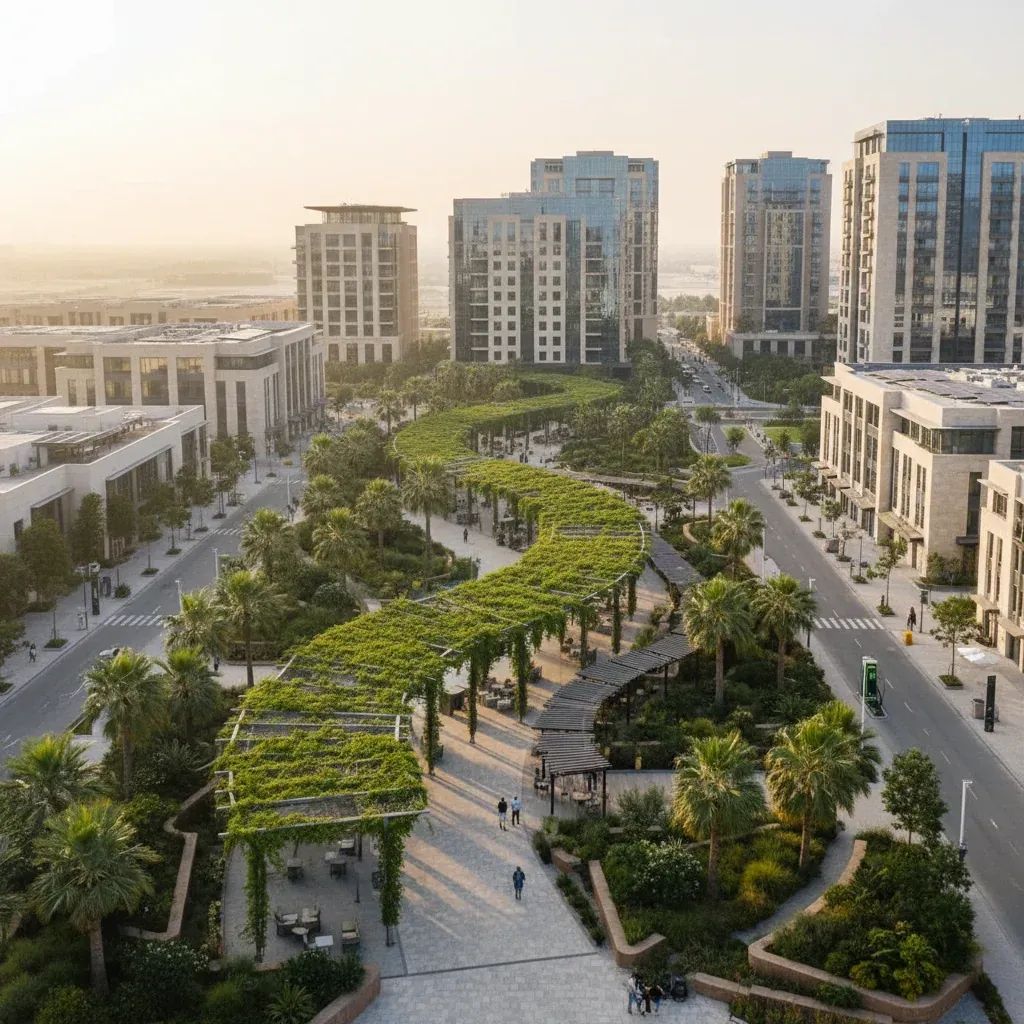
The United Arab Emirates Ministry of Energy & Infrastructure has placed the 20-minute-city concept at the core of its 2040 policy toolkit, a move that will shorten commutes, bump up neighborhood property values and nudge retailers to rethink where they open their next branch.
Why This Matters
• 80 % daily-needs goal: Dubai plans for 4 of every 5 errands to be reachable on foot, by bike or on zero-emission transit within 20 minutes.
• Property premiums rising: Walkable, mixed-use zones in Dubai already command 7 % annual capital growth, outpacing single-use districts.
• Heat-proof streets coming: Air-conditioned bus shelters, shaded corridors and misting stations are being budgeted to keep the model workable in 45°C summers.
• Investor signal: Regional real-estate analysts expect the GCC’s mixed-use market to top US $5 Tn by 2029, supported by proximity planning.
The Big Idea: Living Close, Living Better
Proximity-driven planning flips the old "build roads, then sprawl" playbook. Instead, urban designers cluster housing, jobs, healthcare, parks and grocery options so that a resident can accomplish most tasks without firing up a car. The approach is credited with lowering carbon output, boosting foot traffic for small businesses and freeing up personal time—a non-renewable resource in any metropolis.
How the GCC Became a Test Lab
Unlike century-old European capitals that must retrofit medieval street grids, GCC cities benefit from blank-canvas land banks and decisive central planning. Abu Dhabi’s Capital Planning Office, Saudi Arabia’s NEOM Company and Qatar’s Public Works Authority can green-light multi-billion-dirham precincts in months, not decades. That speed has turned the Gulf into a living laboratory for proximity models blended with AI-driven traffic control, e-scooter lanes and 5G-enabled public services.
Progress Report: Dubai, Riyadh and Doha
• Dubai: Pilot districts such as Al Barsha 2 and JVC are rolling out shaded greenways linking homes to metro stops; occupancy in mixed-use hubs like Dubai Hills tops 90 %.
• Riyadh: Grade-A offices near King Abdullah Financial District log 98 % occupancy, and apartments within 500 m of a metro station yield 10-15 % higher rents.
• Doha: The Pearl and Lusail Marina show 15-30 % price premiums for waterfront, walk-friendly units, while Msheireb Downtown targets 7 % gross rental yields.
Pain Points the Region Still Has to Solve
Extreme heat: July temperatures make walking tough. Municipalities are piloting solar-powered canopy corridors, cooled pavement coatings and staggered work hours to keep sidewalks usable.
Car culture: Decades of cheap fuel created a psychological dependency on private vehicles. Parking caps, dynamic road-pricing and improved first-mile transit are being tested to shift habits.
Inclusivity risks: Without careful zoning, high-end proximity enclaves can morph into exclusive bubbles. Regulators are drafting affordable-housing quotas to ensure that essential workers live inside the 20-minute radius they serve.
Misinformation: Online conspiracy theories portraying 20-minute cities as "movement prisons" have gained minor traction. The UAE’s National Media Council is countering with public-awareness campaigns focusing on health and productivity benefits.
Money Trail: What Investors Are Seeing
Consultancy Knight Frank reports that walkable, amenity-rich plots in Dubai’s Business Bay transact at premiums of up to AED 550 per sq ft over conventional sites. Rental yields in mixed-use precincts average 7-8 %, compared with 5.5 % in suburban villa compounds. In Riyadh, proximity to the under-construction metro can inflate land values by 25 % before the first train runs. Institutional investors cite stable cash flows and lower vacancy volatility as motives for doubling allocations to GCC mixed-use funds through 2027.
What This Means for Residents
• Shorter trips, smaller bills: Expect lower monthly petrol spend and potentially slimmer car-ownership needs—handy when comprehensive insurance can exceed AED 6,000 a year.• Higher resale upside: Buying in a certified 20-minute district is likely to deliver stronger capital appreciation, especially once a metro or tram line switches on.• More street life, more choice: Restaurant density typically rises, and public parks receive priority maintenance, making weekend leisure less mall-centric.• Regulatory sweeteners: The UAE Cabinet is reviewing reduced utility tariffs for buildings that achieve "proximity compliance"—a possible 10 % cut on DEWA bills for qualifying homeowners.
Looking Ahead: Timelines to Watch
Date-stamped milestones give a sense of when the blueprint turns concrete:
| Year | Milestone | City ||------|-----------|------|| 2025 | Blue Line completion connects Lusail to central Doha | Doha || 2026 | First 5 km segment of The Line structurally finished | NEOM, Saudi Arabia || 2027 | Dubai’s Green Spine pedestrian corridor fully landscaped | Dubai || 2029 | GCC mixed-use real-estate market crosses US $5 Tn | Region-wide |
Urban planners insist the 20-minute target is not a rigid stopwatch but a quality-of-life metric. If the Gulf continues pairing tech spending with human-scale design, residents could soon swap signal-jammed highways for shaded, five-minute strolls—an exchange few will regret.


