
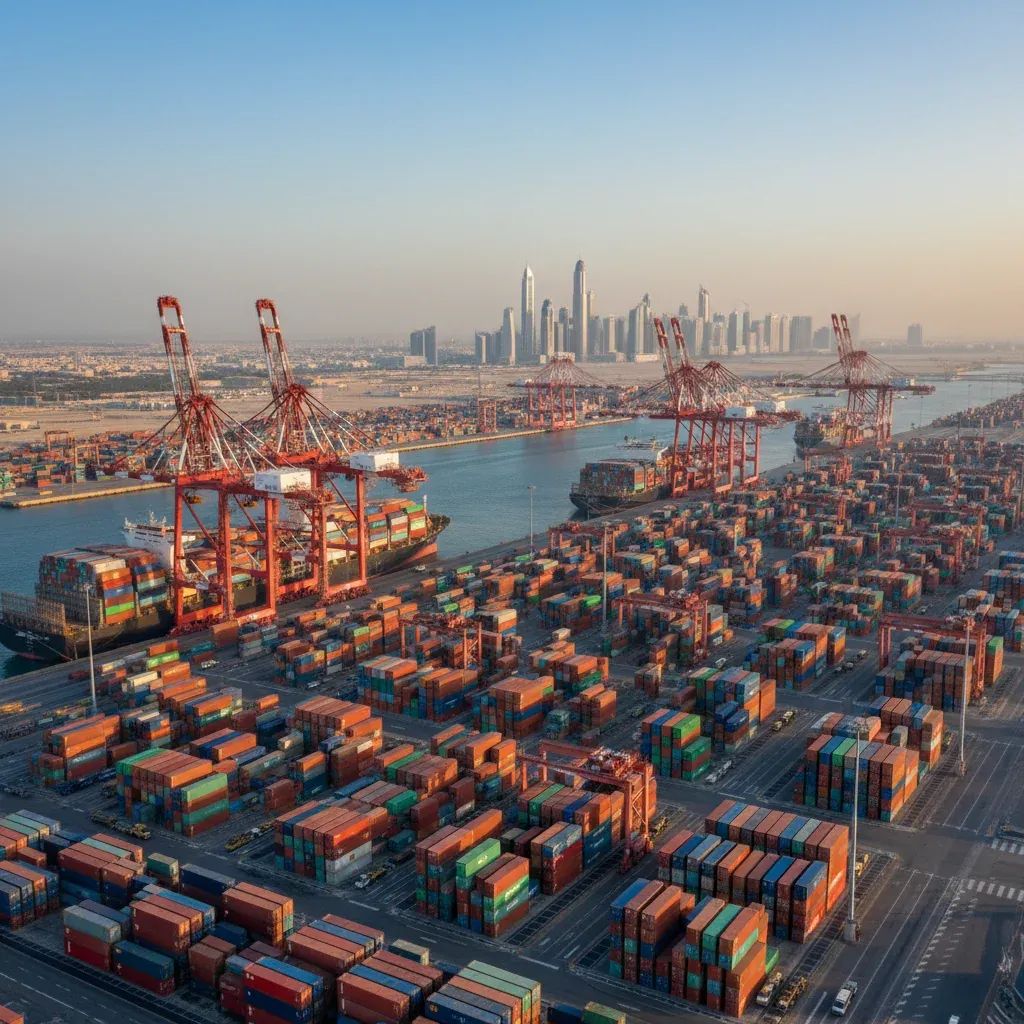
The United Arab Emirates food security apparatus rests on a deliberately engineered paradox: a nation importing roughly 9 of every 10 calories consumed has nonetheless become the Middle East's most stable market for essentials. This stability stems not from eliminating import dependency—an impossible task given the country's desert environment—but from orchestrating that dependency with surgical precision.
Why This Matters
• Nine price-protected staples (rice, cooking oil, eggs, dairy, sugar, poultry, legumes, bread, wheat) cannot increase without ministerial approval, with violators facing AED 500–AED 100,000 penalties and potential license suspension.
• Real-time surveillance covers 627 retail outlets representing 90% of domestic trade, enabling authorities to detect unjustified markups within hours during peak demand periods.
• Strategic reserves buffer four to six months of consumption, absorbing shocks from geopolitical disruptions, shipping delays, and climate-related supplier failures.
• Report violations instantly via 8001222 (WhatsApp-enabled) or info@moet.gov.ae; authorities processed over 7,100 inspections during March 2026 Eid preparation, issuing AED 207,250 in fines.
The Structural Reality
Geography imposes hard constraints. The UAE possesses barely 0.7% arable land, limited freshwater reserves dependent entirely on desalination, and temperatures that render large-scale outdoor agriculture economically unfeasible. These facts are not negotiable. What is negotiable—and what distinguishes the UAE from similarly resource-constrained neighbors—is the institutional apparatus layered atop that limitation.
Abdulla bin Touq Al Marri, the Minister of Economy and Tourism, spent late March conducting unannounced warehouse inspections at both Carrefour distribution facilities and the Lulu Hypermarket chain in Sharjah. These were not ceremonial photo opportunities. The Minister examined shipment manifests, cross-referenced purchase orders against daily inventory submissions, and queried supply-chain coordinators about alternative routing protocols. The visits preceded the Eid Al Fitr shopping surge—historically a moment when households front-load purchases and retailers face pressure to either maintain stock-outs or absorb inventory losses if demand underperforms.
Yusuff Ali M.A., Chairman of Lulu Group International, disclosed that his company had mobilized 26 chartered flights and ocean cargo vessels to import over 5,000 tonnes of fresh produce, meat, and shelf-stable goods within weeks of the holiday. This logistics commitment reflects the scale required to stock a nation where consumption spikes predictably yet retailers cannot simply mandate uniform demand from consumers. The alternative—allowing shortages—invites panic purchasing, hoarding, and exactly the kind of market disruption the government structure is designed to prevent.
How Import Dependency Becomes Managed Complexity
The United Arab Emirates imports between 85–90% of its food, depending on commodity classification. Coffee, rice, frozen seafood, and specialized proteins come predominantly from single-origin regions: Indian basmati, Australian beef, Indonesian ground beans. When geopolitical friction strikes—recent tensions surrounding the Strait of Hormuz created precisely this scenario in early March 2026—the supply consequences cascade immediately.
Shipping insurance premiums climb 300–500% overnight. Carriers deliberately reroute around affected zones, adding weeks to transit times. Refrigerated containers bunch into waves when routes reopen, creating temporary oversupply followed by extended gaps. For perishables especially, this rhythm proves destructive. Reports indicated that Dubai distribution centers held only 8–10 days' forward stock of fresh vegetables by early March, a precarious margin when a single weather event or port closure can trigger shortage.
The Ministry of Climate Change and Environment responded by pre-positioning additional inspection teams at all entry points—ports in Jebel Ali and Khalifa Port, as well as overland crossings into Oman and Saudi Arabia. The goal was categorical: reduce customs dwell time without sacrificing food-safety verification. Faster clearance translates into fresher produce reaching retailers and consumers. It also signals to shippers that the UAE prioritizes throughput, encouraging carriers to resume normal routing rather than diverting shipments to competitors.
Concurrently, the government instructed major retailers to activate alternate logistics corridors—routing shipments through secondary ports, leveraging air freight for high-value items despite cost premiums, and negotiating long-term supply agreements with secondary suppliers to create redundancy. The Ministry of Economy and Tourism held 26 coordination meetings with importers and major retail chains, making explicit that supply continuity during the Eid period was non-negotiable and that cost absorption—subsidizing freight premiums if necessary—would fall partly on the public treasury.
The Regulatory Enforcement Engine
Price controls in the UAE operate through a tiered structure. The government maintains a designated list of nine essential commodities. Any retailer wishing to increase prices on these items must submit formal application to the Ministry of Economy and Tourism, justifying the increase through documented cost rises. The ministry holds authority to approve, reject, or mandate a smaller increase than requested. Once approved, a minimum six-month window must pass before the next increase becomes eligible for approval—a deliberate throttle on volatility.
This framework exists alongside real-time enforcement. The digital price-monitoring system automatically flags retail outlets where pricing deviates beyond established baselines. Consumer complaints directed to the hotline trigger inspection cycles. Dubai's Consumer Protection Department conducted 2,500 field audits during the 20-day run-up to Eid, with inspectors verifying that displayed prices matched checkout scan readings, confirming promotional discounts were applied correctly, and photographing expiry dates and condition of stock.
Violations carry teeth. Retailers found charging above-approved rates for protected items receive written warnings on first offense. Repeat violations trigger AED 500–AED 100,000 fines depending on severity and intent. Systematic manipulation or conspiracy to inflate prices—collusion among competitors—invites license suspension, administrative closure of outlets, and court-ordered refunds to affected consumers with prices rolled back to pre-violation levels.
The regulatory framework operates on a conviction that attempted manipulation, once detected, becomes strategically irrational for retailers. The cost of fines and reputational damage, combined with operational disruption from inspections and potential license suspension, exceeds the marginal profit gained from price increases. Retailers respond rationally by staying within the guardrails.
Local Production as Supplementary Buffer
The UAE has invested heavily in agricultural technology—vertical farming, hydroponic systems, controlled-environment agriculture—not to achieve food independence but to incrementally reduce import pressure and stabilize pricing for specific categories. By the end of 2025, domestic vegetable production covered roughly 20% of market demand, up from near-zero a decade earlier. The government target is 50% self-sufficiency by 2051, a multi-generational commitment acknowledging that quick pivots are unrealistic.
These farms operate under license, supply planning systems monitored by the Ministry of Climate Change and Environment, and benefit from subsidized electricity and water pricing. They concentrate on high-value, perishable items—tomatoes, cucumbers, leafy greens—where import delays inflict the greatest economic damage and supply uncertainty poses genuine market risk.
The scale remains modest relative to total consumption, but the direction is deliberate. Each percentage point of domestically sourced production reduces exposure to a single supplier disruption or geopolitical shock. It also creates redundancy: if Indian vegetable shipments face delay, locally grown alternatives partially substitute, absorbing demand that might otherwise concentrate among secondary suppliers.
Market Monitoring as Real-Time Discipline
The digital backbone linking 627 major retail outlets operates as both surveillance and market stabilizer. Every price transaction, inventory adjustment, and promotional activity flows continuously to government terminals. Algorithms analyze this data stream in real time, automatically flagging suspicious patterns—sudden price increases on high-demand items, unusual inventory reductions, pricing mismatches across nearby outlets.
Physical inspectors respond to algorithmic flags. An inspector arriving at a retail outlet within hours of a suspicious price spike can verify whether the increase reflected legitimate cost changes or attempted manipulation. The rapid response loop—detection to verification to enforcement—makes sustained price manipulation operationally difficult. A retailer might attempt to inflate prices during holiday confusion, but the digital system ensures discovery within a window where intervention still prevents market distortion.
This infrastructure requires upfront investment and sustained operational cost. Data systems must be maintained, inspectors deployed, administrative staffing sustained. The UAE government has determined these costs justify the return: market stability, consumer confidence in pricing fairness, and reduction of hoarding behavior that would otherwise amplify supply pressure during demand spikes.
The Regional Standing and Comparative Context
The Global Food Security Index ranks nations on affordability, availability, quality, and food safety. In 2022—the most recent comprehensive measurement—the UAE achieved 23rd globally and first within the Middle East and North Africa region. This positioned it ahead of Qatar (30th), Oman (35th), Bahrain (38th), Saudi Arabia (41st), and Kuwait (50th).
The gap reflects execution quality, not resource availability. Qatar has achieved near-total self-sufficiency in dairy and poultry through public-private partnerships but lags the UAE in overall food security due to pricing volatility and supply-chain resilience. Saudi Arabia has committed USD 10 billion to agricultural modernization under Vision 2030 but confronts administrative fragmentation across multiple government entities. The UAE combines policy clarity, enforcement consistency, and technological integration in ways that translate into measurable market stability.
The National Food Security Strategy 2051 aims for a top-10 global ranking within 25 years, anchored by targets to increase domestic production, reduce waste by 50%, and maintain reserves sufficient for all emergency scenarios. The supporting legal framework—the Strategic Food Security Law and the National Pathway for Food Systems Transformation (both approved in 2021)—establishes formal mandates with enforcement mechanisms, converting aspiration into operational obligation.
Persistent Risks and Mitigation Thinking
The system is resilient within bounds but not immune to severe shocks. Prolonged geopolitical conflicts blocking the Strait of Hormuz indefinitely, coordinated export bans from major supplier nations, or climate-driven failures affecting multiple agricultural regions simultaneously would strain current capacity. Oil-price volatility historically threatened the UAE's purchasing power for imports, though economic diversification has partially decoupled this relationship.
Against these scenarios, authorities maintain strategic reserves—six months of consumption for key staples—diversify suppliers across multiple continents and supply routes, and explicitly absorb certain logistical costs to shield consumers from freight-price spikes. Retailers submit daily compliance reports. The government conducts unannounced inspections. The digital system monitors continuously.
The March 2026 Eid period provided a practical stress test. Demand rose 40–50% above baseline for fresh produce, dairy, and proteins. Regional maritime tensions persisted. Yet retail shelves remained stocked, pricing remained stable, and consumer behavior remained orderly—no panic purchasing, no reported shortages, no unusual hoarding. This outcome did not occur accidentally. It resulted from deliberate coordination among government agencies, supply-chain operators, and retailers, all working within a regulatory framework that incentivizes market stability over short-term profit maximization.
The UAE's model illuminates a broader reality: food security does not require food self-sufficiency. It requires managed imports, transparent oversight, consistent enforcement, and willingness to invest public resources in monitoring systems and reserve maintenance. Few nations demonstrate this commitment systematically. The UAE does, which explains why residents shopping during the holiday season encountered well-stocked shelves and stable prices while neighbors grappled with more acute supply uncertainty.


