
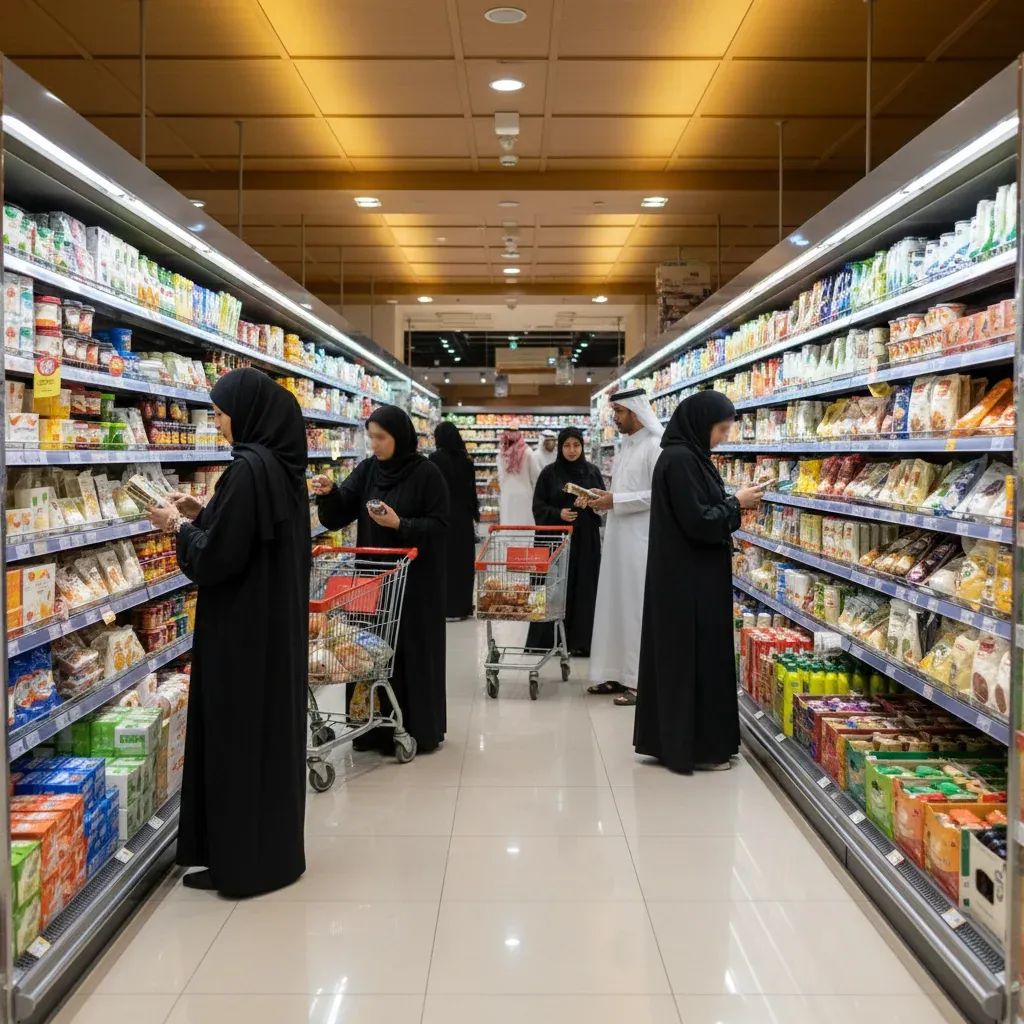
When tensions spiked across the Gulf region in early March, Kuwait's government moved decisively to prevent domestic food scarcity, imposing a sweeping one-month ban on all food exports and locking in prices across domestic retail channels. The measure signals how vulnerable the region remains to supply disruptions, and offers a window into how governments across the Arabian Peninsula now respond to geopolitical stress.
What This Means for UAE Residents and Businesses
For people living in the United Arab Emirates, Kuwait's emergency intervention raises immediate questions: Will supermarket prices rise? Will specific food categories become scarce? The short answer is reassuring for now. Kuwait accounts for less than 2% of the UAE's total food imports, and UAE supermarket chains maintain diversified sourcing across multiple suppliers and countries. However, this does not mean the measure has zero impact.
Practical implications for UAE residents:
• No immediate price spikes expected: Since Kuwait is not a primary food supplier to the UAE, retail prices at Carrefour, Spinneys, and other major chains are unlikely to spike due to this measure alone.
• Affected categories: If any disruptions occur, they would be marginal and limited to specialty Kuwaiti products and fresh vegetables that occasionally flow through Kuwait's trade corridors. Staples—rice, grains, frozen goods—come primarily from India, Australia, and Europe.
• Reassurance from UAE sourcing: The UAE's own food production capacity, combined with established supply agreements with suppliers outside the Gulf, provides a buffer that Kuwait lacks.
For UAE businesses with Gulf operations: Companies with active trade relationships across Kuwait should review their contracts for force majeure clauses and identify alternative routing through Oman or Bahrain if disruptions extend beyond the 30-day window. UAE government has not issued formal restrictions on Kuwaiti imports, indicating a pragmatic approach to the measure.
Why This Matters
• Complete export freeze: From March 1 onwards, any Kuwaiti food shipment leaving the country requires explicit written clearance from the Minister of Commerce, with violators facing criminal charges under existing trade law.
• Price enforcement kicks in: The government has fixed all food selling prices, with a dedicated control room monitoring markets continuously and authorities empowered to document violations and refer them to prosecution immediately.
• Regional vulnerability on display: Kuwait imports over 90% of its food; the export ban is primarily a reassurance tool for domestic audiences rather than a meaningful global trade intervention.
The Immediate Trigger and Government Response
On March 1, Minister Osama Boodai issued the export suspension decree in response to what officials termed a "regional situation"—diplomatic language that reflects the broader security tensions affecting the Gulf. The following day, Kuwait's Supreme Emergency Committee convened to assess whether strategic food reserves would hold steady throughout the month-long freeze. Officials were emphatic: no stockpiling is necessary, bakery output already exceeds local demand, and food chains remain uninterrupted.
This messaging serves a dual purpose. It acknowledges public anxiety without validating it, while simultaneously preparing the public for potential price volatility or temporary shelf shortages that often accompany emergency interventions. The ministry encouraged residents to report price violations through its electronic portal and mobile app—a digital enforcement mechanism that mirrors compliance systems already operating across the United Arab Emirates and Saudi Arabia.
Director Faisal Al-Ansari, heading the Commercial Control and Consumer Protection Department, personally delivered repeated assurances that supplies are adequate. Yet the very need for such reassurance hints at underlying consumer concern—and possibly early signs of panic buying—that prompted officials to establish round-the-clock market surveillance.
Impact on Regional Trade Patterns
Kuwait's emergency intervention points to a troubling pattern: when geopolitical risks spike, food policy becomes a tool of governance rather than market function. The measure is unlikely to shift Kuwait's domestic food costs materially; a 30-day export freeze in a country that produces almost no exportable food surplus is largely symbolic. But symbols matter in crisis management.
The deeper concern lies in precedent. The United Arab Emirates already blocked rice exports for four months in 2023 following India's restrictions on non-basmati shipments. Saudi Arabia currently maintains import bans on poultry and eggs from over 40 countries, citing avian influenza risks. Qatar has curtailed agricultural exports to preserve scarce water resources. Each measure reflects legitimate security concerns, but collectively they hint at a region increasingly willing to fragment its internal market during moments of external pressure.
What UAE Businesses Should Do Now
For businesses with supply contracts spanning multiple Gulf states, the practical implication is clear: force majeure clauses are no longer academic safeguards—they are operational necessities. Companies relying on Kuwaiti food logistics should:
• Review agreements for protection against sudden government interventions
• Identify alternative routing through Oman or Bahrain if disruptions extend beyond 30 days
• Communicate with logistics partners about potential delays at customs checkpoints
• Confirm supplier contracts explicitly allow for rerouting during government-imposed restrictions
For UAE-based retailers and distributors accustomed to stable, market-driven pricing, Kuwait's fixed-price regime represents a different regulatory philosophy entirely. While the UAE has historically resisted price controls, choosing instead to manage inflation through monetary policy and currency strength, Kuwait's paternalistic approach could gain traction if regional instability persists or domestic inflation accelerates.
Why Export Bans Rarely Deliver Long-Term Stability
Economists across the Gulf recognize a hard truth: food protectionist policies create short-term reassurance but long-term fragility. Indonesia's 2022 ban on palm oil exports temporarily reduced domestic cooking oil prices but eroded producer confidence and cost Indonesia permanent market share abroad. Similarly, the UAE's rice export freeze in 2023—though brief—sent ripples through Asian suppliers, who diversified their customer bases away from Gulf markets in anticipation of future arbitrariness.
Kuwait's one-month timeline suggests the government understands this dynamic. A 30-day measure signals an interim safeguard, not a structural reorientation of economic policy. But the question haunting policymakers across the region is whether short-term interventions can coexist with long-term resilience. Diversifying import sources, building strategic reserves, and investing in overseas agricultural production are multi-year commitments. When crises strike, governments default to the levers immediately available: price controls and export freezes.
The GCC remains acutely vulnerable. Member states import 85% of total food consumption, including 90% of cereals and virtually all rice. Unlike Argentina or Ukraine, which export grain globally, Gulf nations have no agricultural surplus to leverage diplomatically. Export restrictions in the region are reactive measures, not strategic leverage.
Enforcement Architecture and Compliance Risk
The Kuwaiti government has signaled serious enforcement intent. Under Decree-Law No. 10 of 1979, unauthorized food exports face fines, business license revocation, and criminal prosecution through the Commercial Prosecution unit. The ministry's control room conducts real-time market surveillance, with inspectors authorized to document artificial price increases on the spot and issue immediate referrals.
This enforcement apparatus is notably more robust than that of neighboring states, where consumer protection often depends on retroactive complaints rather than proactive monitoring. For food importers, wholesalers, and retailers operating in Kuwait, the lesson is unambiguous: regulatory compliance is now a high-stakes operational priority. A single price violation—even if unintentional—can trigger business-threatening consequences during a geopolitical crisis.
The Historical Pattern: Temporary Measures That Sometimes Persist
Kuwait's track record with emergency food interventions offers nuance. In March 2022, the government imposed a three-month ban on vegetable oil and grain exports. From October 2022 to May 2023, fresh egg exports were prohibited. Both measures were eventually lifted, but only after sparking debate about whether interventionist policies were sustainable in a globalized economy.
The question now is identical: Will the March 2026 ban expire quietly on April 1, or will the "regional situation" that prompted it remain unresolved? Officials have offered no visibility into exit criteria. This ambiguity is itself destabilizing—companies cannot effectively plan if they cannot forecast when restrictions will lift.
The Path Forward for the UAE and Gulf Region
Kuwait's emergency intervention points to a fundamental tension within GCC economic policy: the ambition for market liberalization and cross-border integration collides repeatedly with the political imperative to protect citizens from external shocks. Food security in the Gulf is not merely an economic issue—it is a governance challenge, intimately tied to regime stability and public confidence.
For the United Arab Emirates, which maintains significantly more diversified food production capacity and logistics infrastructure than its neighbors, Kuwait's precedent deserves close attention. The UAE's more stable approach to price management and broader supplier diversification positions it to weather such disruptions better than other Gulf states. However, if regional tensions persist, the UAE could face similar pressure to prioritize domestic food availability over cross-border trade flows, with cascading consequences for business, consumers, and the broader project of building a resilient, interconnected Gulf economic architecture.
The coming weeks will reveal whether Kuwait's ban remains a one-month circuit breaker or the opening move in a longer period of regional trade fragmentation.


