
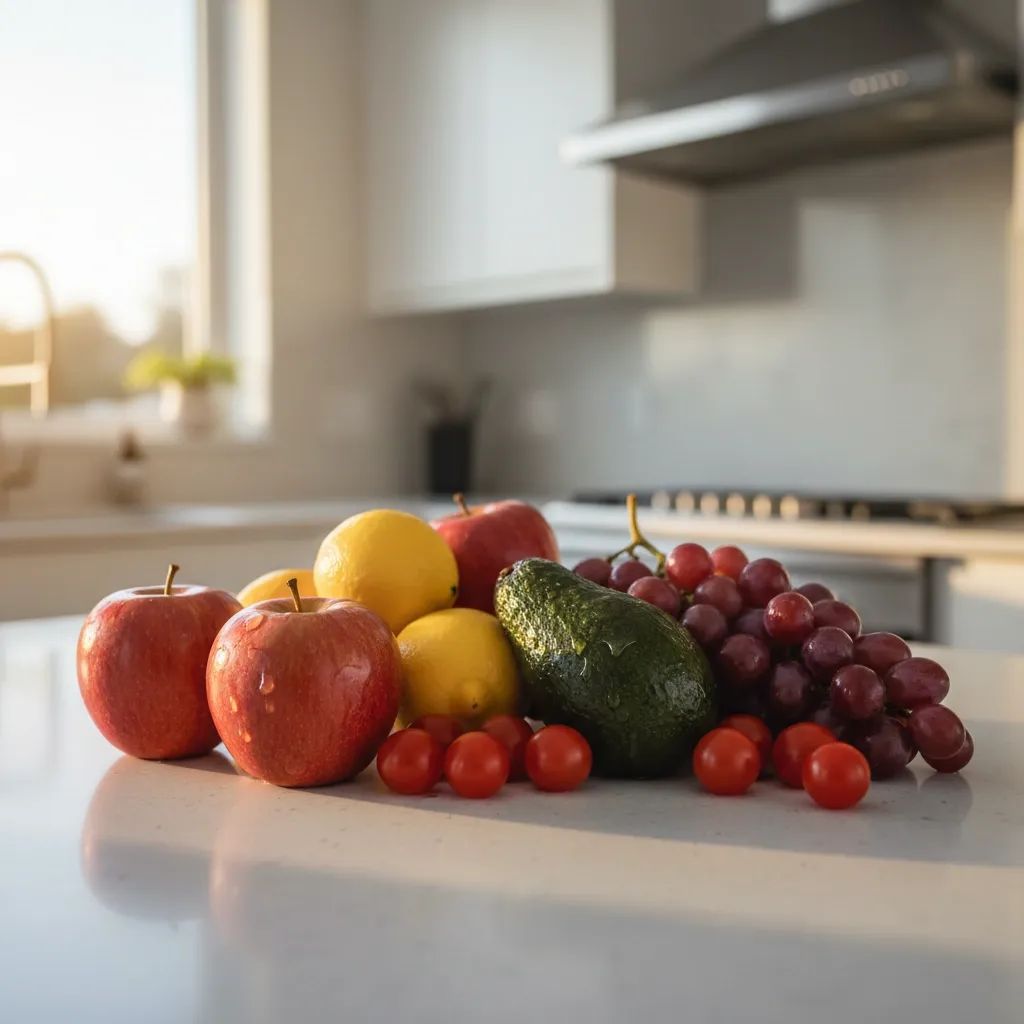
Al Ain researchers have just achieved something potentially transformative for the way the Middle East handles food waste: a biodegradable, edible coating that can wrap produce straight off the tree and survive the entire journey to a consumer's kitchen. The United Arab Emirates University has secured US Patent 12495808 for this innovation, announced in February 2026, marking a rare moment when laboratory research translates into a technology with immediate commercial relevance for a food-import-dependent nation.
Why This Matters
• Shelf life extension proven: The patented film kept fresh produce free from significant microbial growth through extended cold storage—a concrete performance benchmark for the Gulf's warm climate and inconsistent cold-chain logistics.
• Zero-waste packaging: Unlike traditional plastic, the coating is fully edible and biodegradable, requiring no removal, washing, or disposal—consumers eat it as part of the produce.
• Regional market timing: The Middle East edible-packaging sector is experiencing significant growth projections, with the UAE leading adoption, creating a rare window for first-mover advantage.
How the Technology Works
The film operates as a semi-permeable barrier, not a hermetic seal like conventional plastic wrap. This distinction matters. While traditional packaging suffocates produce by blocking all gas and moisture exchange, the UAEU coating allows the fruit or vegetable to continue its natural respiration—just slower. The formulation carries antimicrobial properties, actively inhibiting bacterial and fungal colonization on the produce surface, while also contributing antioxidant effects that slow the cellular oxidation that browns cut apples or wilts leafy greens within hours.
Researchers Prof. Abdel-Hamid I. Mourad from Mechanical and Aerospace Engineering and Dr. Zainab F.R. Ahmed from Integrative Agriculture, working alongside Navjot Kaur, developed the formulation to be applied in three ways: brushed directly onto fruit skin, used as an inner layer in cardboard packaging, or applied as an outer wrap over conventional boxes. Laboratory testing confirmed the film is transparent, mechanically robust across temperature swings, and resistant to microbial growth.
The patent filing occurred in December 2023; the US patent office granted it in February 2026. The research team published accompanying peer-reviewed findings in January 2024, providing the scientific foundation for regulatory submissions ahead.
Why This Matters for Residents and Businesses
For shoppers: If major UAE retailers like Carrefour, Lulu, or Spinneys pilot this technology—plausible within 18–24 months given the patent's recent approval—coated produce could appear on shelves with minimal behavioral change required. The coating is tasteless and invisible; consumers would wash and prepare food exactly as they do now, simply consuming the film with the peel or skin.
For food service and hospitality: The Emirates hospitality sector faces acute waste pressures. Hotel buffets, catering operations, and restaurant prep kitchens discard significant volumes of produce due to spoilage and presentation decay. Sustainability-certified hotels (increasingly common in Dubai and Abu Dhabi) pursuing waste-reduction targets could adopt this technology as part of green-operations initiatives, improving their environmental footprint and regulatory standing simultaneously.
For agricultural exporters: Date and citrus producers in the UAE, Oman, Qatar, and Saudi Arabia face identical shelf-life constraints when exporting to regional and international markets. Licensing the patent technology to regional packing houses could create a competitive advantage in export quality, particularly for premium and organic products where sustainability messaging drives buyer decisions.
For the UAE knowledge economy: The patent positions UAEU as a contributor to applied agritech innovation—a strategic priority as the nation diversifies from hydrocarbons into knowledge-driven sectors. UAEU partnerships with Emirates Biotech on biopolymers signal institutional intent to move research into commercialization pathways.
The Market Reality: Global Precedents and Local Barriers
The broader edible films and coatings market is experiencing sustained growth, with industry analysts projecting significant expansion in coming years. However, laboratory innovation and market adoption exist in different universes.
Akorn Technology, a US competitor, deployed a three-component vegetable-based coating combining plant protein, botanical wax, and vegetable oil. It has demonstrated shelf-life doubling for mangoes and retail waste reduction of 20–30%. Akorn's key commercial advantage: its coating integrates into existing packing-house waxing equipment, eliminating capital expenditure barriers for growers. Akorn secured significant funding, forged distribution partnerships with major US retailers, and began commercial deployment in 2025.
Chungnam National University in South Korea developed a chitosan-based film with UV-blocking properties that extended shelf life for various produce types. Swiggy Pvt Ltd, based in Sweden, launched an additive-free plant-based coating in October 2025 specifically targeting cucumbers and bell peppers.
The UAEU innovation sits comfortably within this competitive landscape, particularly for high-temperature and high-humidity applications—environmental conditions that accelerate spoilage in Gulf climates but are less pressing in temperate markets where competitors dominate. The formulation's validated performance under these regional conditions is a genuine technical distinction.
Where Commercialization Stalls
The journey from patent to supermarket shelf is typically measured in years, not months, for several concrete reasons.
Production cost remains the primary barrier. Natural raw materials used in the formulation are significantly more expensive than conventional plastics, and for supply-chain operators working on razor-thin margins, such cost differentials are commercially challenging unless regulation or consumer willingness-to-pay subsidizes the premium. Scaling from batch chemistry to continuous industrial production introduces quality-control complications; natural raw materials exhibit inherent batch-to-batch variability, complicating consistency guarantees required by food-retail contracts.
Regulatory fragmentation across export markets complicates commercialization. The UAEU film would require separate approvals from the Emirates Authority for Standardization and Metrology (ESMA) for local distribution, the US FDA for North American export, and varying frameworks across the EU, UK, and GCC nations. Each jurisdiction defines "edible film" differently, stipulates different safety testing protocols, and maintains distinct ingredient approval lists.
Consumer acceptance remains uncertain. While early adopters embrace sustainability narratives, mainstream shoppers—particularly in price-sensitive markets—often prioritize cost and familiarity over environmental credentials. The proposition of eating packaging challenges ingrained assumptions about food safety, despite scientific soundness. Building consumer trust typically requires marketing investment and retail visibility that research teams lack capacity to execute.
Supply-chain actors face conflicting incentives. Retailers, growers, and distributors have no immediate financial reason to adopt higher-cost packaging unless regulation mandates it or consumers demonstrably pay premiums for sustainably packaged produce. In the UAE and Middle East, these regulatory mandates and consumer-price signals remain nascent.
The Path Forward: Realistic Timelines
The UAEU team now faces typical commercialization hurdles: securing industrial partnerships for pilot production, conducting trial deployments with cooperative retailers or exporters, obtaining regulatory approvals, and demonstrating cost competitiveness at scale.
Precedent suggests a realistic timeline:
Months 1–6: The team will likely approach regional food processors, packaging suppliers, and major retailers with pilot proposals. Discussions with Emirates Biotech (an existing partner on other projects) could accelerate prototyping.
Months 6–18: Pilot trials with smaller chains or premium segments (organic produce, high-end hospitality) would generate performance data and refine production workflows. Parallel submissions to ESMA for local food-safety approval would commence.
Year 2: If pilot data is positive, licensing agreements with regional packing houses serving export markets could launch. The technology's comparative advantage in high-heat, high-humidity conditions makes date and citrus export packaging a logical entry point.
Year 3+: Retail availability at scale remains conditional on cost reductions through economies of scale and either regulatory intervention (plastic bans with enforcement) or sustained consumer demand for premium, sustainably packaged produce.
What Success Looks Like
The Middle East biodegradable plastics market is currently experiencing significant annual growth—driven by regulatory pressure and corporate sustainability commitments. Industry analysts project continued expansion in this sector. If the research team navigates production-scale challenges and secures a single major distribution partner—say, a regional packing house serving GCC date or citrus exports—the patent could generate licensing revenue, validate the technology for subsequent markets, and establish UAEU as a legitimate player in agritech commercialization.
Failure to navigate these hurdles is equally plausible. Many university patents, technically sound and strategically sensible, remain locked in licensing limbo because the business case doesn't align with investor risk tolerance or supply-chain economics.
The Bigger Picture
For a nation that imports over 80% of its food supply and generates over 3M tonnes of annual food waste, the economics of spoilage run into billions of dirhams annually. Beyond the financial toll lies the environmental cost: wasted irrigation water, squandered refrigeration energy, and decomposing organic matter fueling methane emissions in landfills—all acute vulnerabilities in a country confronting water scarcity and climate pressure.
The UAEU patent represents not a silver bullet, but a credible tool for incrementally shifting those dynamics. Whether it becomes a commercial reality depends less on the science—which is sound—and more on whether supply-chain actors, regulators, and consumers align incentives around the value proposition of edible, biodegradable coatings.
For now, the innovation stands as a proof point: UAE-based research can generate solutions tailored to regional challenges—high temperatures, import dependency, waste pressure—rather than merely adopting global technologies. That capability, once demonstrated repeatedly and successfully commercialized, could reshape how the region sources, protects, and consumes its food.


