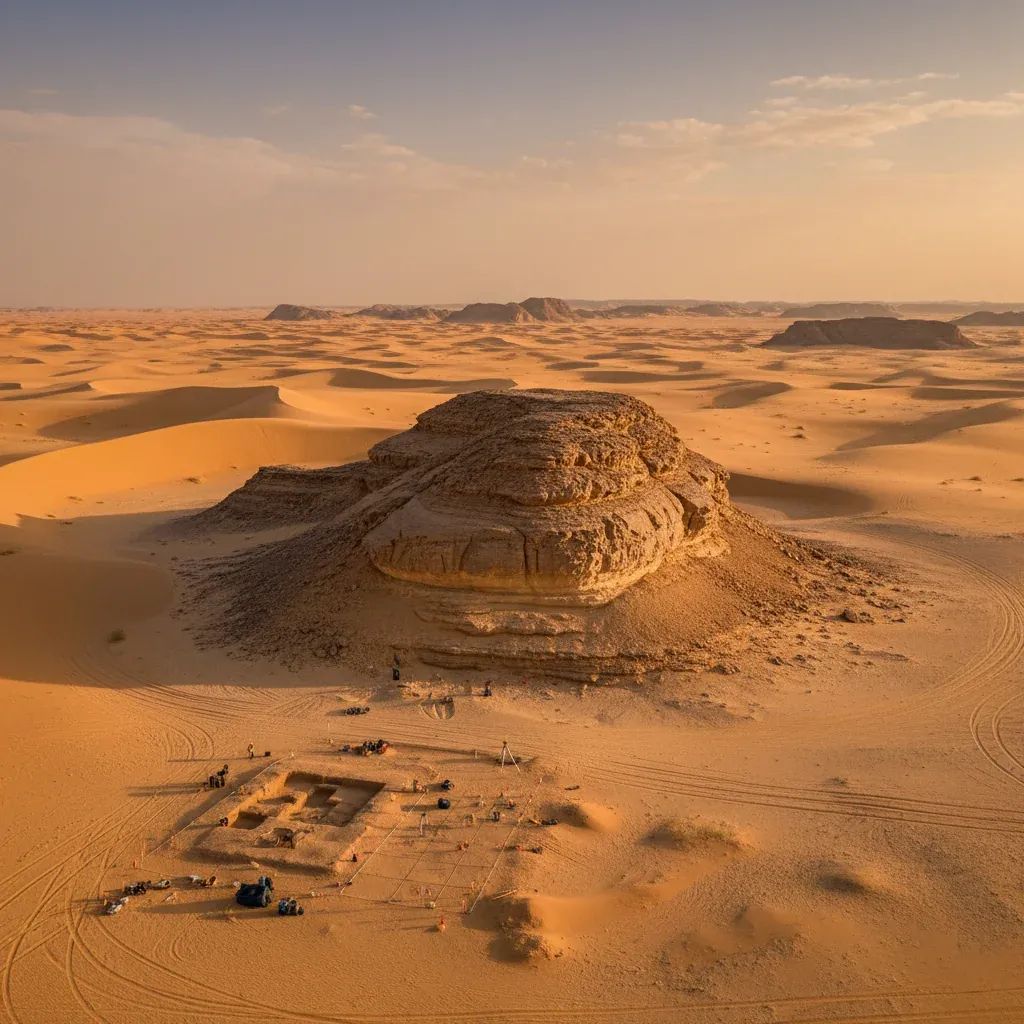
Sharjah's ancient landscape holds the archaeological equivalent of a time capsule spanning over 200,000 years of human habitation—and that discovery is reshaping how researchers understand our species' first ventures beyond Africa. The Al Faya Palaeolandscape, inscribed on the UNESCO World Heritage List in July 2025, presents unbroken geological and cultural evidence stretching back roughly over 200,000 years. For people living in the United Arab Emirates, this recognition matters not merely as a source of regional pride, but as a catalyst for scientific investment, tourism infrastructure, and a fundamental rewriting of the Arabian Peninsula's place in human prehistory.
Why This Matters
• AED 2 million funding cycle: The Sharjah Archaeology Authority is distributing competitive research grants through 2028, attracting international academic teams and supporting specialized heritage conservation jobs across the UAE.
• First desert Paleolithic World Heritage Site: Al Faya holds the distinction of being the inaugural Paleolithic site designated specifically for its desert cultural landscape, cementing the Arabian Peninsula's role as central—not peripheral—to human migration science.
• Continuous occupation model: Rather than documenting isolated moments in deep time, Al Faya demonstrates that early human populations returned repeatedly to the same desert region across 125,000-year intervals, fundamentally altering migration theory.
• International heritage recognition: Recognition on the UNESCO World Heritage List amplifies the UAE's soft power on global heritage conversations and positions Sharjah as a legitimate scientific hub rather than merely a custodian of artifacts.
Rewriting the "Uninhabitable Desert" Narrative
For decades, a prevailing assumption dominated Paleolithic archaeology: the Arabian Peninsula underwent a climatic collapse roughly 60,000 years ago when the last glacial maximum intensified, creating hyper-arid conditions that rendered the region essentially abandoned until climates stabilized around 12,000 years ago. Populations, scholars reasoned, either evacuated or perished.
That assumption crumbled when researchers excavated evidence at Al Faya showing human occupation at multiple distinct temporal horizons spanning over 200,000 years. According to research published in March 2026, findings reveal human presence at approximately 125,000, 59,000, 35,000, and 16,000 years ago. The implications are startling. People didn't flee when the desert intensified. They adapted, returned, adapted again, and stayed put across entire climatic cycles.
Excavations yielded approximately 650 and 6,000 stone tools at different sites. But the more revealing discovery came from one excavation area: researchers recovered animal bones, human skeletal remains from three individuals, and evidence of deliberate cremation—a funerary practice documented nowhere else in Arabian Peninsula archaeology. The existence of cremation ritual implies communities stable enough, organized enough, and culturally sophisticated enough to invest labor in mourning ceremonies. These weren't desperate nomads passing through; they were establishing social structures, spiritual frameworks, and collective identity.
The Stone Tool Blueprint Connecting Africa to Arabia
Archaeologists read ancient human behavior largely through stone tools, and Al Faya's most telling implements date to roughly 125,000 years ago. Researchers identified a distinctive collection of tools, and when compared against tool traditions from northeast Africa and Sudan, the technological parallels proved unmistakable. These weren't independent innovations; they reflected shared methods, shared knowledge, shared origin.
This discovery underpins the southern dispersal hypothesis—the theory that modern humans didn't merely drift passively into the Arabian Peninsula but carried African cultural practices across the Red Sea during humid climate windows. These migrations likely occurred during "Green Arabia" periods, when monsoon rains temporarily transformed the hyperarid landscape into a mosaic of lakes, grasslands, and game. Yet the archaeological record shows these weren't one-way journeys. Humans came back repeatedly—over tens of thousands of years—suggesting not exploration but deliberate return, implying knowledge of routes, seasonal patterns, and resource availability.
The multiple distinct geological layers preserved at Al Faya function as a vertical archive. Each layer represents a different temporal epoch, from the Paleolithic through Neolithic periods. Researchers can literally excavate downward through deep time, observing how tool technologies evolved, how settlement strategies shifted in response to climate pulses, and how human resilience manifested across environmental upheaval.
Placing Al Faya Within the Global Migration Puzzle
The broader context matters. Scientists now recognize multiple dispersal corridors and multiple human populations leaving Africa at different moments—not a single "Out of Africa" exodus but overlapping waves of departure and attempted settlement.
Misliya Cave in Israel holds the oldest directly dated Homo sapiens fossil outside Africa: an upper jawbone positioned at 177,000–194,000 years ago. This suggests an early northern route through the Levant. Yet Al Faya's stone tool evidence and human occupation traces point to an earlier southern route across the Bab-el-Mandeb strait into the Arabian Peninsula. Both pathways apparently operated simultaneously or near-simultaneously during the Late Pleistocene.
Oman's Dhofar Mountains contain over 100 archaeological sites bearing "Nubian Middle Stone Age" tools—an African tradition dated to 109,000–95,000 years ago. Al Wusta in Saudi Arabia provides the oldest directly dated Homo sapiens fossil outside Africa and the Levant, fixed at 95,000–86,000 years ago, confirming that modern humans penetrated deep interior Arabia. Meanwhile, Jubbah in the Nefud Desert reveals multiple migration pulses at 400,000, 300,000, 200,000, 130,000–75,000, and 55,000 years ago—a pattern suggesting humans tested Arabian habitation repeatedly across half a million years, succeeding or abandoning settlement in response to climate shifts.
Al Faya's exceptional strength lies in its compressed, densely documented temporal sequence spanning over 200,000 years. Compare it to Klasies River Caves in South Africa, which documents roughly 125,000 years of occupation—a benchmark site in early modern human archaeology. Omo Kibish in Ethiopia extends back approximately 230,000 years. Al Faya, with its unbroken span of over 200,000 years concentrated in a single geographic footprint, rivals these African reference sites while offering something unique: evidence of human persistence and adaptation within a desert context—an environmental challenge largely absent from other major Paleolithic benchmarks.
The Research Infrastructure Taking Shape
In January 2026, the Government of Sharjah formally launched the Faya Research Grant, allocating AED 2 million across 2026–2028. Six one-year research awards of up to AED 100,000 each—two projects funded annually—target archaeology, palaeoenvironmental studies, digital heritage modeling, and conservation initiatives. Applications receive evaluation by the Faya World Heritage Property Scientific Committee, ensuring that funded research advances Al Faya's UNESCO-designated "Outstanding Universal Value."
The first application cycle closed on March 31, 2026, with details published at jebelfaya.ae/faya-research-grant/. Funded teams gain exclusive site access, collaboration with Sharjah Archaeology Authority staff, and international visibility—a compelling incentive that attracts leading researchers from universities and research institutions across Europe, Asia, and North America.
For the United Arab Emirates economy, these grants catalyze secondary effects extending well beyond academic prestige. International research teams require accommodation, meals, transportation, and logistical support—expenditures that flow through Sharjah's hospitality sector. Universities hosting visiting scholars sponsor seminars and symposia. Specialized heritage conservation creates employment in digital modeling, archival work, and site management. Published research draws academic networks and cultural tourism toward Sharjah, positioning the Emirate as a destination for heritage education and scientific tourism.
Simultaneously, in April 2026, the Government of Sharjah advanced a comprehensive governance framework for the Al Faya World Heritage Property. This policy balances preservation with sustainable, managed development—a delicate calibration necessary in a rapidly urbanizing nation. Without such safeguards, heritage sites face pressure from sprawl, infrastructure projects, and haphazard construction. Sharjah's proactive framework demonstrates that cultural conservation and economic growth aren't mutually exclusive; they can reinforce each other when designed intentionally.
Visiting Al Faya: Access for UAE Residents and Visitors
For people living in and visiting the United Arab Emirates, Al Faya offers a tangible connection to humanity's deepest past. The Sharjah Archaeology Authority manages public access to designated viewing areas and maintains a heritage information center providing interpretive materials about the site's significance. Residents interested in visiting should contact the Sharjah Archaeology Authority through official channels or check jebelfaya.ae for current access procedures, guided tour schedules, and interpretive programming. While active excavations continue in restricted research zones, designated public spaces allow residents to experience the landscape and learn about the archaeological work reshaping our understanding of human migration.
The Broader Heritage Economy Context
The Arab region hosts 97 UNESCO World Heritage Sites, concentrated across 22 countries. Globally, the United Nations Educational, Scientific and Cultural Organisation maintains over 1,100 designated sites. These properties anchor regional identity, attract investment, and function as anchors for a heritage sector generating an estimated 370 million jobs worldwide while contributing approximately 10% of global GDP. Al Faya's inscription on the UNESCO World Heritage List amplifies the UAE's cultural standing on the global heritage platform and enhances diplomatic soft power.
The site overturns the historical narrative that positioned the Arabian Peninsula as peripheral to human development—a mere corridor through which populations passed en route to Asia. Instead, Al Faya demonstrates that the desert was a central stage where our ancestors innovated, adapted, survived environmental catastrophe, and built social structures. The region wasn't empty; it was inhabited with intention and sophistication.
What Happens Next
The Sharjah Archaeology Authority continues expanding excavations using advanced technologies including optically stimulated luminescence dating, DNA analysis, and three-dimensional heritage modeling. International research grants began funding fieldwork and collections analysis in 2026, with projects launching across the calendar year. These efforts ensure that Al Faya remains both scientifically productive—continuously generating new data that refines human migration models—and physically accessible for future generations, positioned as a living research landscape rather than a frozen museum artifact.
As the funding initiatives accelerate and international research teams arrive across 2026 and 2027, the United Arab Emirates is asserting itself not merely as a guardian of ancient heritage but as an active participant in reshaping global understanding of human origins, environmental resilience, and the complex dispersal pathways our species followed when first leaving Africa. For a nation often defined by its future-oriented development, claiming ownership of humanity's deepest past represents a powerful cultural statement.