
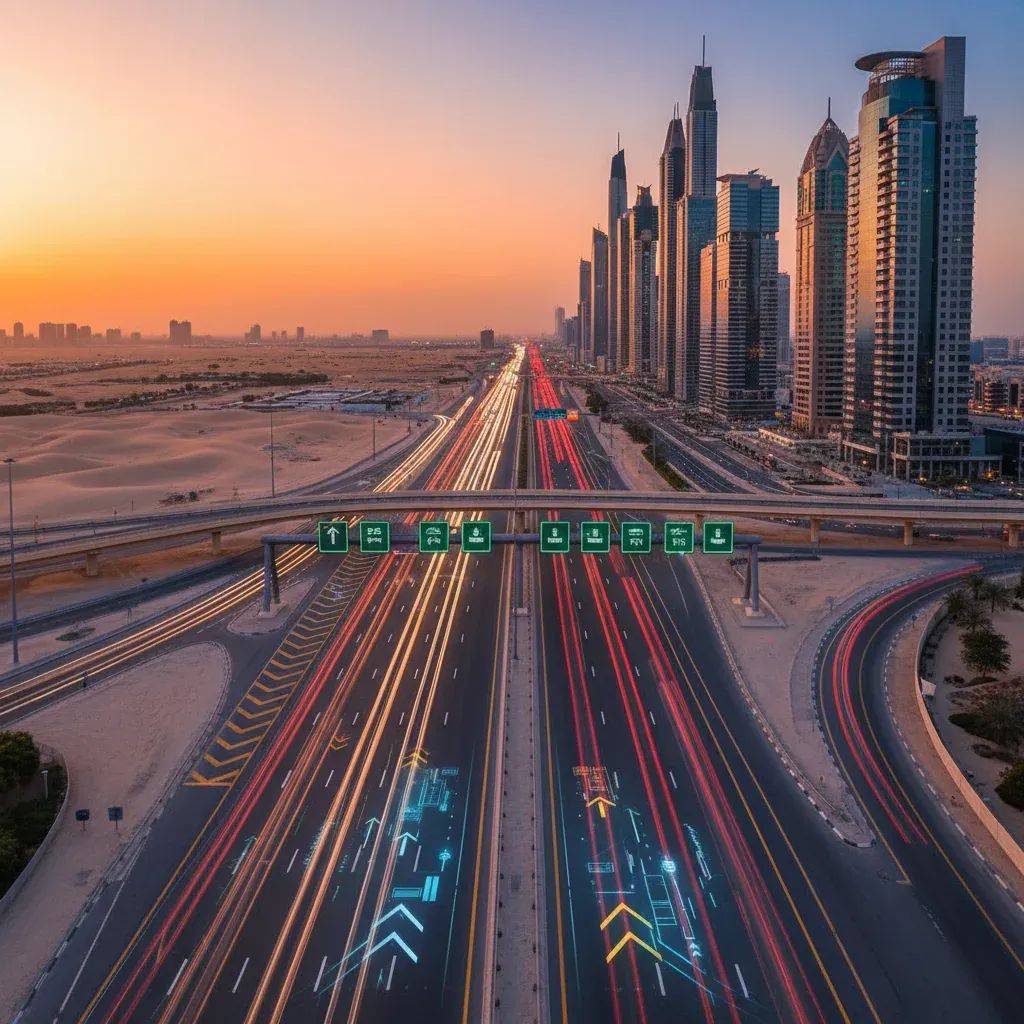
Dubai's Road Revolution: What a 96.65% Performance Score Actually Means for Your Commute
The Roads and Transport Authority of Dubai has quietly constructed one of the world's most responsive road networks—and unlike many headline-grabbing infrastructure projects, this one delivers tangible results measured in saved minutes, fuel savings, and avoided traffic jams. The emirate's road quality score of 96.65% reflects a fundamental shift: from repairing roads after they fail to predicting failure before it happens.
Why This Matters
• Daily commute savings: Following implementation of integrated smart systems beginning in 2025, residents are experiencing significantly reduced time stuck in traffic, translating directly to lower fuel costs and reclaimed personal time.
• Money in motion: Between 2006 and 2023, Dubai's transport improvements generated AED 262 billion in economic value—nearly double the AED 140 billion poured into roads during that period.
• Safety gains: Traffic deaths have declined significantly since 2007, a consequence of early detection systems catching dangerous road conditions before they become accident sites.
• Strategic positioning: For businesses, logistics providers, and investors, Dubai's infrastructure reliability has become a competitive asset.
The Technology Behind the Numbers
Driving through Dubai's streets, you see nothing unusual. That's precisely the point. Beneath the asphalt lies a dense network of laser sensors, ground-penetrating radar, and mathematical algorithms that work 24/7 without slowing traffic. The Roads and Transport Authority uses laser-based crack detection systems to scan road surfaces at highway speeds, capturing microscopic damage invisible to the human eye. These machines calculate the International Roughness Index (IRI)—a measure of surface irregularity—and feed data into the Pavement Management System (PMS).
The PMS doesn't wait for a pothole to form. It predicts which road sections will deteriorate within the next three to six months and schedules targeted repairs before degradation cascades. This approach has extended road lifespan by an estimated 40% and reduced emergency repair costs significantly. LiDAR technology complements this by creating hyper-accurate 3D maps of Dubai's entire road network, enabling maintenance teams to pinpoint work with surgical precision.
Consider the practical impact: inspection time that once required road closures or lane reductions has dropped by 400% in efficiency through aerial laser technology. Drones equipped with artificial intelligence now monitor construction sites in real time, ensuring contractors meet pavement specifications and deadlines. This dual oversight has nearly eliminated costly project delays and quality disputes.
Traffic Flow: The Optimization Engine
Smooth roads matter little if congestion defeats their purpose. Dubai's iTraffic system analyzes real-time traffic patterns across the emirate and pushes live recommendations to smart signage—essentially showing drivers alternate routes or adjusted speeds before they encounter a bottleneck. But the real sophistication lies in the traffic signals themselves.
The UTC-UX Fusion system, deployed in large-scale rollout beginning in 2025, uses artificial intelligence to dynamically adjust signal timing at 300 major intersections. Rather than following static, pre-programmed cycles, each signal responds to live traffic volume, creating coordinated "green waves" that allow vehicles to flow without stopping. Early trials recorded a 37% boost in traffic flow at key junctions and reduced average travel times by 10% to 20% at those specific locations.
How does this work without gridlock? The Roads and Transport Authority runs a digital twin simulation—a virtual replica of Dubai's entire street network fed by thousands of embedded sensors. Engineers test signal adjustments in this digital environment before deploying them to actual intersections. The simulation can model the impact of a closed lane, a blocked intersection, or a major event weeks in advance, enabling proactive rather than reactive management.
The AI Traffic Lab, operational since 2025, takes this further by forecasting congestion around events, construction zones, and peak periods. The Roads and Transport Authority can position resources, adjust signal timing, or recommend rerouting before demand surges, helping smooth traffic flow management during peak times.
The Data Advantage
None of this would function without massive information infrastructure. The Roads and Transport Authority's Big Data Platform, launched in 2017 and now managing over 670 terabytes of transport data, grows at 30% annually. This isn't just road information—the platform integrates traffic signals, public transit schedules, parking availability, and emergency response coordination into a unified system.
The 5Vs framework of big data—volume, velocity, variety, veracity, and value—guides how Dubai deploys this information. Volume covers millions of daily sensor readings. Velocity means processing that data in milliseconds. Variety refers to diverse data types: video feeds, GPS signals, weather conditions, event calendars. Veracity ensures accuracy through multi-source validation. Value is the outcome: decisions that reduce congestion, extend infrastructure life, and improve safety.
When the Roads and Transport Authority identified that the Al Mustaqbal Street intersection was generating eight-minute average travel times, data analysis showed the problem wasn't capacity but signal timing coordination. Resequencing signals cut wait times to 3.5 minutes—a 56% reduction achieved without new construction or lane expansion.
The Economic Case
Investors and residents alike recognize that quality infrastructure strengthens a city's financial standing. Dubai's road network contributes significantly to the emirate's economy through improved logistics, reduced downtime, and attraction of businesses seeking reliable infrastructure. Companies handling freight see tangible benefits: faster transit times mean lower warehousing costs, quicker customer delivery, and reduced fuel burn.
The Benefit-Cost Ratio for recent road investments is projected to reach AED 8.8 for every dirham spent by 2030—meaning government returns from tax revenue and business activity generation substantially exceed the capital invested. For comparison, most infrastructure projects consider a BCR above 1.5 economically justified; Dubai's approaching 6 indicates exceptional value.
Environmental Wins
Smoother traffic flows mean less stop-and-start driving, which translates to reduced fuel consumption and emissions. Dubai's integrated road and traffic optimization system has avoided approximately 9.5 million tonnes of CO₂ emissions by eliminating idle time and unnecessary acceleration cycles. The iTraffic system's green-wave optimization further cuts emissions by guiding vehicles through coordinated signal sequences that maintain momentum.
The Roads and Transport Authority's Artificial Intelligence Strategy 2030, announced during Dubai AI Week, explicitly targets a 20% to 30% reduction in travel times and 25% to 40% productivity gain through AI-driven tools. These efficiency improvements directly support Dubai's broader environmental commitments under the Dubai 2040 Urban Master Plan.
Vehicle-to-Everything (V2X) technology represents the next phase. The Roads and Transport Authority plans to expand direct communication between traffic signals and compatible vehicles at signalized intersections, transmitting live signal information, optimal speeds for continuous flow, and instant safety alerts. This technology will transmit precise green light timings and optimal speeds to help vehicles maintain continuous flow. Implementation is targeted for the coming years as infrastructure and compatible vehicle adoption expand. Drivers will no longer guess whether to accelerate through yellow lights or brake hard—the signal tells them the precise speed to reach the next green light. This eliminates unnecessary acceleration and emergency braking, cutting emissions further.
Real Infrastructure Investments Underway
The road management system exists within a broader capital investment program. In January 2026, the Roads and Transport Authority launched six major projects, including expansion of Al Warqa'a 1 Street with smart signalized intersections that immediately delivered a 30% improvement in peak-hour traffic flow. Upgrades to Umm Suqeim Street, Al Wasl Road, and Al Safa Street are underway to boost capacity and reduce travel times across high-density commercial and residential zones.
The Roads and Transport Authority completed 67 rapid traffic improvement measures in 2025 alone and has scheduled over 45 additional interventions for 2026, targeting intersections, residential and commercial access points, and school zones. These aren't grandiose ribbon-cutting projects—they're surgical improvements identified by data analysis as delivering maximum congestion relief per dirham invested.
Measuring Against Global Standards
Dubai's 96.65% road quality score uses an internal performance metric centered on maintenance responsiveness and surface condition. This represents Dubai's own measurement framework and is distinct from international comparison scales. International comparisons use different frameworks. The World Economic Forum's Quality of Road Infrastructure (QRI) score, rated on a scale of 1 to 7, places the United Arab Emirates at 5.92. This puts the nation fourth globally for road quality, behind Singapore (approximately 6.45), Hong Kong (second), and Japan (third). Countries like Switzerland (6.36), the Netherlands (6.18), and Portugal (6.05) also rank ahead.
It's important to note that Dubai's internal 96.65% metric and the WEF's QRI scale operate on different measurement systems and are not directly comparable—the internal score focuses on maintenance performance and responsiveness, while QRI is a broader international infrastructure quality assessment.
However, Dubai's achievement is particularly notable given the extreme desert climate. Sustained heat above 50°C accelerates asphalt oxidation and degradation, making predictive maintenance more critical than in temperate zones. The laser and IRI monitoring systems were specifically calibrated for Gulf conditions, where pavement lifespan without proactive intervention is shorter than in moderate climates.
Challenges to Scaling the Model
Dubai's success reveals why AI-driven road management hasn't spread globally. Most cities face infrastructure gaps—their sensor networks don't exist or integrate poorly with legacy systems. Data fragmentation and proprietary restrictions prevent unified, interoperable systems. Initial costs run into hundreds of millions of dirhams, a barrier for smaller municipalities. Technical expertise is scarce; fewer than a handful of engineers worldwide can manage digital twin platforms and AI traffic optimization at scale.
Privacy concerns and cybersecurity risks remain contentious. Systems that process real-time vehicle locations and driving patterns invite surveillance questions. Dubai's approach requires robust data governance, transparent policies on data use, and strong encryption—protections many cities struggle to implement or fund.
Additionally, AI models experience "drift" as traffic patterns shift and new conditions emerge. Continuous retraining and algorithm updates are necessary to maintain performance. The computational power required for these operations carries an environmental cost, though typically offset by emissions reductions from optimized traffic flow.
What Comes Next
Dubai's next frontier involves air taxi integration, targeted for future rollout. The Roads and Transport Authority is simultaneously advancing the "20-minute city" concept, aiming for 80% of daily services accessible within a 20-minute journey by walking, cycling, or micro-mobility. This requires smart pedestrian signals, improved walking infrastructure, and integrated micro-mobility lanes. A smart robot is already being trialed to monitor violations involving e-scooters and similar devices, ensuring safe coexistence with pedestrians and vehicles.
The Roads and Transport Authority's 81-project AI strategy extends beyond traffic signals into autonomous vehicle integration, predictive emergency response routing, and emissions monitoring. By 2030, Dubai's transport network may function as a nearly autonomous system—individual drivers still navigate, but infrastructure continuously optimizes flow, predicts hazards, and adapts to changing demand in real time.
For residents, this means longer-term reliability and improved commute predictability. Fuel costs should decline proportionally with reduced congestion, and road safety should continue improving through early detection systems. For investors, it reinforces Dubai's positioning as a logistics hub with world-class infrastructure. For the environment, it demonstrates that urban growth and emissions reduction aren't opposing forces when intelligent systems guide the flow of humanity and commerce.


