
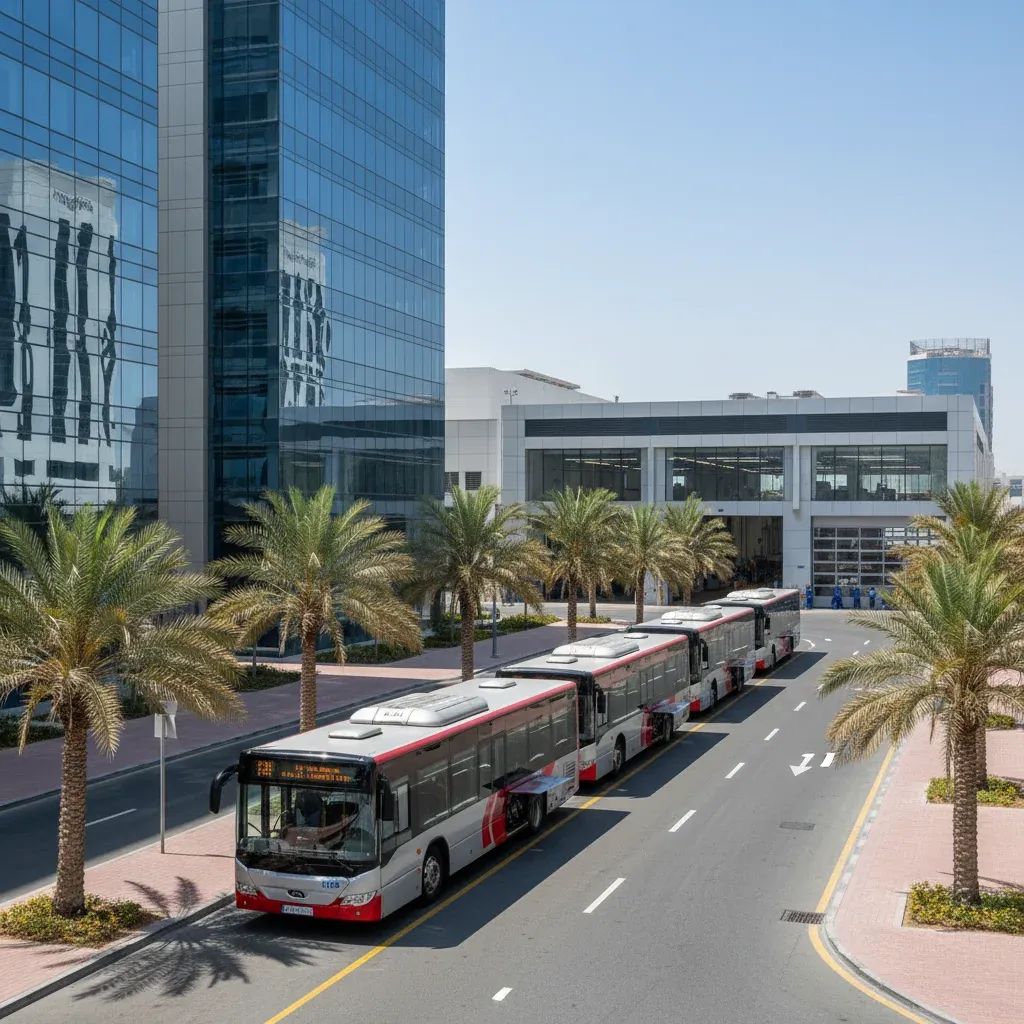
The Roads and Transport Authority of Dubai has set what it claims is a global benchmark for public transit durability, with buses in its fleet surpassing 2 million kilometers of operational distance each—a threshold no other major city has reportedly reached. The achievement, announced today, positions the emirate's public bus network as among the world's longest-serving in active duty, with vehicles remaining in service for over 18 years while maintaining what the RTA describes as "high operational efficiency."
Why This Matters
• Cost savings: Extending bus life defers the need for fleet replacement, potentially saving the UAE government hundreds of millions in capital expenditure.
• Environmental impact: Longer vehicle lifespans reduce manufacturing waste and emissions tied to production and disposal, aligning with Dubai's circular economy targets.
• Service reliability: In 2025, the RTA's buses recorded an availability rate above 93%, meaning fewer breakdowns and more predictable commutes for residents and workers.
• Regional leadership: The claim—if verified—sets a new operational standard for the Gulf region and positions Dubai as a transit management model for developing economies.
How Dubai's Buses Compare Globally
The RTA's announcement includes comparative figures that underscore the scale of the achievement. According to the authority, London's bus fleet typically reaches 1.3 million kilometers per vehicle, while Singapore's buses average around 1.4 million kilometers before retirement. Dubai's fleet has now exceeded both by a margin of 600,000 to 700,000 kilometers—roughly equivalent to circling the Earth 15 to 17 times per bus.
For context, a standard city bus in Europe or North America is often retired after 800,000 to 1 million kilometers, or around 12 to 15 years of service. Dubai's buses have been running for nearly double that lifespan while still meeting operational benchmarks.
The RTA attributes this to what it calls a "precision maintenance culture"—a combination of preventive care, real-time diagnostics, and aggressive component replacement schedules designed to catch wear before it triggers breakdowns. The authority reports that its buses logged an "exceptionally low fault rate" in 2025 compared to global peers, though it did not release specific failure metrics or comparative data.
What This Means for Residents and Commuters
For the 3.7 million residents and workers who rely on Dubai's public transport network, the extended bus lifespan translates into fewer service disruptions and more stable routes. High availability rates mean buses are less likely to be pulled from service for repairs during peak hours, a common frustration in transit systems where aging fleets lead to schedule gaps.
The financial implications are also significant. By deferring the purchase of replacement buses, the Dubai government avoids capital outlays that can run into the hundreds of millions of dirhams. A single 12-meter city bus can cost between AED 700,000 and AED 1.2 million depending on specifications. Extending the life of a 1,500-bus fleet by even a few years could save upward of AED 1 billion—funds that can be redirected toward route expansion, fare subsidies, or other infrastructure priorities.
From an environmental standpoint, the achievement aligns with the UAE's National Circular Economy Strategy, which aims to reduce waste by 75% by 2030. Manufacturing a single bus generates roughly 40 to 50 metric tons of CO₂ when raw materials, production, and shipping are factored in. Keeping buses in service longer reduces the need for new units and the emissions tied to their production.
The Mechanics Behind the Milestone
While the RTA has not publicly detailed the proprietary maintenance technologies it employs, industry observers point to several likely factors. Preventive maintenance—servicing components on a fixed schedule rather than waiting for failure—is standard practice in high-performing transit systems. Dubai likely goes further by using predictive analytics, where sensors monitor engine performance, brake wear, and fluid levels in real time, flagging issues before they escalate.
Component refurbishment and remanufacturing also play a role. Instead of scrapping buses when engines or transmissions wear out, the RTA appears to be overhauling and reinstalling certified parts—a strategy that extends vehicle life while maintaining safety and performance standards.
Climate may also be a factor. Dubai's hot, dry environment—while harsh on air conditioning systems—eliminates the road salt and moisture that accelerates corrosion in colder climates. This could give the emirate's buses a structural advantage over fleets in London or Singapore, where humidity and salt exposure degrade metal and electronics faster.
Strategic Implications for Dubai's Transit Future
The record comes at a time when Dubai is rapidly expanding its public transport footprint. The Dubai Metro now carries over 200 million passengers annually, and the RTA has committed to increasing the share of public and shared transport trips to 26% by 2030, up from around 18% in 2023.
Extending bus lifespans allows the authority to scale service without proportionally scaling capital budgets. It also sends a signal to investors and manufacturers: Dubai is serious about lifecycle cost optimization, not just upfront procurement savings. This could influence how contracts are structured in future fleet tenders, with greater weight given to durability and maintenance support rather than initial purchase price alone.
The achievement also has reputational value. For a city that markets itself as a global hub for smart infrastructure and innovation, setting a transit record reinforces that narrative. It positions Dubai as a case study for other rapidly growing cities in the Middle East, Asia, and Africa seeking to build resilient, cost-effective public transport networks.
What Remains Unclear
The RTA's announcement, while impressive, leaves several questions unanswered. The authority has not disclosed how many buses have surpassed the 2 million kilometer mark, whether the figure represents an average or a peak, or how the metric was independently verified. No third-party audit or international transit association has yet confirmed the claim.
Additionally, the comparison to London and Singapore lacks sourcing. While the 1.3 million and 1.4 million kilometer figures align with rough industry norms, neither Transport for London nor Singapore's Land Transport Authority publicly reports average lifetime distance per bus in a standardized format that would allow direct comparison.
Finally, the RTA has not specified whether the 18-year service life applies to the entire fleet or a subset of vehicles, nor has it clarified how many buses have been retired or replaced over that period.
These gaps do not invalidate the achievement but suggest that the full story is more nuanced than the headline figure implies. For now, the record stands as a testament to the operational discipline and financial pragmatism that have become hallmarks of Dubai's infrastructure strategy—even if the fine print remains under wraps.


