
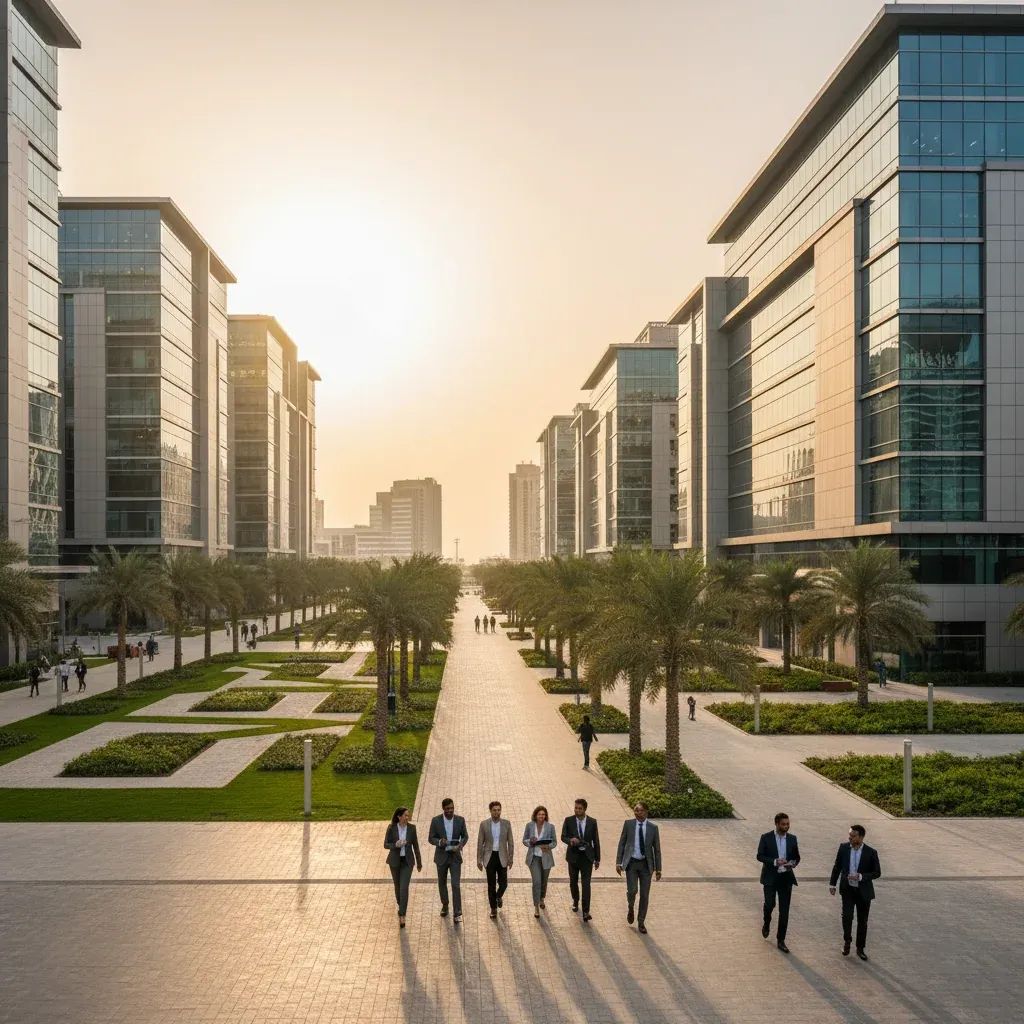
For the better part of a decade, Dubai South has quietly built itself into one of the region's most significant logistics and aviation hubs, yet it remains largely overshadowed by the more glamorous Dubai Marina and Downtown developments. That narrative shifted slightly this month when the sprawling free zone authority announced a sweeping financial relief program for the small and medium-sized enterprises that form the backbone of its Business Park operations. The intervention—rent freezes, deferred payment windows, and waived administrative charges—reads as a straightforward business gesture. In reality, it reflects a calculated recognition that Dubai's commercial real estate market is entering more complex territory, and the companies occupying 46,500 square meters of office space within Dubai South's premises may need tactical support to ride out the volatility ahead.
Why This Matters
• Rent freezes and payment deferrals provide immediate cash flow protection for logistics, e-commerce, and technology firms facing compressed margins from rising operational costs.
• Waived administrative penalties eliminate a recurring cost drain for smaller operations managing tight working capital during economic uncertainty.
• The package extends through at least June 2026, creating a defined window for businesses to stabilize operations before broader market corrections potentially take hold.
• This initiative aligns with Dubai's AED 1 billion government relief program (active April 1–June 30, 2026), which layers fee deferrals, customs grace periods, and residency permit streamlining across the emirate.
The Rationale Behind the Relief
Dubai South functions as a compact, high-density ecosystem designed to capitalize on two geographic advantages: immediate proximity to Al Maktoum International Airport and seamless connectivity to Jebel Ali Port. This positioning has made it exceptionally attractive to companies in e-commerce, third-party logistics, light manufacturing, and aviation support services. The development welcomed 653 new businesses in 2025 alone, bringing its total active roster to just over 4,200 companies. Commercial licensing surged 65% year-over-year, and office leasing climbed 300% in 2024 compared to the prior year.
Yet growth and pressure often coexist. Warehouse and industrial rents across the broader Dubai market climbed 19.9% in the second quarter of 2025, driven by constrained supply in logistics-heavy districts. At the same time, new office construction across Dubai is accelerating, with supply expected to weigh on rental rates later in 2026. Companies that might have tolerated slightly higher rents during the boom phase are now calculating whether to stay, relocate, or consolidate operations. Dubai South's tenant retention rate held at 90% through 2025, which suggests relative resilience, but leadership clearly recognizes that margin is tightening.
Nabil Al Kindi, Group CEO of Dubai South, framed the relief package as recognition of SMEs' role in diversification. The messaging emphasizes continuity and long-term partnership rather than crisis management—a careful tone that avoids alarming investors while signaling confidence in the zone's fundamentals.
What the Package Actually Covers
The relief initiative operates on four distinct pillars. First, businesses renewing leases qualify for rent-free periods tied to their renewal terms—a meaningful concession for companies managing quarterly or annual overhead reviews. Second, payment deferrals have been expanded, offering more flexibility for businesses that encounter seasonal cash flow dips or unexpected expense spikes. Third, the development waives minor administrative penalties—late fees, procedural charges, and other bureaucratic costs that individually seem modest but collectively drain working capital from startups and growth-stage enterprises. Fourth, rental rates remain frozen at current levels for eligible renewals, a hedge against the broader market pressures that might otherwise trigger landlord increases.
The package is not indefinite. Dubai South officials have committed to regular review and adjustment "based on evolving market dynamics," language that suggests measures may taper if commercial conditions stabilize or extend if pressure persists.
The Broader Support Ecosystem
Dubai South's relief package does not operate in isolation. It sits within a far larger constellation of assistance initiatives that the Dubai government and private sector have deployed throughout early 2026.
The headline measure is Dubai's AED 1 billion economic facilitation program, approved in March and effective through at least mid-2026. This city-wide initiative defers selected government fees, temporarily suspends the hotel sales fee and tourism dirham levy, and extends customs clearance grace periods from 30 to 90 days. The streamlining of residency permit issuance and renewal addresses another friction point for businesses managing large multinational workforces.
Beyond this, sector-specific programs have proliferated. Qashio, a corporate finance platform, partnered with Dubai Chambers in March 2026 to launch a relief initiative offering over AED 10 million in benefits. Eligible SMEs gain access to Qashio's platform without setup fees, receive payment deferral options, and earn loyalty points redeemable as Emirates Skywards Miles or cashback credits. Majid Al Futtaim's Ma'an program, which opened applications in April 2026, offers qualified UAE-based SMEs marketing and distribution exposure across the conglomerate's ecosystem—malls, cinemas, and Carrefour stores—plus access to over 10 million SHARE loyalty members.
The Mohammed Bin Rashid Establishment for Small and Medium Enterprises Development (Dubai SME) has structured its own multi-pronged approach. Its "Founders of Tomorrow" initiative, launched in February 2026 with partner INJAZ UAE, connects university students with business incubation, mentorship, and funding facilitation. The organization has publicly committed to facilitating the launch of 27,000 new Emirati businesses by 2033. On the financial side, Dubai Chambers signed memoranda of understanding with four fintech companies—Mamo, Qashio, Pemo, and Vault—to expand SME access to alternative banking products, corporate cards, and working capital solutions.
This layering of initiatives suggests both opportunity and underlying tension. The frequency and scope of relief measures indicate that policymakers perceive real cash flow and sustainability pressures among smaller enterprises. Simultaneously, the breadth of support demonstrates institutional confidence that these pressures are manageable and temporary rather than structural.
Sectoral Composition and Market Dynamics
The tenant roster within Dubai South Business Park reflects the zone's infrastructure advantages. Logistics, aviation, and e-commerce dominate, followed by technology, financial services, light manufacturing, education, and online gaming. The free zone framework—offering 100% foreign ownership, zero corporate and personal income tax, and unrestricted capital repatriation—attracts international enterprises seeking tax efficiency and regulatory simplicity.
The logistics segment has been particularly resilient. Prime logistics assets in Dubai South maintain near-full occupancy, driven by continuous e-commerce expansion and supply chain regionalization across the Middle East and North Africa. This sector benefits from the $35 billion expansion of Al Maktoum International Airport, positioned to become the world's largest aviation hub by capacity. However, resilience in one sector masks volatility in others. Office markets across Dubai are experiencing a supply shock. Prime office buildings maintain occupancy rates exceeding 95%, yet a surge of new construction is expected to depress pricing later in 2026. Some analysts project potential double-digit corrections—up to 15%—in certain segments if absorption slows.
Dubai South's commercial rents remain described as "very competitive" compared to established districts like Dubai Marina or Business Bay, a positioning that provides some cushion against correction. Yet competitiveness also signals a market reality: the zone is still building its brand and tenant base, which means its landlords have less pricing power than their counterparts in more established precincts.
The Tax Deadline Nobody's Discussing
One timing factor adds urgency to these support measures. The UAE's small business relief provision—which permits qualifying enterprises to pay 0% corporate tax on taxable income—expires December 31, 2026. After that date, standard rates take effect: 0% on the first AED 375,000 of taxable income, then 9% on amounts exceeding that threshold.
This creates a compressed window for SMEs to optimize their financial footing while tax relief remains in place. Companies that lock in stable rental rates, access deferred payment flexibility, and manage cash flow more effectively during this window have a better foundation when the corporate tax framework changes. For Dubai South, the relief package is partly a pre-emptive measure to ensure its SME tenant base doesn't deteriorate between now and year-end.
What Happens Next
Dubai South is projected to contribute over half a trillion dirhams annually to the UAE economy upon full completion and generate approximately 500,000 jobs. That ambition rests partly on successfully retaining and nurturing the current cohort of 4,200-plus businesses already operating within its boundaries.
The relief package signals institutional clarity about what comes next: a transition period in which growth stabilizes, supply-demand relationships rebalance, and businesses consolidate rather than expand rapidly. For tenants currently occupying space in the Business Park, the freeze on rates and expansion of payment flexibility provides a defined runway—roughly through mid-2026—to evaluate long-term positioning. Some will use this window to strengthen operations and commit to renewals. Others will use it to plan exits or consolidations.
Dubai South's willingness to absorb rental flexibility and waive penalties suggests confidence that this stabilization phase is temporary and that underlying demand fundamentals remain intact. Whether that confidence proves justified will become clearer over the next 12 months as the airport expansion accelerates, new commercial supply materializes across Dubai, and the broader regional economy navigates geopolitical and interest rate dynamics that remain fluid.
What is certain is that the relief program marks a pivot from the rapid-growth rhetoric of 2024–2025 toward a more defensive, relationship-focused posture aimed at protecting the ecosystem that has already been built.


