Dubai's Airport Reaches a Singular Milestone—And Confronts Its Constraints
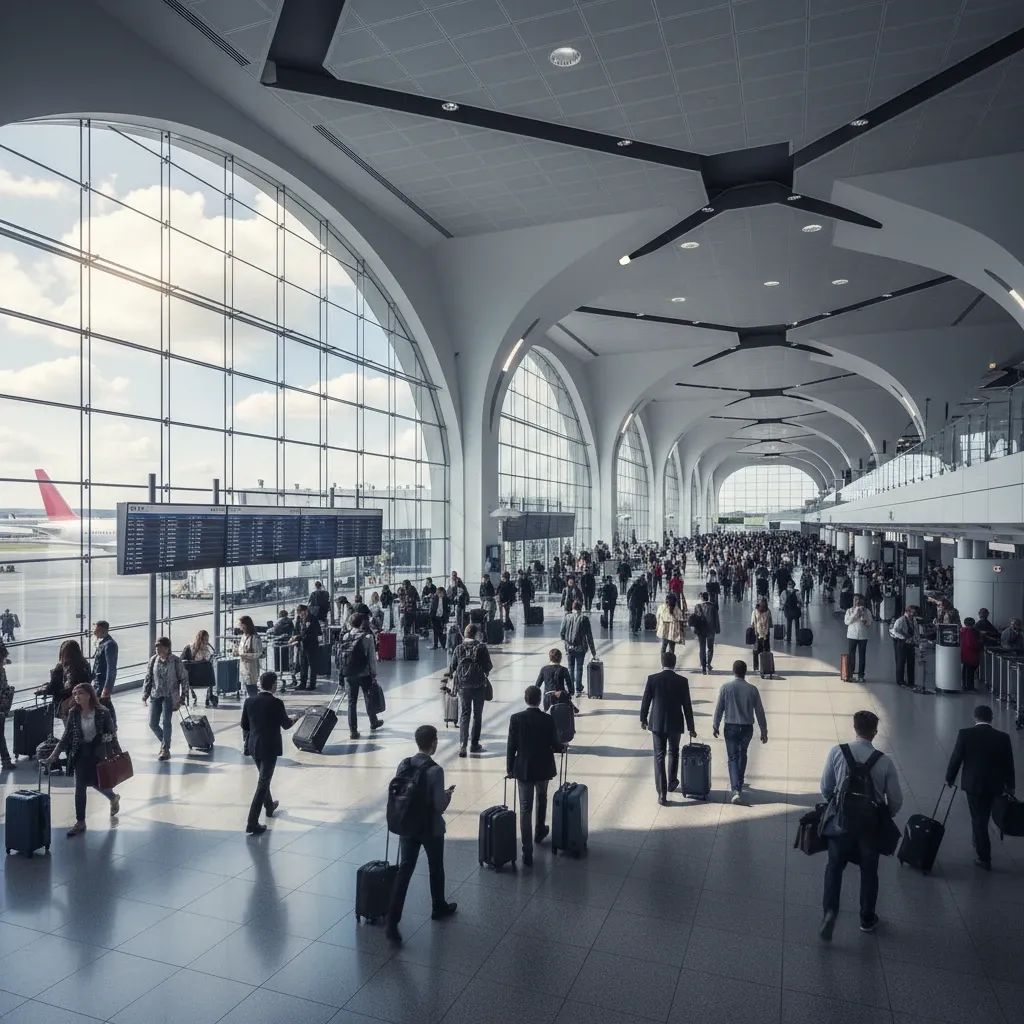
If you've noticed Dubai Airport getting more crowded in 2025, you're not imagining it. The facility just hit 95.2 million passengers—a new record that extends its reign as the world's busiest international hub to twelve consecutive years. Yet this achievement masks a harder reality: the airport has virtually run out of room to grow, and geopolitical tensions now threaten the seamless connectivity that made it dominant in the first place.
For residents and expats in the United Arab Emirates, this matters immediately. More passengers mean busier terminals. Airspace closures force longer flight times and higher ticket prices. But record demand also means more route options and lower fares on emerging market connections—if you know where to look.
Why This Matters for You:
• Capacity is now the constraint: DXB handled 95.2M passengers in 2025 (up 3.1% annually), but annual capacity maxes out at roughly 115M. Growth beyond that requires moving traffic to the new Al Maktoum International Airport, creating uncertainty through the 2030s. Expect longer queues and possible service changes at DXB as the transition approaches.
• The geopolitical tax: Airspace closures over Iran, Iraq, Syria, and Israel force persistent flight detours, adding 45–90 minutes to European-Asian routes, increasing crew costs, fuel burn, and insurance premiums. Airlines absorbed these costs in 2025; if regional tensions harden, expect higher ticket prices.
• Better connectivity on emerging routes: Growth markets—China (+16.6%), Russia (+6%), Egypt (+14.3%), Turkey (+6.7%)—mean new flight options to these destinations. For residents with family or business ties to these regions, fares are falling as carriers increase frequency.
The Numbers That Define Dominance
To understand what Dubai International Airport represents today, start with scale. In December 2025 alone, the airport processed 8.7 million passengers—a monthly volume that exceeds the annual tourism of many nations. Across the full year, 454,800 flight movements connected 291 destinations across 110 countries, served by 108 international carriers.
The competitive distance is staggering. London Heathrow, which ranks second globally in international passengers, handled 79.8 million travelers in 2025—a gap of 15.5 million passengers separating first from second. South Korea's Incheon landed third with 73.5 million, followed by Singapore at 69.4 million and Amsterdam at 67.8 million.
Dubai has achieved something no other airport has: it is simultaneously a destination airport, an origin airport, and—most critically—a transfer point of unmatched efficiency. For a European traveler reaching India or Southeast Asia, Dubai becomes the obvious waypoint. For an Asian business executive reaching Europe or Africa, Dubai offers the most convenient connection.
The airport processed 86.75 million bags in 2025, maintaining a 99.75% successful baggage handling rate—among the world's best. For business travelers managing tight connections or residents checking luggage to multiple destinations, this operational precision creates measurable value.
Why Geography Became Economics
Dubai's reign rests on a geographic fact: two-thirds of humanity sits within an 8-hour flight radius. This isn't marketing language; it's measurable reality that shapes routing economics for every global airline.
Emirates, the dominant carrier, recognized this early. The airline operates more than 150 routes to 80 countries and accounts for over 51% of all passenger traffic through the airport. Flydubai, the low-cost affiliate, fills secondary markets and price-sensitive segments. Together, these carriers create a network density that other hubs struggle to match.
For residents, this means abundant flight options and competitive pricing. A resident with flexible travel plans can often find cheaper routes through Dubai than direct flights elsewhere.
A Portrait of Recovering Demand
Passenger volumes now exceed 2019 pre-pandemic levels by 10.2%, confirming that post-COVID travel demand has fundamentally shifted upward.
India remains the largest origin, delivering 11.9 million passengers—roughly one-eighth of all traffic. But growth markets tell a different story. China posted 16.6% growth to reach 2.5 million passengers, driven by United Arab Emirates government visa-relaxation policies and China's domestic tourism recovery. Russia climbed 6% to 2.8 million, a remarkable feat given Western sanctions and airspace closures—testament to Dubai's positioning as a geopolitically neutral hub. Egypt surged 14.3% to 1.8 million, Italy jumped 12.5% to 1.6 million, and Turkey expanded 6.7% to 2.2 million.
The traditional markets—Saudi Arabia (7.5M), United Kingdom (6.3M), Pakistan (4.3M), United States (3.3M)—provide volume stability.
London remained the busiest destination city with 3.9 million passengers, trailed by Riyadh, Mumbai, and Delhi.
The Infrastructure Squeeze: What's Coming Next
Dubai International Airport now operates with virtually no spare capacity. With annual throughput capped at approximately 115 million passengers, and actual 2025 traffic at 95.2 million, the margin for further growth is roughly 20 million annual passengers—a buffer that could absorb only 2–3 more years of 3% growth before saturation.
The United Arab Emirates government has acknowledged this reality through Al Maktoum International Airport (DWC), undergoing a $35 billion expansion designed to eventually accommodate 260 million annual passengers. The project includes five parallel runways, approximately 400 gates, and integration with Dubai Metro's Blue Line expansion and Etihad Rail.
Operational transfer is planned for the early 2030s, creating a transitional decade of uncertainty for residents and businesses. Airlines will hedge commitments across both facilities. Gate allocation will shift gradually. For travelers, expect service adjustments, new terminal layouts, and possible congestion during the transition.
Competitors Mobilizing Globally
Dubai's dominance has not gone unnoticed. Across every major continent, competitors are investing billions to capture market share within the next decade.
Singapore's Changi Airport broke ground on Terminal 5 in early 2025, with capacity projections rising from 90 million to 140 million passengers by the mid-2030s, alongside a third runway extension. Istanbul Airport is constructing a fourth main runway (completion targeted for August 2026) and planning expansions to reach 120 million passengers within ten years. London Heathrow allocated £1.3 billion for 2026 alone on terminal upgrades.
For residents, this competition is beneficial. More hub capacity globally means alternative route options and lower fares as airlines diversify away from single hubs.
Doha's Hamad International Airport completed expansion in March 2025 with new concourses, lifting capacity to over 65 million passengers annually—a direct competitive response within the United Arab Emirates region.
Geopolitical Risk: The Real Constraint
The broader context shaping Dubai's future is geopolitical, not physical. Permanent airspace closures now span Iran, Iraq, Syria, and portions of Israel, forcing all Europe-Asia traffic onto detour routes. A direct flight from London to Bangalore that historically required 10 hours now requires detours adding 45–90 additional minutes.
Airlines absorb the fuel cost premium, crew hour extensions, and elevated insurance premiums for operating in restricted zones. These costs remain manageable when isolated. But if geopolitical instability expands, long-haul routing economics shift. Airlines may establish secondary hubs in Istanbul, Singapore, or Bangkok to minimize exposure to Gulf risks.
For residents, this means:
• Flight delays: Regional tensions can trigger unexpected schedule disruptions
• Higher airfares: Fuel surcharges and insurance costs may be passed to passengers
• Travel uncertainty: Booking flexibility becomes more valuable when airspace restrictions can shift rapidly
Paul Griffiths, CEO of Dubai Airports, noted that markets affected by regional tension represent less than 2% of total traffic. Growth in China, Russia, Turkey, and Egypt has offset political headwinds. Yet the statement underscores fragility: if political disruptions expanded to regions representing 10% of traffic, the buffer vanishes instantly.
What This Means for Your Travel Plans
Dubai's record performance translates into practical benefits. More flight options mean lower fares. Carriers diversifying into secondary routes—particularly budget airlines capturing emerging markets—mean you're no longer funneled through a single hub to reach smaller cities across South Asia, North Africa, or Southeast Asia.
The tourism momentum—19.6 million international visitors in 2025, a 5% annual increase—drives pricing competition in hospitality and transport, benefiting residents and visitors. The airport's 99.75% baggage handling success rate reduces stress for tight connections.
However, operational uncertainty is rising. Residents planning travel should:
• Monitor regional tensions: Iran-U.S. dynamics and Israeli conflicts directly impact flight schedules
• Build flexibility into bookings: Allow extra connection time given airspace detours
• Consider timing carefully: Off-peak seasons mean smoother operations and lower fees
The transition to Al Maktoum International (DWC) in the early 2030s will create another layer of uncertainty: gate availability shifts, new procedures, potential service gaps. Residents should expect operational friction during that period and may benefit from flexibility in booking.
The Decade Ahead: Dominance Tested
Dubai Airports forecasts 99.5 million passengers for 2026, with expectations to breach the 100 million milestone by year-end—a threshold no international airport has previously reached in a single calendar year.
Dubai has engineered unmatched connectivity, operational precision, and geographic centrality. Yet capacity constraints, rising geopolitical risks, and ambitious competition from Singapore, Istanbul, and London threaten to fragment the market.
The $35 billion investment in Al Maktoum International represents a bet that Dubai can scale its success to triple capacity while maintaining operational quality. Whether Dubai Airports becomes an exception or struggles through transition will define regional aviation through the 2040s—and your travel experience as a resident through the next five years.
For people living in the United Arab Emirates, the next decade demands attention. Today's advantages persist. Geopolitical exposure and capacity friction may test them tomorrow. Booked soon, you'll benefit from current connectivity and pricing. Delayed, you may face higher costs and operational uncertainty during the transition to new infrastructure. Plan accordingly.