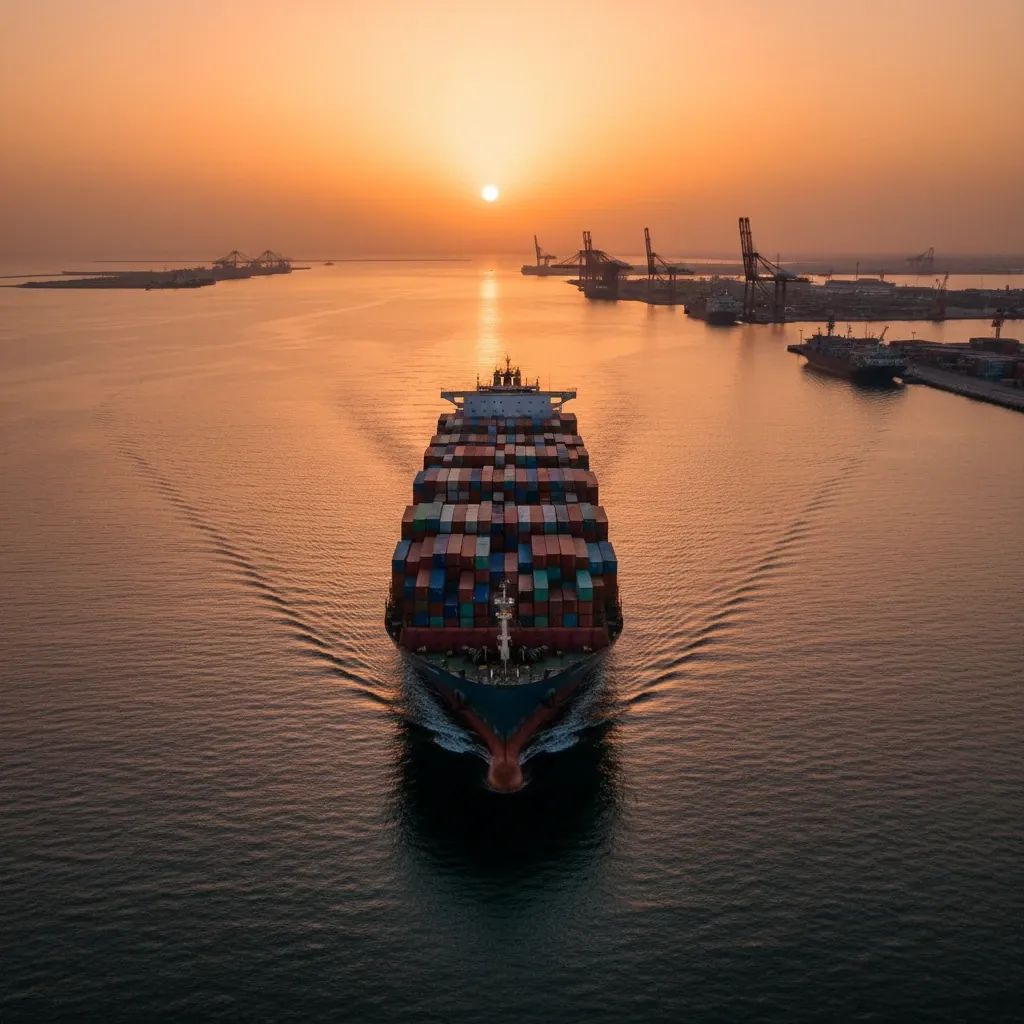
Why Global Shipping Chaos Hits UAE Wallets—and What's Changing
For UAE residents and businesses, the impact is immediate and personal. A container that cost 1,200 AED to ship from Shanghai in 2024 now runs 4,400 AED—a 267% increase that doesn't stay hidden in logistics ledgers. It lands on supermarket shelves, in electronics shops, and on manufacturing costs. Electronics imported from China and Southeast Asia have already seen retail price increases of 15-25% since early 2025. Furniture retailers report similar margin pressure. Food distributors, automotive suppliers, and appliance retailers across the UAE are absorbing these shocks in real time.
Yet beneath the cost crisis lies a less obvious reality: the industry itself, alongside governments and multilateral institutions, is actively engineering solutions to compress these pressures. The question isn't whether relief is coming—it's whether adoption accelerates before margin-dependent sectors collapse.
Why This Matters
• Container freight has tripled on some routes: Asia–Mediterranean services now charge nearly 4,400 AED per forty-foot equivalent (approximately $1,200 USD), compared to historical norms below 1,500 AED. This directly inflates import costs for United Arab Emirates retailers, manufacturers, and re-exporters.
• War risk insurance made direct Red Sea transit uneconomical: Premiums jumped from 15,000–25,000 AED per voyage to 150,000–500,000 AED (roughly $41,000–$136,000 USD), forcing carriers to take the Cape of Good Hope route and adding 8–14 days and approximately 272,000 USD (1 million AED) in fuel per vessel.
• Administrative harmonization is already cutting transit delays: Ecuador reduced customs processing by 67%; Kenya-Tanzania border waiting times dropped 87%—proof the WTO Trade Facilitation Agreement works when fully deployed.
The Artificial Scarcity Behind Soaring Rates
Counterintuitively, global shipping isn't suffering from a cargo shortage. It's suffering from deliberately engineered capacity discipline.
The global container shipping industry entered May 2026 in what executives call an "extraordinarily tight" operational state—yet underlying demand hasn't exploded. Instead, carriers made a calculated strategic decision: withdraw vessel capacity to extract maximum pricing power. Transpacific Eastbound deployment fell to just 82% of available slots, meaning roughly one-quarter of operational capacity was intentionally removed through blank sailings and fleet repositioning.
Spot rates from China to U.S. West Coast ports doubled since early March, now hovering between 2,800–3,400 AED per container. East Coast shipments fetch 3,700–4,500 AED. Asia–North Europe lanes sit around 1,500 AED per twenty-foot equivalent, well above sustainable historical benchmarks. Meanwhile, United Arab Emirates–based importers face the maddening paradox of abundant cargo but scarce vessel space.
The result is "rolled cargo"—shipments delayed to a later vessel without explanation or predictability. For logistics operators and retailers managing inventory across the region, this creates dual damage: elevated freight charges combined with extended lead times that lock working capital in transit longer. Every additional 10 days in a container compounds inventory financing costs by roughly 0.55% of cargo value, excluding other expenses.
Why can't shippers simply move freight over alternative routes? Because the capacity math is brutal. A single modern container ship carries the cargo equivalent of approximately 70 freight trains. When rail corridors and intermodal terminals across the Middle East are already operating near maximum capacity, diverting maritime cargo to land-based networks creates gridlock instead of relief. Truckload capacity across the United Arab Emirates and neighboring markets tightened further in early 2026, with freight brokers reporting elevated tender rejections and rising drayage costs compounding the bottleneck.
The Red Sea Calculation: Why Carriers Chose the Long Route
Houthi attacks in the Red Sea and Gulf of Aden have made direct routing through these waters dangerous and economically unviable, forcing a stark carrier decision: accept extended voyages around the Cape of Good Hope or absorb extraordinary insurance costs that render direct routing economically indefensible.
The Cape alternative adds 3,000–4,000 nautical miles to Asia–Europe voyages and 8–12 days to Asia–U.S. East Coast shipments. This elongated transit has consumed an estimated 5–7% of global container fleet capacity purely through time dilation. Fuel consumption on these extended routes typically costs carriers an additional approximately 272,000 USD (1 million AED) per major vessel voyage.
Yet fuel is only part of the calculation. War risk insurance—premiums covering political violence and maritime incidents—surged catastrophically. Baseline premiums, historically 10,000–20,000 AED per voyage, climbed to 150,000–500,000 AED ($41,000–$136,000 USD), or even 0.5–1% of vessel value for some routes. At that price point, the direct Red Sea transit becomes mathematically impossible for cost-conscious carriers. Even vessels taking alternative routes face elevated baseline insurance due to market-wide uncertainty.
Carriers have passed these cascading costs downstream through disruption-related surcharges of 500–1,500 AED per container. On Asia–Middle East routes—the most directly affected lanes—rates have climbed 25–40% above pre-crisis baselines on certain services. For United Arab Emirates–based businesses navigating currency volatility and inflation, surcharges that appear unpredictably in booking confirmations represent a compounding squeeze on already-thin margins.
The extended transit times themselves create a secondary financial drain. Longer lead times mean working capital remains tied up in containers for additional weeks. An established logistics reality: an extra 10 days in transit adds approximately 0.55% to cargo value in financing charges alone, excluding other costs. For manufacturers, retailers, and food distributors operating on margins of 3–5%, this represents meaningful erosion—costs that often get transferred to end consumers through higher prices.
Navigating Multimodal Complexity: Where Digitalization Becomes Essential
Shippers increasingly pursue blended transportation models to navigate maritime constraints: containerized cargo moves by vessel from China, transfers to rail across Central Asia or the Middle East, then shifts to trucking for final delivery. This flexibility offers theoretical advantages. The practical reality is administrative complexity.
Each modal transition—vessel to rail, rail to truck—can trigger separate customs inspections, documentation requirements, and clearance procedures if systems across jurisdictions lack integration. The World Trade Organization Trade Facilitation Agreement (TFA) explicitly addresses this challenge through provisions on risk management, pre-arrival processing, and authorized economic operator programs, yet full implementation remains uneven globally.
The results from jurisdictions embracing digitalization and streamlined customs are quantifiable and compelling. Ecuador reduced customs processing times by 67%; Jordan achieved 75% reductions. Indonesia cut import license processing by four days on average. Most dramatically, border waiting times between Kenya and Tanzania dropped 87% after implementing digital systems and electronic documentation frameworks. As of December 2025, 161 of 164 WTO members have ratified the TFA, and developing nations—many serving as transit points for United Arab Emirates–bound cargo—have implemented nearly 81% of agreed provisions.
Yet gaps persist. Smaller jurisdictions and markets with limited infrastructure investment remain constrained. The United Arab Emirates, which invested heavily in customs digitalization through advanced clearance systems at Jebel Ali Port and across its federal apparatus, now faces a coordination challenge: ensuring that partner nations—Saudi Arabia, Oman, Qatar, and broader regional partners—maintain compatible systems and real-time information-sharing protocols. When containers move via alternative multimodal routes, administrative friction multiplies exponentially unless each jurisdiction enforces harmonized standards.
The World Bank's Trade Facilitation Support Program has documented tangible impact: 58 countries implementing 283 TFA measures have achieved 21% reductions in trade times and over 29.5 million USD (108.7 million AED) in private-sector cost savings. That success model is replicable but demands political will, sustained investment, and continuous coordination—precisely the elements the WTO is evaluating during its second comprehensive review of the TFA throughout 2026.
Emerging Routes: Potential and Real Constraints
The shipping industry and logistics operators are actively testing alternatives to traditional chokepoints, but each option carries distinct limitations for United Arab Emirates–centric supply chains.
Mexico's Interoceanic Corridor of the Isthmus of Tehuantepec (CIIT) represents a concrete near-term development. This 303-kilometer rail project connecting Salina Cruz on the Pacific to Coatzacoalcos on the Gulf became fully operational in the first half of 2026, offering a "dry canal" alternative to Panama Canal congestion. However, its capacity ceiling is approximately 3 million containers annually—roughly one-quarter of Suez's pre-crisis baseline throughput of 12–14 million twenty-foot equivalent units yearly. For routes primarily serving the United Arab Emirates, the CIIT offers minimal direct benefit.
The India-Middle East-Europe Economic Corridor (IMEC) theoretically offers fresher possibilities. This multimodal initiative integrating maritime, rail, and overland transport across participating nations could trim transit times by up to 40% and provide alternative routing for UAE-origin cargo headed to Europe or South Asia. Yet IMEC remains in early infrastructure phases, with coordination challenges and capability gaps in several key corridors limiting immediate utilization.
Arctic shipping routes—the Northern Sea Route along Russia's Arctic coast and the Northwest Passage north of Canada—are becoming operationally viable due to ice melt, offering substantially shorter Asia–Europe transits. Geopolitical tensions, environmental concerns regarding the Arctic ecosystem's fragility, and minimal port infrastructure make these routes unlikely to absorb material volumes in 2026. Carriers are testing cautiously, but widespread adoption remains years away.
The Cape of Good Hope remains the default fallback, despite its inefficiency and cost. This reality underscores a sobering constraint: until Red Sea security improves materially or new major corridors mature and develop supporting infrastructure, geographic chokepoints will continue suppressing logistics efficiency and elevating global costs.
What Infrastructure Investment Demands Look Like Now
Industry executives meeting with World Trade Organization Director-General Ngozi Okonkwo-Iweala on May 28 called for substantial infrastructure upgrades to restore operational predictability and efficiency. Global estimates suggest billions of dollars over five years in required investment for cargo handling equipment, port automation, and logistics infrastructure at key facilities worldwide—including critical nodes for United Arab Emirates trade lanes.
The Dubai and Abu Dhabi port authorities have initiated expansion projects and automation initiatives, positioning the United Arab Emirates as a regional hub better equipped than most peers. But the pace of disruption demands accelerated timelines and deeper public-private collaboration. Port throughput capacity, intermodal connectivity, and customs processing velocity will determine whether the UAE maintains its competitive edge as a regional logistics gateway or cedes share to competing alternatives.
Digital infrastructure—real-time cargo visibility platforms, AI-driven demand forecasting, and predictive supply chain analytics—is becoming operational baseline rather than competitive differentiator. The deployment of these systems, combined with standardized data-sharing protocols across borders, enables shippers and carriers to absorb and route around disruptions with greater agility. Carriers restricting capacity cannot mask their decisions from platforms tracking fleet utilization and vessel positioning in real time.
What Stabilization Looks Like Ahead
Industry consensus expects freight rates to remain volatile through the remainder of 2026, buffeted by supply-demand imbalances, fuel price fluctuations tied to OPEC decisions, and strategic capacity moves by carriers. Brent crude oil remains the largest variable cost driver, accounting for 20–30% of ocean freight expenses and up to 40% in air freight. Every dollar swing in crude directly feeds into fuel surcharges that shippers pass downstream to consumers.
The 10% universal U.S. tariff remains in effect, with policy discussions potentially escalating levies on European Union automobiles to 25%, adding unpredictability to trans-Atlantic flows that indirectly ripple through United Arab Emirates re-export activity. U.S. tariff policy shifts can reorient cargo routing patterns and pricing dynamics within weeks.
For United Arab Emirates businesses, the current operating environment demands proactive adaptation: diversified supplier networks across multiple geographies, strategic inventory buffers for mission-critical items, and continuous monitoring of freight market dynamics. Companies deploying digital platforms for end-to-end supply chain visibility and real-time decision-making are positioned to absorb cost shocks and operational surprises more effectively than competitors relying on legacy manual processes.
The WTO is conducting its second comprehensive review of the TFA throughout 2026, with scheduled assessments of implementation progress, technical assistance effectiveness, and persistent friction points. For United Arab Emirates policymakers and business leaders, active participation in these forums offers leverage to advocate for measures that streamline cross-border trade, reduce customs delays, and enhance multimodal transport efficiency—investments that directly lower logistics costs for the entire region.
Long-term relief—a genuine reopening of Red Sea shipping routes or significant new-vessel capacity coming online—remains many months away minimum. Until then, United Arab Emirates importers, exporters, and consumers navigate an environment where smart adaptation, infrastructure investment, and regional collaboration define competitive positioning. The cost of inaction—eroded profit margins, lost market share, and price inflation at checkout—far exceeds the complexity of proactive strategic adjustment.