
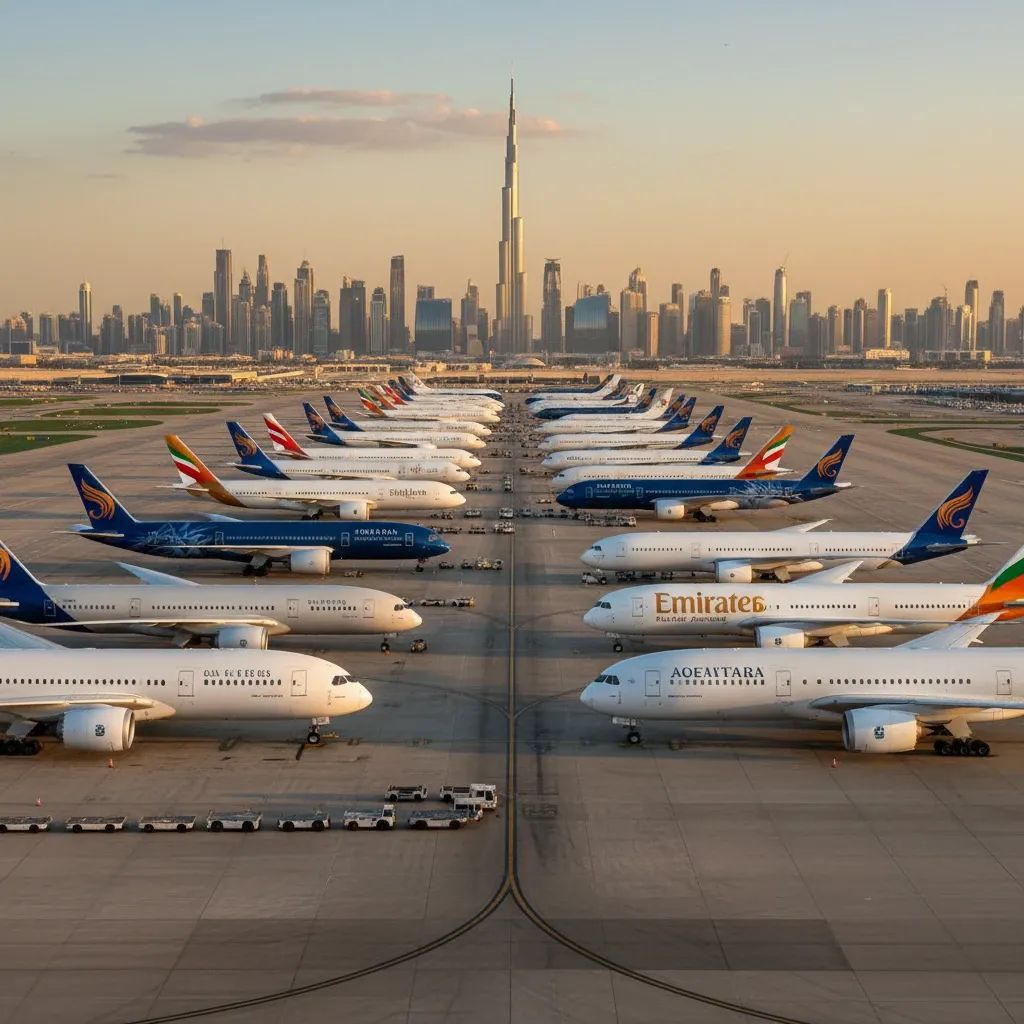
The Dubai Aerospace Enterprise has moved to reconfigure global aircraft leasing dynamics by absorbing Macquarie AirFinance, a Sydney-headquartered competitor, in a $7 billion transaction expected to finalize later in 2026. The consolidation expands DAE's operational footprint dramatically: the resulting entity will manage 1,029 aircraft across 191 airline clients in 79 countries—a portfolio dominance that repositions the UAE-based lessor among the sector's commanding voices and reshapes competitive advantage in an industry worth billions annually.
Why This Matters
• Fleet size after closing: 1,029 aircraft—more than doubling DAE's 2024 baseline and placing the group among top-five global lessors by volume
• New market access: 37 additional airline relationships plus seven country markets where DAE previously had no operational presence
• Timeline: Closing subject to regulatory clearance from U.S., European, Chinese, Indian, and Brazilian authorities through H2 2026
• Funding model: Debt-and-equity hybrid preserving DAE's investment-grade credit ratings
The Industrial Logic Behind the Deal
The aircraft leasing sector is experiencing significant change. Manufacturers—Boeing and Airbus—carry order backlogs extending into 2029 and beyond, making new-production aircraft scarce. Airlines cannot wait; they need flying equipment now. That scarcity drives lease pricing upward, rewarding lessors with modern, fuel-efficient fleets. Simultaneously, consolidation has accelerated: the Sumitomo-led consortium's $28.2 billion acquisition of Air Lease Corporation (expected to close H1 2026) created a second global leasing titan.
DAE's ambition is unambiguous. CEO Firoz Tarapore has publicly targeted a top-three ranking globally—a position unachievable through organic growth alone. Acquiring established platforms with mature customer relationships accelerates that trajectory. Macquarie AirFinance's 352-aircraft portfolio—young, efficient, geographically distributed—supplies precisely the assets DAE requires to justify that claim.
What Macquarie Brings to the Table
The acquired lessor operates primarily in Latin America, Europe, and Southeast Asia—regions where DAE's exposure remained thin. That geographic diversity reduces revenue concentration; if volatility strikes one market, the broader portfolio absorbs shock.
The fleet composition tilts toward modern narrowbodies: approximately 191 Airbus jets (spanning A220, A320neo, A321, A330, A350 families) and 134 Boeing aircraft (primarily 737 MAX and 737 NG variants). These modern aircraft command premium residual values—the resale proceeds when leases end—maximizing recovery advantage and protecting DAE against obsolescence risk.
The Financial Architecture Enabling Ambition
DAE entered 2026 from a position of material strength. Year-end 2025 results revealed $1.73 billion in total revenue (up 20.7% year-on-year), with net profit reaching $702.2 million—a 47% surge from prior-year performance. That profitability funded aggressive acquisitions: the company deployed $3.9 billion in long-term debt financing during 2025 while expanding total assets to $16.5 billion from $13.0 billion the prior year.
The Nordic Aviation Capital acquisition—a $2 billion transaction closed in 2025—demonstrated DAE's integration capacity. Adding 280 aircraft to the fleet while simultaneously selling 111 units reflects disciplined portfolio optimization: culling older, less efficient aircraft to refocus on modern jets commanding higher lease rates.
Investment-grade credit ratings from S&P and Fitch (both BBB) are critical to DAE's borrowing capacity. This rating equivalence to stable corporates provides access to competitive market borrowing rates, a significant advantage in securing financing for major acquisitions.
Scale and Competitive Repositioning
Post-closing, DAE will rank fifth among global lessors by fleet volume, behind AerCap (approximately 1,900 aircraft), the merged Sumitomo Air Lease entity (projected 850+ aircraft), BOC Aviation (around 670 aircraft), and Avolon (roughly 580 aircraft, subject to ongoing divestitures). The gap to market leader AerCap remains substantial—a structural reality unlikely to close through a single acquisition.
But trajectory matters more than absolute position. DAE has doubled its fleet since 2020—a growth rate outpacing many peers. CEO Tarapore has signaled deliberate portfolio turnover: aging aircraft rotate to cargo operators and dismantlers; proceeds redeploy into A321neo and 737 MAX orders. That mix shift tilts the fleet toward premium lease economics and extended residual value curves.
The Macquarie Deal's Integration Challenges
Large transactions of this scale present execution challenges: merging Macquarie's Irish legal domicile, Australian parent reporting, and legacy IT infrastructure into DAE's Dubai command structure requires careful coordination. DAE successfully absorbed Nordic Aviation Capital in 12 months; the Macquarie integration will require disciplined project management.
Customer retention ranks among the key priorities. Airlines cultivate long-standing relationships with lessors; perceived service continuity during transition is essential to maintaining customer relationships.
Regulatory approval constitutes a major requirement. Antitrust authorities in the European Union and United States examine leasing consolidation through market-concentration lenses. The Air Lease precedent consumed 6-8 months for regulatory review; DAE may face similar timelines, potentially pushing closing into Q4 2026 or beyond.
DAE Engineering: The Competitive Advantage
DAE owns DAE Engineering, the UAE's preeminent independent airframe MRO provider. The division operates modern maintenance facilities at Dubai South, supporting comprehensive aircraft maintenance capabilities.
Integrating Macquarie's 352 jets creates opportunities for cross-selling maintenance services. DAE can bundle lease and MRO services into combined contracts, creating additional value while establishing steady revenue streams from technical maintenance alongside aircraft leasing.
Regulatory Scrutiny and Timeline
The transaction cleared DAE's Board of Directors but remains subject to customary closing conditions, including regulatory approvals from U.S. Department of Justice, European Commission, and aviation authorities in China, India, and Brazil—jurisdictions where both lessors operate substantial portfolios.
Antitrust precedent suggests Q3 2026 will yield early indications of regulatory sentiment. If authorities signal approval without remedies, closing could land in Q4 2026. If behavioral concessions are demanded—aircraft divestitures, customer-base restrictions, or regional market-share caps—renegotiation consumes additional months.
The Broader UAE Aviation Ecosystem Context
This transaction reflects decades of deliberate UAE aviation finance positioning. Emirates Airline pioneered hub-and-spoke connectivity in the 1990s. DAE, founded in 2006, extended that into aircraft financing. Dubai South—a major aviation and logistics district—has developed as a hub for aerospace manufacturing and MRO operations.
DAE Engineering operates within that ecosystem, part of a broader UAE aerospace sector development strategy. The Macquarie acquisition builds on this foundation: more aircraft under DAE management naturally increases maintenance demand and expands service offerings.
The deal also demonstrates that government-linked enterprises can compete globally with commercial discipline. DAE maintains investment-grade ratings, accesses financing on market terms, and operates with professional management standards comparable to international peers.
Implications for UAE Stakeholders
For aviation professionals in the UAE, this transaction signals opportunities in aircraft maintenance, lease administration, and commercial roles that naturally expand with fleet growth.
For UAE legal and financial advisers, the deal underscores the importance of aviation finance expertise. Allen Overy Shearman Sterling and KPMG served as transaction counsel; post-closing integration will engage UAE-based advisers for compliance and operational matters.
For UAE capital markets, the transaction reinforces positioning as a global aviation finance hub. Government-linked enterprises executing billion-dollar transactions while maintaining investment-grade ratings signal to international investors that UAE capital markets support sophisticated, internationally competitive operations.
For UAE airline clients (Emirates, flydubai, Air Arabia, Etihad), the consolidation creates broader access to aircraft capacity and combined leasing-maintenance solutions through a single UAE-based provider.
Looking Ahead: 2027 and Beyond
If the deal closes as targeted in H2 2026, 2027 will become the credibility test. Integration milestones—fleet utilization rates, customer retention metrics, operational efficiency—will surface in annual results. Successful execution would confirm DAE's operational capabilities and international competitive standing.
The Macquarie acquisition signals that the UAE's aviation ecosystem has matured into a globally competitive sector capable of executing sophisticated international transactions. For residents and stakeholders, that positioning supports sustained industry activity, economic diversification, and confirmation that the UAE functions as an indispensable hub in global aviation finance and operations.


