
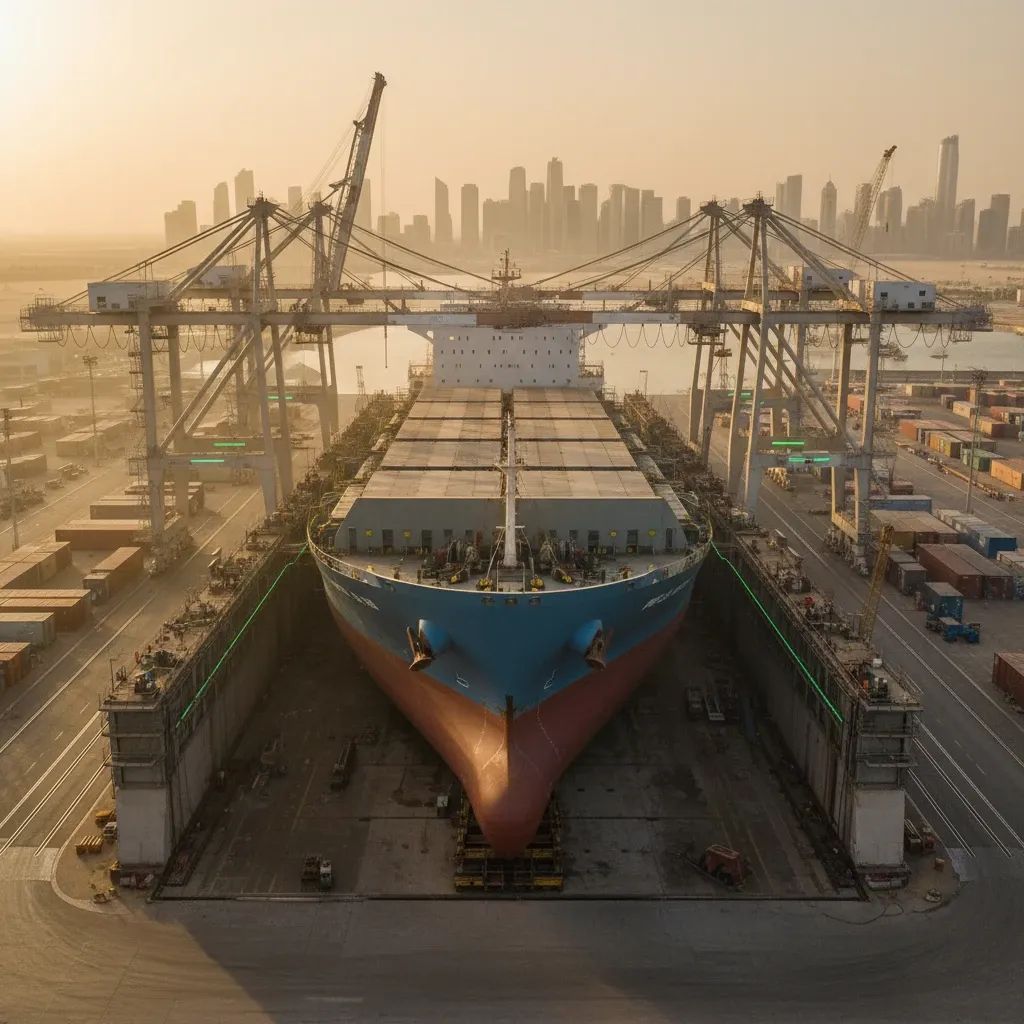
The United Arab Emirates shipyard Drydocks World has joined the Maritime Emissions Reduction Centre (MERC), a move that could accelerate the rollout of next-generation fuel-saving upgrades on vessels calling at the nation’s ports and refit yards.
Why This Matters
• Retrofit bookings likely to rise: Owners bringing vessels to Dubai for overhauls may soon bundle in decarbonisation work, potentially lifting yard utilisation and local skilled-labour demand.
• Lower-carbon exports: As Gulf carriers face new EU and IMO levies on CO₂ from 2026, upgrades done in the UAE can keep freight costs—and therefore commodity prices—competitive.
• Local tech spin-offs: Emirati engineering firms could license or co-develop wind-assist, air-lubrication, and battery-hybrid solutions trialled under the programme.
• Investor signals: DP World’s decision reinforces the federal push to turn the Jebel Ali-Dubai logistics corridor into a hub for green shipping finance.
The Engineering Muscle Behind the Deal
MERC—an Athens-based non-profit steered by Lloyd’s Register and leading Greek shipowners—was looking for a yard that can translate white-paper ideas into steel. Drydocks World, part of DP World’s portfolio, fits the brief with four decades of heavy-lift conversions, LNG retrofits, and more recently an in-house hybrid-tug programme.
By taking a seat on MERC’s technical board, the Dubai yard will now help rank energy-efficiency technologies by cost, installation time, and payback period. Early focus areas include:
• Hydrodynamic hull tweaks that shave 5-8% off fuel burn.
• Wind-assisted propulsion systems—rigid sails or kites—for bulkers trading through the Red Sea.
• Auxiliary power alternatives, such as deck-mounted fuel cells paired with battery banks for peak-shaving.
• Data-driven voyage optimisation layers that link the bridge to onshore control rooms in Jebel Ali.
Reading the Regulatory Barometer
The International Maritime Organization’s carbon-intensity index (CII) began penalising poor-performing ships last year. From 2027, the EU will demand 40% lifecycle emissions cuts on voyages to its ports. Because 60% of crude, container, and dry-bulk tonnage leaving UAE terminals heads to Europe or the Mediterranean, compliance is now a board-level risk for regional carriers.
Embedding a decarbonisation test-bed inside the country gives the UAE two strategic advantages:
Shorter upgrade lead times—no need to steam to Asian yards.
Knowledge transfer—Emirati naval architects can participate directly, building a local talent pipeline.
What This Means for Residents
• Seafarers and technicians: Expect fresh recruitment drives for welders, electricians and software engineers trained in green propulsion. Vocational colleges in Dubai and Abu Dhabi are already tailoring electives to MERC-aligned skills.
• Small suppliers: Instrumentation, composite materials and drone-inspection start-ups can pitch pilot projects under MERC’s open-innovation calls, opening a pathway into the USD 14B global retrofit market.
• Retail consumers: Shipping costs feed into supermarket prices. Efficient vessels burning 15-20% less fuel help buffer freight-induced inflation, especially on refrigerated food imports.
• ESG-minded investors: Sukuk or green bonds linked to ship retrofits could offer a new fixed-income pocket, diversifying beyond solar and utility debt.
Stakeholder Reactions
"The yard’s hands-on retrofit lineage gives us confidence these concepts will move from CAD file to quay in months, not years," said Nikos Kakalis, MERC’s managing director, during a webcast briefing.
Regional owners—among them Bahri and Gulf Navigation—privately welcomed the tie-up, noting that drydocking slots in Asia are already booked two seasons ahead. Lloyd’s Register added that Emirati participation bolsters the centre’s ability to demonstrate compliance with EU FuelEU Maritime rules under real-yard constraints.
The Road Ahead
The first joint work-stream—expected to be announced before summer—will likely involve a Kamsarmax bulker scheduled for class renewal at Drydocks World. Engineers will test a modular air-lubrication system and a deck-mounted battery pack sized for at-berth zero-emission power.
If successful, similar packages could be marketed across DP World’s global network, from London Gateway to Sokhna Port, positioning the UAE as both a laboratory and export base for maritime decarbonisation technology.
Bottom Line for the UAE
Drydocks World’s move is more than a membership badge—it embeds the Emirates at the centre of a fast-growing retrofit economy, promising new jobs, stable freight rates, and a chance for local innovators to shape the hardware that will propel ships—and the nation’s trade—into a lower-carbon future.


