
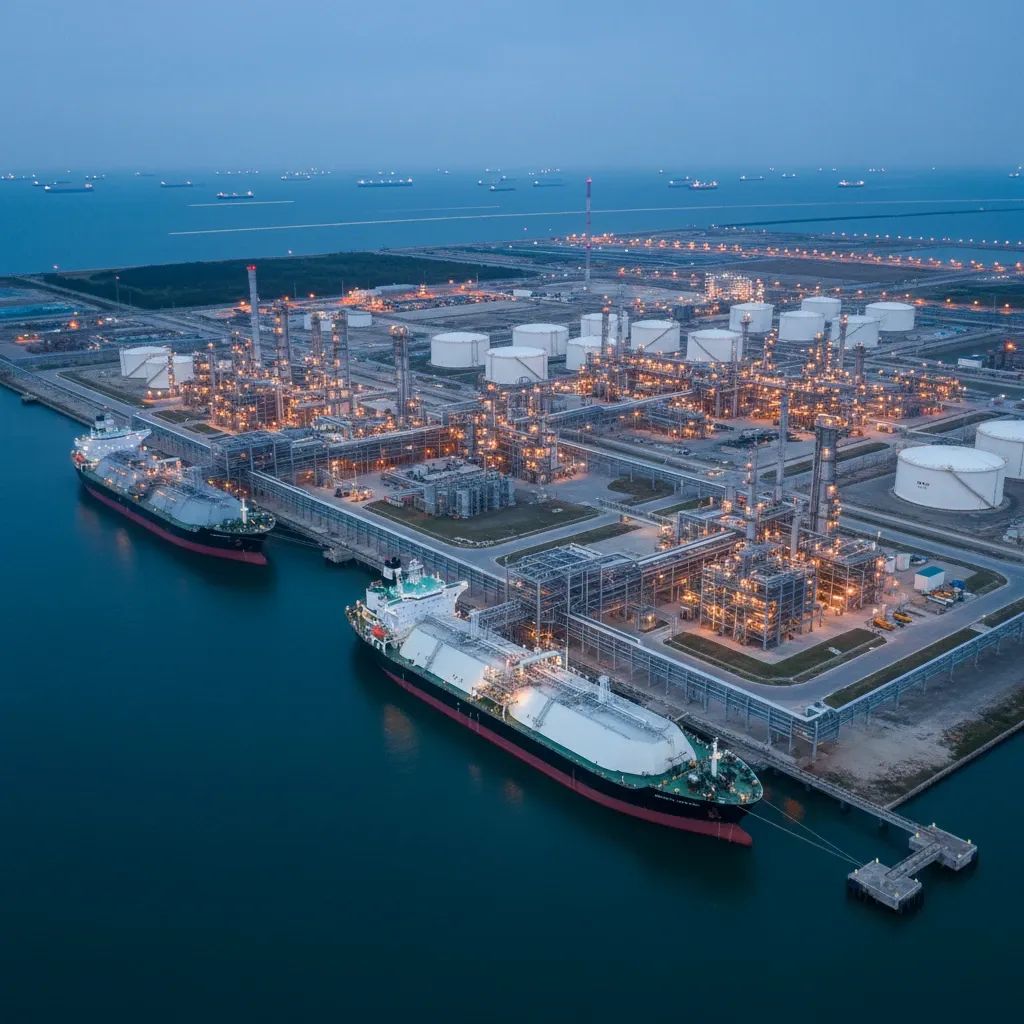
A Critical Industrial Shutdown Reshapes Global Markets and UAE Economy
The United Arab Emirates-based aluminium producer Emirates Global Aluminium (EGA) has initiated extensive damage assessments at its Al Taweelah facility following missile and drone strikes that obliterated roughly 4% of the world's primary aluminium supply in a single weekend. The company faces a reconstruction timeline extending potentially through early 2027, with primary smelting operations remaining offline for up to 12 months—a technical challenge far more complex than simple infrastructure repair.
Why This Matters
• Production capacity erased: The Al Taweelah smelter, which contributed 1.6 million tonnes annually, has been completely shut down; this facility represents the single largest disruption to global metal supply in recent years.
• Solidified potlines block restart: When power failed across the complex, molten aluminium inside reduction cells froze solid—requiring engineers to physically dismantle and rebuild each circuit individually rather than simply restarting the system.
• Pricing shock ripples worldwide: London Metal Exchange aluminium prices soared past $3,500 per metric ton, with financial analysts forecasting potential climbs toward $4,000/t if regional instability persists.
• Regional capacity decimated: Combined with curtailments at Aluminium Bahrain and Qatalum, the Gulf region has shed approximately 3 million tonnes of annual capacity—nearly half its total output.
Impact on UAE's Industrial Workforce and Economy
EGA's Al Taweelah facility employs over 3,000 workers from 40 nationalities, making workforce continuity a critical concern for the multinational team. The company has announced temporary facility evacuation and is actively supporting employee transitions during the extended shutdown period. For the broader UAE workforce, the incident underscores the importance of industrial diversification—Abu Dhabi's manufacturing sector depends heavily on stable aluminium supply for downstream industries including construction, automotive components, and electronics manufacturing.
The facility's closure directly impacts local businesses that depend on aluminium feedstock. Construction projects requiring aluminium components, automotive suppliers, and packaging manufacturers across the UAE are already facing supply constraints and rising input costs. The disruption also carries implications for Dubai and other Emirates that benefit from Abu Dhabi's industrial output.
The Physical and Technical Reality
The Al Taweelah complex sits within Khalifa Economic Zone Abu Dhabi and represents one of the world's most sophisticated aluminium operations. Its smelter, alongside casthouse operations, power generation facilities, an alumina refinery producing 2.4 million tonnes annually, and a recycling plant with 185,000-tonne capacity, suffered significant structural damage in the March 28 strikes.
The immediate aftermath proved catastrophic for different reasons than observers initially anticipated. EGA management stated that facility-wide power loss triggered an uncontrolled shutdown of the facility's potlines—the heart of any aluminium smelter. Unlike equipment that can simply be restarted, aluminium reduction cells operate at around 960 degrees Celsius, suspending molten metal in constant circulation. The moment electricity ceased, this molten content solidified instantaneously, essentially creating a geological formation of frozen metal inside each individual cell.
Restarting this frozen landscape requires workers to methodically excavate the solidified metal from each reduction cell, repair any structural damage caused by the thermal shock, replace corroded anodes and cathodes, and gradually reheat the circuit back to operational temperature—a process that must occur sequentially across hundreds of cells. Early engineering assessments suggest this cell-by-cell restoration alone will consume the majority of the 12-month timeline.
The alumina refinery and recycling plant, which depend on external feedstock and chemical processes rather than molten-metal physics, may restart operations earlier. Yet alumina output had supplied 46% of EGA's internal aluminium requirements, making any extended refinery offline period a downstream bottleneck.
Cascading Market Stress Across Continents
The Middle East historically accounts for approximately 9% of global aluminium production—a seemingly modest percentage that masks its strategic importance. Smelting requires extraordinary amounts of electricity and natural gas; the Gulf's abundance of both resources, combined with geographic proximity to Asian markets, established the region as a marginal-cost producer where operations could persist even during global price downturns. Remove this production, and the margin between surplus and deficit collapses entirely.
Goldman Sachs revised its 2026 outlook dramatically, shifting from a projected surplus to a 570,000-tonne annual deficit. The investment bank raised its Q2 average price assumption from $3,200 to $3,450 per metric ton and its full-year 2026 average from $3,100 to $3,200/t. ING forecasts remain more conservative, projecting $2,900/t for 2026, but even this implies structural undersupply. Both institutions acknowledge that assumptions hold only if no further geopolitical disruptions occur—a hypothesis that grows more fragile each week.
Industries most exposed include automotive manufacturing, construction, aerospace, packaging, and electronics—sectors where aluminium represents either a material cost component or manufacturing input. Europe, the United States, Japan, and South Korea—regions with limited domestic smelting capacity—face the greatest immediate pressure. These economies import substantial quantities of Gulf aluminium precisely because local production costs and environmental regulations make domestic smelting uncompetitive.
The Sourcing Scramble and Customer Negotiations
EGA announced it maintains substantial metal inventory on water and in warehouses across the United Arab Emirates and overseas locations, offering temporary relief for existing customers. The company stated it will negotiate directly with clients whose deliveries face disruption, though the specifics of how long inventories can sustain commitments remain unclear.
This inventory cushion masks a darker reality: contracts typically include force majeure provisions allowing suppliers to invoke extraordinary circumstances. Yet invoking force majeure simultaneously exposes producers to commercial damage claims and customer defection. EGA walks a narrow line between fulfilling obligations and acknowledging genuine inability to deliver.
Alternative suppliers—China Hongqiao Group, Aluminum Corporation of China (CHALCO), United Company RUSAL, Alcoa, Norsk Hydro, Rio Tinto, and Hindalco Industries—are fielding frantic inquiries from buyers attempting to secure alternative long-term offtake agreements. Capacity exists globally, but it remains tied to existing customers under long-term contracts or operates at near-maximum utilization. Australian, Brazilian, and Canadian producers can theoretically expand capacity, though lead times for equipment procurement and facility expansion extend into 2027.
The practical outcome: buyers are accepting higher prices today to secure certainty tomorrow. This willingness to pay premium rates extends through supply chains, trickling down to manufacturers who must either absorb cost increases or raise final product prices.
Security Situation and UAE Response
The Al Taweelah strikes represent part of an escalating confrontation that has extended since late February. Iranian missile and drone campaigns have targeted multiple United Arab Emirates installations, including gas facilities in Habshan and Ajban, plus an Oracle data center in Dubai. The UAE Ministry of Defense has reported successfully intercepting substantial numbers of ballistic missiles, cruise missiles, and unmanned aerial vehicles through its air defense systems.
In response to the attacks, UAE authorities have enhanced security protocols across industrial zones, particularly within Khalifa Economic Zone Abu Dhabi. Military presence has increased and air-defense capabilities remain active. Officials have communicated that defensive systems remain operational and committed to protecting critical infrastructure, though they have acknowledged that attacks have caused casualties among various nationalities working at affected facilities.
For residents and workers in industrial areas, the UAE government has provided regular security briefings and maintained communication channels through civil defense organizations. The situation underscores the importance of situated awareness in critical infrastructure zones, though authorities have emphasized that expanded security measures are designed to ensure operational continuity rather than indicate escalating threat levels.
The effective closure of the Strait of Hormuz—through which roughly 20% of global oil passes—compounds the crisis by restricting natural gas shipments that fuel aluminium smelting and limiting imports of alumina (the raw material feeding smelters). Even facilities that escaped direct physical damage face operational constraints from energy supply shortages.
UAE's Industrial Resilience and Diversification Strategy
The Al Taweelah incident carries broader implications for the UAE's industrial diversification strategy. Abu Dhabi has invested substantially in establishing itself as a regional hub for heavy industry and manufacturing, leveraging abundant natural resources and strategic geographic position. The disruption highlights both the value of this positioning—as demonstrated by the global impact when a single facility goes offline—and the concentration risks inherent in industrial clustering.
UAE policymakers are likely to use this incident as a catalyst for reviewing industrial resilience frameworks. Beyond immediate economic support for affected businesses, the shutdown may accelerate discussions about geographic diversification of critical manufacturing capacity across the broader UAE, supply chain redundancy for essential industrial inputs, and strengthened coordination between industrial operators and national defense infrastructure.
The Timing and Pre-Existing Market Pressures
The Iranian attacks arrived as the global aluminium market was already tightening. China's capacity caps, imposed for environmental reasons, have held primary production essentially flat despite surging demand. Power constraints in other key producing regions have limited expansion possibilities. Infrastructure spending and electric-vehicle electrification are driving metal consumption upward, creating a structural deficit independent of geopolitical disruption.
The March attacks accelerated an inevitable trajectory rather than creating an unexpected anomaly. Even if Al Taweelah restored to full capacity by early 2027, the underlying market dynamics would remain tight. Combined with continued uncertainty about regional stability, this suggests price volatility extending well into late 2026 and likely 2027.
Looking Forward
EGA's leadership has communicated a commitment to supporting customers "during this difficult period," though the reality remains constrained by physics and reconstruction timelines. Even optimistic scenarios assume stable power supply, absence of further attacks, and availability of specialized replacement parts—none guaranteed in the current environment.
For the broader global economy, the Al Taweelah shutdown represents a permanent shock to supply chain assumptions that prevailed for two decades. Buyers will likely maintain higher safety stock levels indefinitely, adding carrying costs to products worldwide. Manufacturers may increasingly pursue vertical integration or geographic diversification to reduce concentration risk. These adjustments impose economic friction that will persist even after Al Taweelah eventually restarts—a slow-motion consequence more consequential than the initial headline damage.
For UAE residents and businesses, the situation reinforces the importance of economic adaptation and supply chain awareness. While the Al Taweelah facility ultimately will resume operations, the global market restructuring triggered by its shutdown will likely create lasting changes in how international industrial capacity is allocated and valued.


