
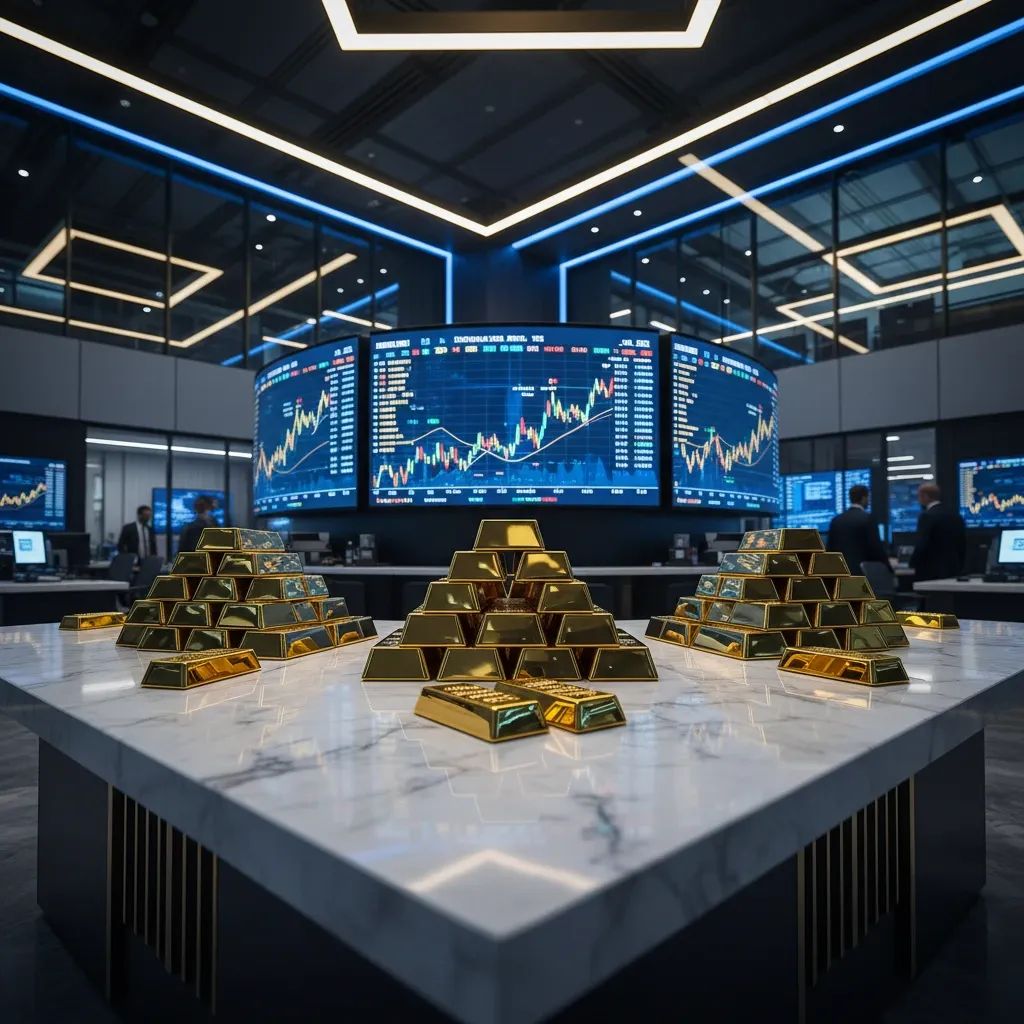
The price of gold has collapsed to its weakest level in seven months, slipping below the symbolic $4,000-per-ounce barrier as a resurgent US dollar and increasingly hawkish signals from the Federal Reserve reshape the entire precious metals investment landscape for residents across the United Arab Emirates.
Why This Matters
• Portfolio reality check: Gold investors who entered positions during January's record high of $5,589 per ounce now face losses exceeding 28%—equivalent to roughly AED 103,000 on a standard 500-gram holding.
• Opportunity window: Lower entry points have triggered demand from central banks and savvy institutional buyers, suggesting the floor may be forming for patient accumulation strategies.
• Tax advantage remains: UAE residents continue to benefit from zero capital gains taxation on precious metals, preserving wealth that investors in higher-tax jurisdictions lose to government levies.
Understanding the Two-Day Selloff
On Wednesday, 24 June, spot gold plummeted 3.3% in a single session, settling at $3,973.79 per ounce before stabilizing slightly on Thursday morning at $3,985.89. The decline represents one of the sharpest two-day moves since the panic selling of March 2026, which marked the metal's worst monthly performance since June 2013.
August gold futures contracts mirrored the weakness, closing 3.4% lower at $4,008.80 on Wednesday and easing another 0.2% to $4,001.60 by Thursday. The broader precious metals universe showed consistent pressure: silver dropped 0.2% to $57.33 per ounce, while platinum retreated 0.2% to $1,575.85. Only palladium managed modest gains, rising 0.3% to $1,170.25, sustained by chronic supply deficits from Russian and South African production.
This sharp reversal comes after six months of grinding weakness following January's euphoric peak, when geopolitical tensions and emerging-market central bank accumulation pushed gold into uncharted territory. The correction to current levels represents a brutal erasure of roughly $1,600 in value per ounce—the kind of volatility that separates strategic investors from panic sellers.
The Federal Reserve Inflation Trap
Rising expectations for US interest rate increases have fundamentally altered the calculus for owning non-yielding assets. At its June meeting, the Federal Reserve kept rates anchored at 3.50–3.75%, the same band held for four consecutive sessions. Yet behind closed doors, the policy committee revealed sharp internal divisions: nine governors projected at least one additional rate hike in 2026, with six believing two or more increases are warranted.
Futures markets have absorbed this hawkish leaning, now pricing in rates climbing toward 3.8% by September and reaching approximately 4% by December. Bank of America's Global Research team recently revised their forecast to expect a total of three rate increases before year-end, citing a more aggressive posture from the new Federal Reserve Chair and unrelenting economic resilience that keeps inflation stubbornly elevated.
The mechanism punishing gold is textbook economics: when interest rates rise, the opportunity cost of holding zero-yielding gold becomes intolerable compared to US Treasury bonds offering real inflation-adjusted returns. Capital that might have gone into bullion instead flows toward fixed-income assets paying actual yields. This dynamic intensifies when the dollar strengthens alongside rate expectations—as has occurred through mid-2026—because international buyers find gold increasingly unaffordable when priced in strengthened US currency.
The critical variable remains real interest rates, calculated as nominal rates minus inflation. Gold flourishes in environments where real yields turn negative, effectively preserving purchasing power when cash and bonds erode wealth through inflation. But with the Fed signaling tighter monetary policy to combat sticky inflation, real yields have climbed into positive territory, stripping away one of gold's historical attractions.
Dollar Strength as a Double Sword for UAE Residents
The US Dollar Index (DXY) has climbed to its highest 2026 levels, exceeding 100—a strength that creates peculiar challenges for UAE-based investors. While the United Arab Emirates dirham is formally pegged to the US dollar at a fixed exchange rate, this anchoring provides no hedge when gold declines in dollar terms. When the dollar strengthens against other currencies, gold becomes more expensive for international buyers holding euros, sterling, or yen, dampening their demand. But for dirham holders, there is no offsetting currency benefit—they experience the full brunt of falling gold prices.
This dynamic partly explains why physical gold demand from retail UAE residents remains surprisingly resilient despite the price weakness. Buyers in the market for jewelry, investment bars, and coins appear to view current levels as a tactical accumulation opportunity rather than a reason to flee precious metals entirely.
Conversely, for UAE investors with international holdings—currency reserves, overseas property portfolios, or expatriate salaries denominated in foreign currencies—the strong dollar has temporarily boosted wealth when converted to dirhams, potentially freeing capital for alternate investments.
Central Banks Are Still Buying
While retail and institutional investor sentiment has clearly soured, evidenced by outflows from gold-backed exchange-traded funds (ETFs), a structural floor persists beneath prices: central bank demand remains surprisingly robust. Emerging-market authorities, particularly in Asia and the Middle East, continue methodically diversifying foreign reserves away from dollar-concentrated holdings toward gold—a trend accelerated by geopolitical fragmentation and concerns about Western financial system dominance.
These official-sector purchases are characteristically price-insensitive, meaning central banks accumulate regardless of whether gold costs $5,000 or $3,800 per ounce. They follow long-term strategic objectives rather than tactical trading signals, providing consistent bid support even when market sentiment deteriorates sharply.
The World Gold Council conservatively estimates that central banks accounted for roughly 20–25% of global gold demand in 2025, translating to over 1,000 tonnes of purchases annually. This scale of buying creates a floor that prevents liquidation spirals and periodic panic selling—a safeguard missing from many other commodities.
Where the Next Battle Lines Form
Technical analysts and algorithmic traders have identified critical support levels where buying could accelerate. The $4,340 per ounce threshold, aligned with the 200-day moving average, represents the first significant structural floor. A sustained break below this point could trigger liquidation cascades among trend-following funds and algorithmic systems, potentially pushing prices toward $4,100–$4,150 in a downside scenario.
Further south, $3,886 per ounce—near the October 2025 lows—represents psychological support that could attract contrarian buyers if breached. Deutsche Bank forecasts a softer floor between $4,300 and $4,800 for the remainder of 2026 under baseline scenarios where the Federal Reserve holds course without accelerating tightening further. However, under a bear case involving three to four additional rate increases, the floor could plummet to $3,800—territory that would likely trigger significant central bank accumulation and potential short-covering by hedge funds.
Conversely, resistance overhead remains capped near $4,750 (the 50-day moving average) and $5,100 (a key technical level from the January correction). A break above $5,100 would signal reversal and potentially re-energize momentum-driven buying.
What Major Banks Now Expect
The investment community remains bifurcated between near-term pessimism and longer-term optimism. Goldman Sachs, adopting a conservative stance, trimmed its year-end 2026 target to $4,900 per ounce from an earlier $5,400 estimate, citing diminished expectations for Federal Reserve rate cuts this year. This implies gold could rise roughly 23% from current levels by December, though well below the January peak.
More bullish forecasters maintain that gold will recover significantly in the second half of 2026. J.P. Morgan Global Research projects an average price of $6,000 per ounce by the final quarter, potentially reaching $6,300 by 2027—implying a 50% rally from current levels. Wells Fargo Investment Institute similarly predicts $6,100–$6,300 by year-end, while Bank of America targets $6,000 per ounce and UBS expects $5,500 to $6,200 under various scenarios.
These recovery forecasts rest on assumptions that either the Federal Reserve will pivot toward rate cuts in late 2026 or early 2027 as inflation cools, or that geopolitical shocks will trigger safe-haven demand waves powerful enough to overcome rising rates. The World Gold Council's probability distribution offers useful context: a mild economic slowdown coupled with falling interest rates could drive prices 5–15% higher; a global recession with geopolitical flare-ups could push 15–30% upside. Conversely, strong fiscal-driven growth combined with sustained rates and a firm dollar could result in 5–20% downside from current levels.
Strategic Angles for UAE Investors and Expatriates
For residents navigating this turbulence, several practical considerations warrant attention. Those carrying outsized gold exposure from January's highs should resist capitulation selling and instead consider rebalancing their portfolios at lower entry prices, swapping overweight positions into undervalued alternatives like silver (benefiting from robust industrial demand in solar, electric vehicles, and electronics) or platinum (trading near $1,575 with chronic supply deficits supporting prices).
Physical gold purchases—bars and coins acquired through UAE-based dealers—continue to attract buyers because they sidestep the tax drag that burdens investors in higher-tax jurisdictions. The absence of capital gains taxation in the United Arab Emirates means residents can realize profits or losses without surrendering gains to government levies, a structural advantage that should factor into tactical timing decisions.
Sophisticated investors might consider options strategies or gold mining equities to gain leveraged exposure to potential price recovery, though these instruments require careful risk management and are unsuitable for conservative investors. Exchange-traded funds tracking gold miners offer a middle ground, providing operational leverage to gold prices while maintaining diversification across geographically dispersed producers.
Geopolitical Wildcards Loom
While monetary policy dominates current price action, lurking beneath the surface are geopolitical triggers capable of reigniting safe-haven demand overnight. Recent diplomatic progress between the United States and Iran has unwound part of the so-called "debasement trade," where investors accumulated gold as insurance against monetary fragmentation and currency devaluation. Any reversal of these efforts or escalation of regional conflicts could quickly resurrect safe-haven buying and push prices higher regardless of Federal Reserve policy—a reminder that gold's complexity transcends simple interest-rate dynamics.
For UAE residents, the calculus boils down to positioning and discipline. Those underweight precious metals after the January euphoria may find current levels strategically attractive for accumulation, particularly if confident in the longer-term recovery scenarios. Those overexposed should consider trimming positions on any bounce toward $4,500–$4,750, locking in reduced losses while maintaining some exposure to potential second-half recovery. The volatility itself is a feature, not a bug, for disciplined rebalancing strategies—though it requires emotional fortitude to execute during periods of sharp price weakness.


