
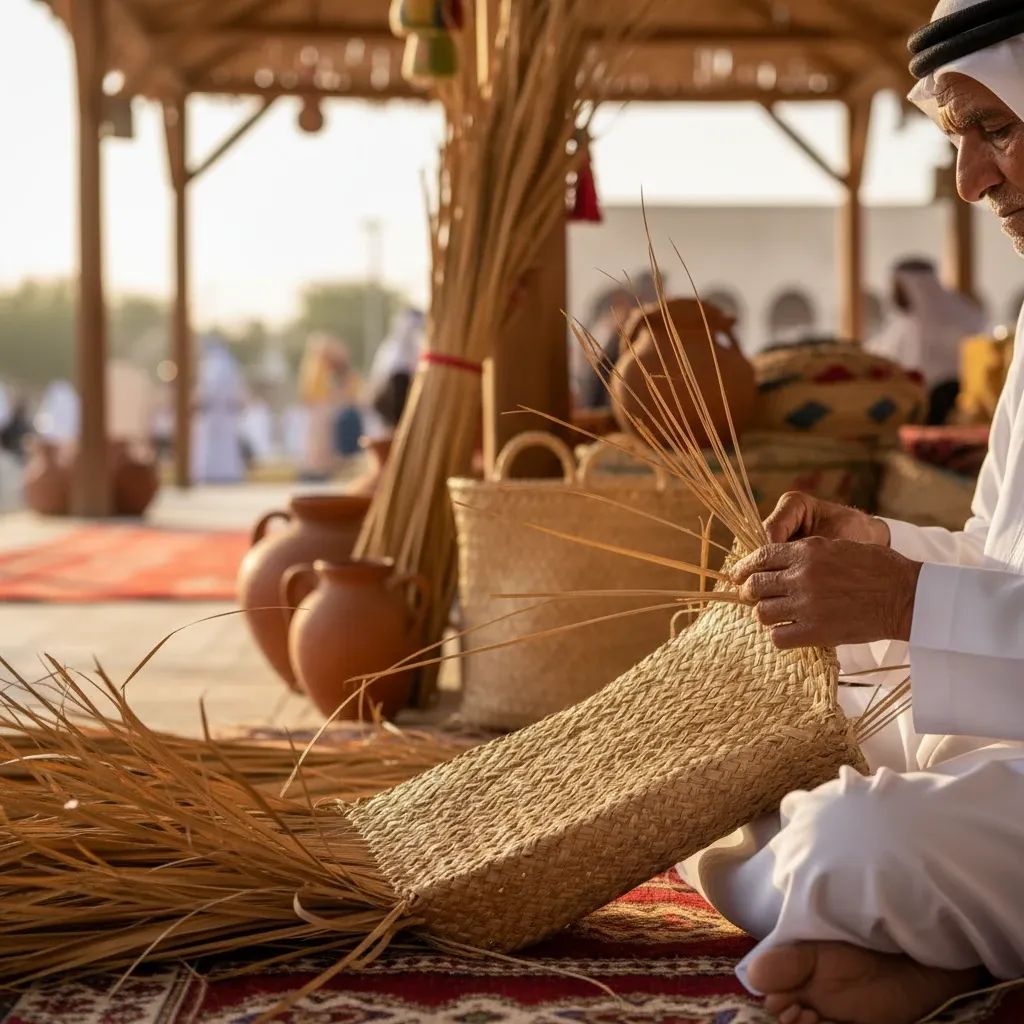
Sharjah has inaugurated a permanent space dedicated to preserving and revitalizing traditional Emirati craftsmanship. The Irthi Museum, launched by the Irthi Contemporary Crafts Council, marks the region's first institution devoted entirely to contemporary craft, signaling that heritage techniques—once at risk of disappearing—have genuine cultural and economic value as viable careers for younger generations.
Why This Matters
• First regional institution of its kind: a museum combining cultural preservation with direct economic benefit for artisans, particularly women craftspeople across Sharjah and the wider United Arab Emirates.
• The Irthi Contemporary Crafts Council, established by Her Highness Sheikha Jawaher bint Mohammed Al Qasimi in 2015, has supported artisans across the region through training and market development initiatives.
• Annual revenue from craft sales has been systematically reinvested into training programs—transforming heritage preservation from cultural initiative into functioning business model.
• The collection draws from design collaborations between Emirati artisans and regional and international designers, establishing international visibility for Emirati craftsmanship.
Ten Years of Craft Economic Development
Traditional Emirati crafts faced significant challenges a decade ago. The Talli embroidery, Sadu weaving, and Safeefah palm-braiding techniques that defined Emirati material culture were concentrated almost entirely among aging artisans. Younger practitioners were rare. The work appeared economically uncompetitive in a global economy dominated by industrial mass production.
When Her Highness Sheikha Jawaher bint Mohammed Al Qasimi established the Irthi Contemporary Crafts Council in 2015, she rejected the path of cultural nostalgia. Instead of framing traditional crafts as artifacts requiring protection, the council reframed them as living design practices capable of competing in contemporary markets. The strategy was deliberate: embed ancestral techniques into modern design contexts and present Emirati craft at prestigious international venues.
By 2025, this approach had fundamentally shifted artisan engagement. The council's network had expanded significantly to support craftspeople—many of them younger practitioners who now see craft work not as cultural obligation but as viable professional identity.
The Irthi Museum is essentially this strategy materialized into institutional form: proof that preservation and cultural authenticity can generate genuine value when positioned within contemporary design frameworks.
Four Traditions, Contemporary Reinterpretation
The museum's collection centers on distinct Emirati craft traditions, each displayed to demonstrate their ongoing evolution.
Talli represents hand-braided metallic and silk embroidery historically reserved for ceremonial garments. The museum presents heritage pieces alongside contemporary applications—retaining the metallic precision of original technique while relocating it into 21st-century aesthetic contexts.
Safeefah transforms dried palm fronds into utilitarian and decorative objects: baskets, coasters, and wall hangings. The museum showcases both practical examples and contemporary pieces—demonstrating how a desert-derived functional craft translates into modern interior design vocabulary.
Sadu, the Bedouin ground-loom weaving technique characterized by bold geometric patterning, originally appeared on tent textiles and rugs. The museum displays traditional pieces alongside contemporary wall hangings and modern upholstery applications. Visitors observe how ancient pattern logics integrate into contemporary interior and design contexts.
Faroukha, a lesser-known Emirati tradition, represents the council's broader commitment to comprehensive documentation. By including diverse practices rather than only "major" crafts, Irthi ensures that traditions receive cultural recognition and renewed relevance.
The Business Model Behind Cultural Sustainability
Historically, Emirati women artisans operated within constrained economic contexts. Intricate handiwork generated minimal monetary return. Commercial platforms barely existed. Irthi fundamentally restructured this arrangement.
Since 2015, the council has systematically reinvested revenue from craft sales into training programs. This represents a functioning financial cycle—not charity or cultural subsidy, but genuine business activity supporting artisan skill acquisition. The council operates training initiatives introducing practitioners to both ancestral techniques and contemporary design principles. These practitioners learn not simply how to create, but for whom and to what professional standards.
Internationally, Irthi's partnerships have opened markets previously inaccessible to artisans whose work circulated only through domestic consumption. Exhibition visibility across international design contexts has normalized Emirati craft within global design circles, creating new commercial narratives and customer bases previously unreachable through traditional channels.
The Ecosystem: Sharjah Creative Quarter as Integrated Infrastructure
The Irthi Museum functions within a deliberate ecosystem. Established through Emiri Decree in January 2025, the Sharjah Creative Quarter clusters specialized institutions designed to support the United Arab Emirates's cultural and design economy holistically.
Sharjah Design Centre provides fabrication facilities for woodwork, ceramics, metalwork, textiles, and jewelry—offering young designers and artisans access to equipment they cannot individually afford.
Sharjah Fashion Lab supplies advanced machinery and fabrication expertise for fashion designers targeting professional manufacturing standards.
L'ÉCOLE, School of Jewelry Arts, supported by Van Cleef & Arpels, operates as Sharjah's jewelry school providing instruction in jewelry craftsmanship and design.
Qasimi Archives honors Sheikh Khalid Al Qasimi, founder of the QASIMI fashion label, and functions as intellectual repository cultivating emerging fashion designers.
This spatial clustering creates practical efficiency. Designers can prototype locally, source artisan elements through Irthi partnerships, and exhibit work—all within proximity. The quarter becomes functioning ecosystem rather than dispersed institutions.
Practical Impact for Sharjah and UAE Residents
For people living in the United Arab Emirates, the Irthi Museum functions on multiple levels. It operates as cultural education venue, offering residents—particularly expatriates—direct exposure to craft traditions historically practiced in private domestic contexts. Visitors gain tangible understanding of how desert ecology, tribal identity, and functional necessity shaped distinctly Emirati aesthetic traditions.
The museum simultaneously functions as commercial platform. Residents and visitors can purchase craft products, participate in workshops, and observe artisans at work. This accessibility transforms craft from abstract heritage concept into tangible economic activity that people directly support through engagement.
The Irthi model signals deeper policy approach regarding how the United Arab Emirates conceptualizes cultural heritage. Rather than treating traditional crafts as museum artifacts—preserved but economically separate—the council positions them as living practices capable of generating income, supporting women's economic participation, and competing internationally. This framework matters: heritage preservation and economic development need not contradict.
For younger Emirati women, the museum and surrounding quarter offer concrete evidence that cultural production constitutes viable career path. Craft work integrates into contemporary design practice, international visibility, and sustainable professional employment. This accessibility shifts perception fundamentally.
Knowledge Preservation Through Documentation
Beyond exhibition space, the museum functions as research and documentation hub. The council has invested in preserving craft knowledge through technical documentation, archiving, and publication efforts. This documentation approach addresses concrete preservation concerns: craft knowledge can be irreversibly lost once elder practitioners retire without successors. Systematic preservation ensures knowledge survives generational transitions and remains accessible for researchers, designers, and future practitioners.
Next Steps
The Irthi Museum operates as part of the evolving Sharjah Creative Quarter initiative. The council indicates the museum will develop programming, research initiatives, and public engagement as it matures—functioning as active platform for contemporary craft practice, artist engagement, and market connectivity rather than static archive.


