
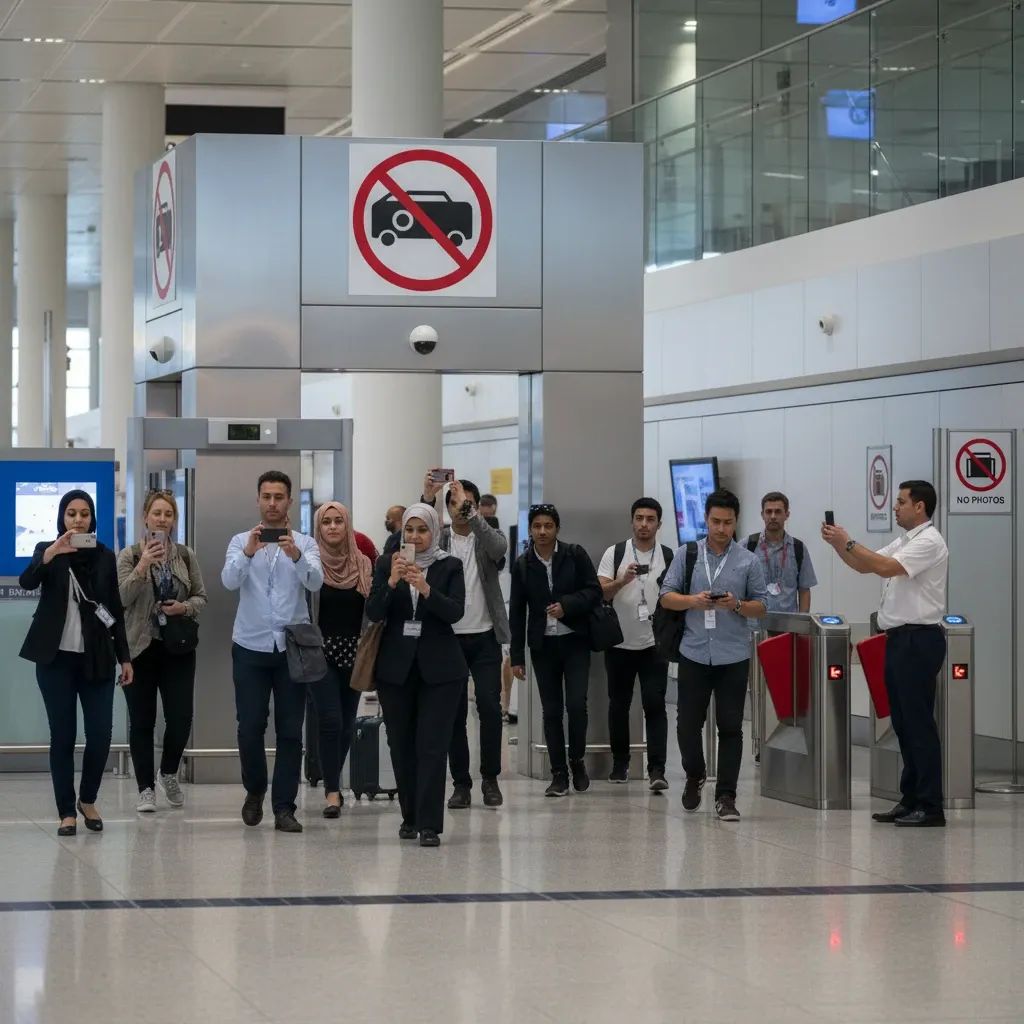
The United Arab Emirates State Security Department maintains strict restrictions governing the photography and circulation of imagery showing sensitive security installations, a move that carries fines reaching AED 500,000 and potential deportation for expatriates who run afoul of the rules.
Why This Matters
• Severe financial exposure: Violations trigger penalties between AED 150,000 and AED 500,000 ($40,800–$136,000), plus possible imprisonment and equipment seizure.
• Broad definition of "sensitive": The prohibition extends beyond military bases to metro stations, bridges, utilities, airports, and even private residences in certain contexts.
• Zero-tolerance misinformation policy: Sharing unverified reports or fabricated content about security incidents—including missile interceptions or deployments—is prosecuted under Federal Decree-Law No. 34 of 2021 with minimum jail terms of one year.
• Strict enforcement regime: Authorities actively monitor social media, and reposting content from unofficial sources is a criminal offense even without malicious intent.
What Counts as a Restricted Location
United Arab Emirates law casts a wide net over locations deemed critical to national security and public order. The most commonly flagged sites include all government buildings, presidential palaces, royal residences, military installations, police stations, civil defense centers, courts, and public prosecution offices. For residents and tourists navigating daily routines, the restrictions also reach transportation infrastructure—airports, metro stations, and aircraft—where photography is prohibited without special clearance.
Less obvious targets can still trigger legal action. Bridges, public utilities, and certain commercial government-linked buildings such as the UAE Armed Forces General Headquarters and the Dubai Chamber of Commerce & Industry are off-limits. Even filming your commute on the Dubai Metro or snapping a photo at the departure gate in Abu Dhabi International Airport can land you in serious trouble if security personnel interpret the shot as surveillance of critical infrastructure.
Private property introduces another layer of complexity. Photographing villas, residential buildings, or the interior of private vehicles without consent is treated as an invasion of privacy, particularly if the image captures women, children, or families. The same logic applies to religious and cultural sites: while some mosques—such as the Jumeirah Mosque—permit photography for visitors, many places of worship enforce outright bans. Respect local signage, follow dress codes, and seek explicit permission from management before raising a camera.
Legal Framework and Penalties
Federal Decree-Law No. 34 of 2021 on Combating Rumors and Cybercrimes forms the statutory backbone of these restrictions, covering both privacy violations and the dissemination of content that could compromise security operations. Under this statute, spreading false news or unverified information carries a minimum sentence of one year's imprisonment and a fine of at least AED 100,000. If the offense occurs during a public health crisis, emergency, or disaster, the minimum penalty doubles to two years in prison and a AED 200,000 fine.
Taking photos of government or military sites escalates the risk: authorities can arrest, detain, and deport offenders, especially expatriates, while confiscating cameras and destroying recordings. For semi-government locations, unapproved external or internal photography incurs fines between AED 8,000 and AED 13,000 for half a day and AED 15,000 to AED 25,000 for a full day. Photographing fully classified government sites without authorization costs AED 25,000 per day.
Publishing or sharing images of individuals without explicit consent is prosecuted as a serious privacy violation, attracting fines from AED 150,000 to AED 500,000, imprisonment, or both. Even seemingly innocuous content—such as a video capturing an air defense drill or a missile interception—can be deemed a threat to public order if it circulates on social media, triggering prosecution for "agitating public opinion" or "instilling fear and panic."
The UAE Media Council's 2025 regulatory overhaul introduced 20 content standards enforcing "zero tolerance for misinformation." Violations carry fines up to AED 1 million, doubling to AED 2 million for repeat offenses. Serious cases may result in temporary shutdowns of up to six months or permanent closure for media entities and influencers.
What This Means for Residents and Visitors
If you live or work in the United Arab Emirates, these rules demand a heightened awareness of your surroundings before you press the shutter button. The default posture should be caution: look for "No Photography" signage, and if there is any doubt about whether a structure or location is sensitive, refrain from taking the shot. Security personnel at airports, metro stations, and government complexes are empowered to detain individuals, confiscate devices, and initiate criminal proceedings on the spot.
For tourists, the stakes are equally high. Travel influencers accustomed to documenting every leg of a journey should exercise restraint inside terminals, on public transport, and near any building that could plausibly be classified as government-linked. Even background details—such as a bridge or utility pole visible in a selfie—can attract scrutiny if the image is shared online and flagged by monitoring systems.
The prohibition on unverified information extends to reposting content from unofficial sources. If you encounter a dramatic video showing security deployments, air defense activity, or an incident at a sensitive site, sharing it on WhatsApp, Twitter, or Instagram without confirming its origin through official channels—such as the UAE Government Media Office or Emirates News Agency (WAM)—exposes you to criminal liability. The law holds both the original publisher and secondary distributors accountable, and "I didn't know it was fake" is not a viable defense.
Photographing people without consent is another high-risk activity. Whether you are capturing street scenes, family gatherings, or events, ensure that individuals in the frame have explicitly agreed to be photographed and that you have their permission to publish the image online. This rule is particularly strict when children, women, or families are involved, reflecting broader cultural norms around privacy and personal dignity.
Enforcement and Your Responsibilities
The United Arab Emirates has prioritized enforcement of these restrictions to protect national security and maintain public stability. Authorities actively monitor social media platforms and public spaces, making compliance a practical necessity for all residents and visitors. The State Security Department regularly reiterates the prohibition on photographing sensitive locations and sharing fabricated information, signaling sustained commitment to these enforcement policies.
Practical Guidance for Everyday Life
If you plan to photograph or film in public spaces, adopt these safeguards. First, avoid any location that could be interpreted as government-linked, military, or critical infrastructure. Second, rely exclusively on official sources—government portals, state media, and verified agency accounts—for news and updates, especially during emergencies or crises. Third, obtain written consent from individuals before capturing their image, and never publish photos of children, women, or families without explicit permission. Fourth, disable location tags and metadata on social media posts that reveal sensitive areas or could be used to map security installations.
For businesses and content creators, the UAE Media Council's 2025 standards impose additional compliance burdens. All media content, including influencer posts, must uphold national values, respect religion and public morals, and avoid misleading advertisements or fake news. Violations can result in fines, shutdowns, and permanent bans, so proactive legal review of content calendars and social media strategies is essential.
The Bottom Line on Compliance
The United Arab Emirates has made clear that protecting national security and public order takes precedence over documenting daily life or sharing dramatic footage online. The financial and personal consequences of violating photography and misinformation laws are severe enough to warrant a cautious, permission-first approach to any image or video that could touch on sensitive topics. For residents, expatriates, and tourists alike, the safest strategy is simple: when in doubt, put the camera away and consult official guidance before pressing record.


