
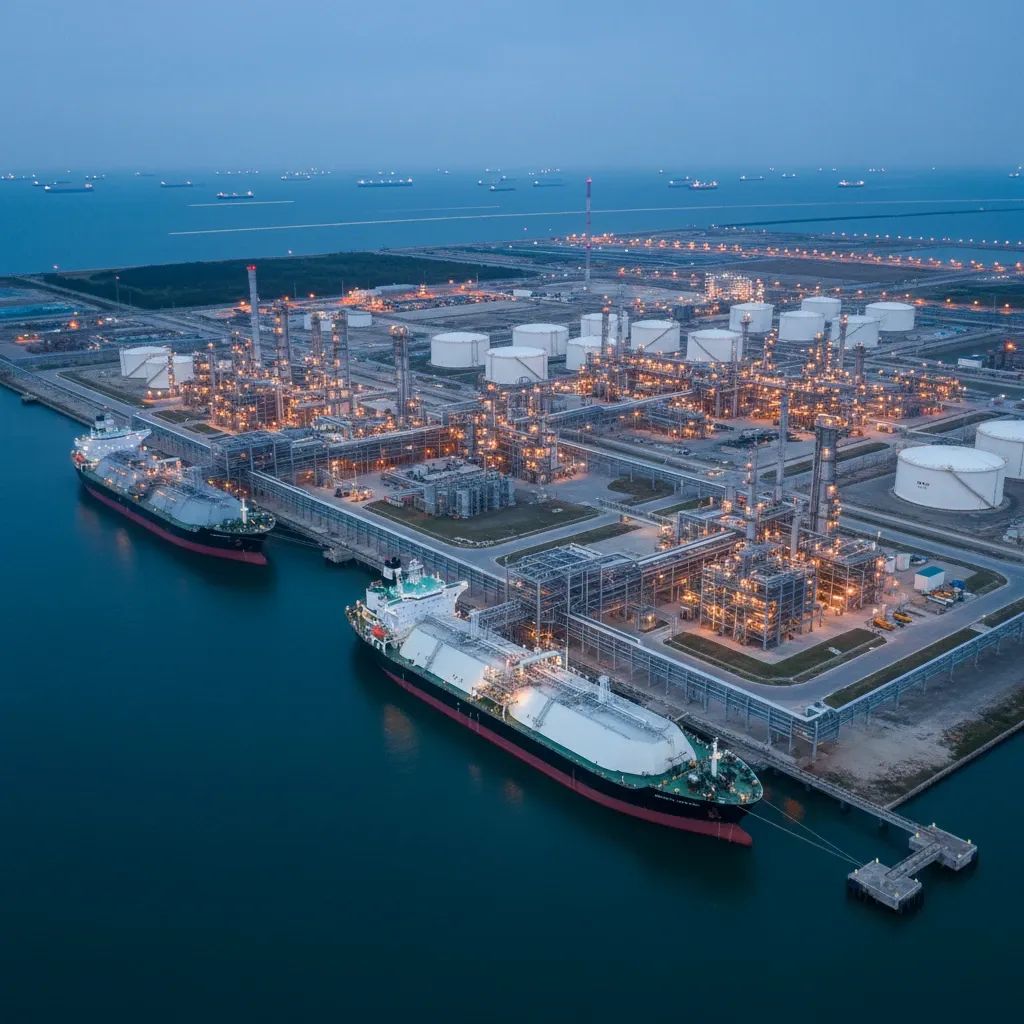
The Abu Dhabi National Oil Company's logistics division has accepted delivery of its fifth new LNG carrier, months ahead of the contracted date, signaling that the United Arab Emirates is steadily dismantling one of the last operational constraints limiting its energy export capacity. The vessel, named Arada, is now actively transporting liquefied natural gas for commercial sale, meaning the UAE's production pipeline and shipping infrastructure are tightening in near-perfect synchronization—a feat that most energy economies fail to achieve.
Why This Matters
• Supply bottleneck solved: With Arada operational now rather than later this year, ADNOC Logistics & Services has one fewer gap between Das Island production volumes and cargo transport capability at a moment when Asian buyers are desperate for reliable supply.
• Efficiency gains compound: These new vessels are 25% larger than older carriers and burn cleaner fuel, reducing the number of voyages needed to move the same cargo while cutting emissions—directly improving profit margins and regulatory compliance across Europe and Asia.
• 2028 readiness accelerated: The Ruwais LNG terminal's expected completion will require robust shipping to maximize utilization; early carrier arrivals from Chinese yards ensure zero logistical delays when that terminal switches on, protecting billions in locked contracts with international buyers.
A Shipyard Meeting Its Promises
Construction on the Arada wrapped ahead of schedule at Jiangnan Shipyard in China, following an established pattern from the batch of six carriers ordered in 2022. Keith Mander, the ADNOC Logistics & Services marine projects manager, attended the formal handover alongside crew members and yard officials, marking the moment the vessel transitioned from production asset to operating revenue generator.
This wasn't the first early arrival from the Shanghai-based shipyard. The Al Shelila arrived in November 2024 running two months fast, followed by Al Rahba in May 2025. The Al Reef was named in August 2025, and Al Sadaf was delivered in December 2025—each vessel moving immediately into commercial rotation without the typical post-delivery fitting delays that plague international shipping. The Arada maintains that rhythm. Two final carriers from this original six-ship commitment remain on order, expected to arrive in the first half of 2026, completing the initial contract by mid-year.
Chinese shipyard performance, in this case, has become a strategic advantage for the UAE. Planners betting on Asian construction capacity have seen returns: on-time and early deliveries compress project timelines and free up capital for additional orders faster than contractually promised. The success here matters beyond simple logistics—it validates the UAE's broader industrial partnership with China and proves that complex maritime construction can operate with precision.
Racing Ahead of Production Capacity
The urgency driving early delivery acceptance lies in a forthcoming production explosion. Das Island, the UAE's established natural gas liquefaction hub, currently operates between 6 and 7.6 million tonnes per year at or near maximum efficiency. That volume represents the physical ceiling of today's export capacity, not a comfortable operating margin. Without additional tankers sitting ready, ADNOC risks a familiar scenario: production exceeds shipping capability, sales delays mount, and reliability ratings suffer in markets where reputation alone determines contract renewal and pricing power.
The Ruwais LNG terminal, expected operational in 2028, will add 9.6 million tonnes of capacity annually. Over 8 million tonnes per annum from that facility is already committed through long-term supply agreements with Asian and European buyers—essentially presold output. Combined output from both terminals would reach approximately 15 million tonnes annually. Moving that volume profitably and reliably demands a fleet large enough to absorb maintenance windows, voyage cycles, and unexpected disruptions without breaking customer commitments.
The Arada and its sister vessels, each rated at 175,000 cubic meters, directly address that demand. Every month an additional carrier sits idle waiting for the Ruwais terminal is a month of unnecessarily constrained shipping capacity. The early arrivals telescope that waiting period backward, ensuring that when 2028 arrives, the fleet is already battle-tested and operating below full capacity utilization—a comfortable position from which to scale.
Environmental Advantage Becomes Operational Asset
Every Arada-class carrier features dual-fuel engines capable of burning liquefied natural gas itself—an engineering choice that cuts methane slip, the fugitive gas emissions that escape during LNG transport. Methane carries roughly 80 times the warming potential of carbon dioxide over a 20-year window; reducing its release per cargo has transformed from a sustainability marketing angle into a hard regulatory requirement.
European and Asian ports increasingly impose penalties on high-emission vessels: mooring delays, berthing surcharges, and preferential scheduling assigned to cleaner ships. The 50% reduction in methane leakage compared to older technology directly translates to faster turnarounds and better contractual terms. A vessel that moves through Singapore or Rotterdam 12 hours faster than a high-emission competitor accumulates meaningful economic advantage across dozens of annual voyages.
For ADNOC, this positioning matters strategically. Buyers seeking to hit their own carbon reduction targets increasingly demand proof of supply-chain emissions compliance. Offering cargo transported on methane-efficient vessels becomes a pricing lever and a contract-winning argument. The new fleet isn't simply larger and newer—it's cleaner by design, embedding a competitive moat that persists for the 20-25 year operational life of each vessel.
Local Consequence and Economic Rhythm
For maritime workers, port operators, and supply chain professionals across the United Arab Emirates, the expanded fleet represents immediate career implications. Carrier deliveries trigger hiring cycles: deck crews, marine engineers, port logistics coordinators, maintenance technicians, and specialized maritime consultants all compete for seats on new vessels entering the rotation. The multi-billion-dollar modernization program channels capital through local suppliers, equipment vendors, and port service providers—economic stimulus dispersed across the maritime sector and beyond.
More broadly, early and reliable carrier arrivals reinforce the UAE's reputation as a disciplined, professionally managed energy exporter. In global energy markets, reliability determines price and contract terms. When ADNOC consistently delivers cargoes on time, arrival patterns improve, and delivery surprises arrive early, buyers internalize a message: this supplier executes. That operational credibility translates into higher contract premiums, easier refinancing, and preferential treatment when new long-term negotiations begin. Every carrier arrival on schedule is a quiet argument in ADNOC's favor during pricing discussions thousands of kilometers away.
The economic consequence extends into years ahead. Export revenue growth stemming from increased production and reliable shipment directly funds domestic spending on infrastructure, public services, and economic diversification initiatives. Greater energy export earnings provide fiscal flexibility during commodity price downturns—a vulnerability that had constrained UAE policy options in previous cycles but becomes less binding as production volumes and export revenue climb.
The Arada's arrival represents unglamorous operational discipline: molecules moved efficiently, crews trained and motivated, suppliers delivering on commitments, and port infrastructure absorbing increased traffic smoothly. That foundation, repeated across six carriers from Shanghai and the coordination of crews and dock workers across the United Arab Emirates, sustains the country's energy export ambitions through 2030 and positions the UAE as a dependable global energy partner when geopolitical turbulence makes reliability scarce and valuable.


