
Why Energy Markets Just Shifted Beneath Your Feet
The Qatar's state-owned energy giant has formally suspended all liquefied natural gas deliveries as of this week, invoking force majeure—a legal safeguard that temporarily releases the company from its contractual obligations. The trigger was straightforward but catastrophic: drone and missile strikes on March 2 targeting the nation's two critical industrial complexes. For residents and investors in the United Arab Emirates, this is not merely foreign news. It is a disruption that will ripple through energy prices, manufacturing costs, and inflation pressures across the region and beyond.
What You Need to Know Right Now:
• Qatar controls roughly 20% of global LNG supply. Its absence sends European gas prices up 50% and Asian benchmarks 39% higher in a matter of hours.
• Two fully-loaded LNG carriers cannot exit regional waters through the Strait of Hormuz, creating an immediate bottleneck that affects supply chains from Europe to East Asia.
• The production halt extends far beyond gas—ammonia, fertilizers, plastics, and aluminum output has ceased, threatening food prices and industrial costs worldwide.
The Attack and What Followed
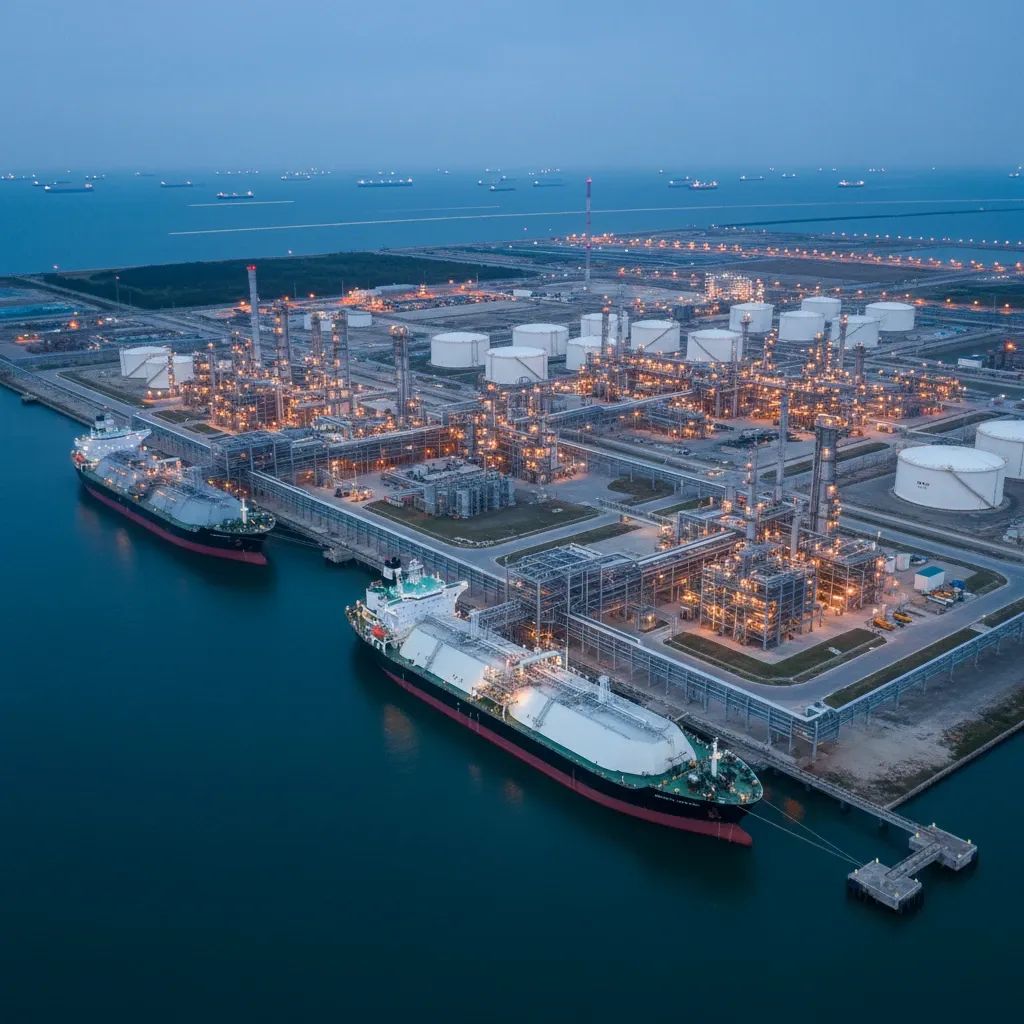
On March 2, Qatar's Defense Ministry detected the arrival of cruise missiles, ballistic missiles, and attack drones aimed at Ras Laffan Industrial City and Mesaieed Industrial City, the twin pillars of the nation's energy infrastructure. The strikes coincided with broader regional military tensions involving United States and Israeli forces responding to Iranian actions. Within hours, QatarEnergy made the operational decision to halt production across its entire LNG complex—the single largest liquefaction hub on the planet.
The consequences were immediate. Facilities that typically process hundreds of millions of cubic meters of gas monthly fell silent. Vessels either could not depart or became stranded in holding patterns. By Wednesday morning, QatarEnergy formally declared force majeure, a contractual mechanism that temporarily suspends delivery obligations when circumstances beyond the operator's control make performance impossible. It is not a dramatic announcement; it is a bureaucratic acknowledgment of profound disruption.
What matters here is scale and vulnerability. Ras Laffan is not one facility among many—it is the operational center of gravity for a commodity that powers hospitals, heats homes, and fuels industrial processes across multiple continents. A single location, disrupted by military action, instantly reshapes global energy availability.
Who Gets Hurt First
India faces the sharpest immediate impact. The nation imports nearly 40% of its LNG from Qatar, a dependency managed through the state-owned Petronet LNG. The company has already issued force majeure notices cascading down to its downstream clients: GAIL (India) Ltd, Indian Oil Corporation Ltd, and Bharat Petroleum Corporation Ltd. Industrial gas distributors across the subcontinent now face potential supply cuts of 40%, affecting thermal power plants, fertilizer factories, and city gas networks that serve millions of households.
One vessel tells the story plainly. The Disha LNG carrier, loaded on March 1 with 138,000 cubic meters of liquefied gas, sits anchored near the terminal. It cannot proceed through the Strait of Hormuz. Clearance may take weeks. That single cargo represents real families in Delhi and Mumbai unable to access reliable household gas until the logistics logjam clears.
Japan depends on Qatari gas for roughly 15% of its LNG consumption, a figure that translates directly into vulnerability for chemical and steel manufacturers operating on thin profit margins. South Korea relies on Qatar for 12% of its supplies, a disruption that immediately pressures these industries facing elevated input costs. China, the world's largest LNG importer, sources 8% of its expanding gas appetite from Qatar—not the largest share, but enough to create competitive pressure as it hunts for replacement volumes.
Europe enters this crisis already weakened. The continent receives 11-12% of its LNG from Qatar and has not yet recovered from reduced Russian pipeline deliveries. Gas storage sits at approximately 30% capacity—dangerously low. European utilities will now enter aggressive bidding wars for available spot cargoes, driving prices higher and forcing economic adjustments across energy-intensive industries.
The Immediate Vulnerability Loop
The Strait of Hormuz sits between Iran and the Arabian Peninsula, a 21-mile-wide waterway through which roughly one-fifth of global oil and a significant share of LNG must pass. This geographic fact became operational reality on March 2. At least two fully-laden LNG carriers cannot proceed. They remain in holding patterns awaiting a transit clearance that may not come for weeks. Even if the regional security situation stabilizes, restarting liquefaction processes takes a minimum of two weeks, meaning the backlog compounds with time.
Markets cannot simply wait. They must draw down existing storage reserves, tightening inventory levels and maintaining elevated prices long after the initial shock. The logistics gridlock thus extends and amplifies the supply shock beyond what the raw production numbers alone would suggest.
Impact on United Arab Emirates Residents and Businesses
For United Arab Emirates residents, the practical consequences emerge gradually but tangibly. The nation itself produces natural gas domestically and does not depend heavily on Qatari LNG for electricity or industrial feedstocks. But regional price dynamics will shift the balance sheet.
Petrol prices at United Arab Emirates pumps will reflect the 8% spike in Brent crude futures that followed the attacks. Logistics companies, airlines, and manufacturing plants will see operating costs rise. Companies that locked in long-term gas contracts before the disruption may find themselves at unexpected competitive advantage over rivals exposed to volatile spot markets.
More insidiously, the halt disrupts ammonia and fertilizer production globally. These are energy-intensive processes, and with Qatari production offline, global supply tightens. Fertilizer prices rise. Food production becomes more costly. These costs migrate across borders through grain imports, dairy products, and packaged goods. United Arab Emirates residents will encounter food inflation pressures that trace back to a March 2 attack on an industrial complex most have never heard of.
For businesses importing petrochemical feedstocks or products derived from Qatari production, uncertainty becomes immediate and operational. Procurement teams face sudden cost volatility and supply availability questions. Long-term budgets become speculative.
The Search for Replacements Already Underway
The global energy market does not tolerate vacuums for long. Buyers are actively seeking alternative supply, and several regions have positioned themselves to capture market share.
The United States presents itself as the geopolitically secure option. Projects including Golden Pass LNG, Corpus Christi, and Plaquemines LNG on the Gulf Coast are ramping up output. American exporters can position themselves as diversification plays—suppliers whose operations do not depend on regional military stability. Canada's LNG Canada Train 1 is scheduled for full operational capacity by mid-2026, adding further North American availability.
Africa presents a growth story. Mozambique's Coral South floating LNG facility faces pressure to accelerate production ramp-up. Eni's 2.4 million-tonne Nguya FLNG plant offshore Congo is positioning itself as a new supplier. Egypt is maximizing output from its Zohr field for European markets. Nigeria is attracting renewed investment from Asian buyers seeking diversified long-term contracts.
Australia is already operating Gorgon and Ichthys at maximum capacity with a focus on Asian fulfillment. The Darwin plant is restarting operations. Russia, despite Europe's strategic pivot away from Russian energy, may find unexpected openings. Uncommitted Yamal project cargoes could flow toward Turkey and Egypt. Reduced Qatari availability might paradoxically create new windows for Russian LNG in Asian markets, particularly China.
What the Supply Shock Means for Markets
The force majeure declaration triggers cascading effects that extend far beyond energy traders. QatarEnergy has committed to providing updates as the situation develops, but the company has not offered a public timeline for production resumption. Analysts suggest that facilities could return to operation within weeks rather than months—optimistic scenarios assume operational capacity by late March or early April.
Yet even a brief disruption keeps markets tight. Inventory levels remain suppressed. Buyers remain willing to pay premium prices for available supplies. The geopolitical risk premium embedded in long-term contracts deepens—markets now price in the vulnerability of concentrated infrastructure to military action.
For United Arab Emirates policymakers, the crisis illustrates the strategic calculus of energy diversification and regional stability. An attack on Qatar resonates economically far beyond Qatar's borders. For businesses, the lesson crystallizes into operational reality: supply chain hedging is not optional luxury but necessary practice. Diversified sourcing, storage capacity, and forward contracting become insurance policies against disruptions that governments cannot always prevent.
The force majeure declaration sits at the intersection of commerce and geopolitics. It is a contractual technicality that unmasks a more fundamental truth: the global energy system, despite its scale and complexity, depends on a handful of critical nodes. When one node fractures, the entire system feels the tremor. For United Arab Emirates residents and investors, that tremor is already arriving, disguised in utility bills, material costs, and the price of imported food.


