When Global Shipping Meets Geopolitical Warfare
The United States Fifth Fleet, stationed in Bahrain and commanding over 10,000 personnel across the Persian Gulf, has entered a new phase of enforcement. By late April 2026, the initial blockade established on April 13—static coastal patrols warning ships away from Iranian harbors—has evolved into something more aggressive: boarding operations targeting suspected Iranian commerce vessels anywhere in international waters. For residents and business operators across the United Arab Emirates, this shift means months of logistical disruption, soaring insurance costs, and the ever-present risk of supply-chain paralysis that extends far beyond energy markets.
Why This Matters for Your Daily Operations
• Strait traffic has collapsed by over 90%: More than 150 merchant vessels are holding position outside the Strait of Hormuz, creating a bottleneck that delays everything from pharmaceuticals to consumer goods destined for UAE ports by weeks.
• Insurance premiums have doubled or disappeared entirely: Some underwriters have stopped quoting Gulf transit coverage altogether, forcing shippers to absorb uninsured risk or abandon routes entirely.
• Oil volatility affects your cost of living: Brent crude climbed to $126 per barrel in April, a record spike that feeds into inflation for fuel, electricity, and transportation across the UAE.
The Shift From Warnings to Forcible Seizure
When Admiral Brad Cooper's US Central Command announced the blockade in mid-April, the operation centered on presence: warships positioned near Iranian coastal areas, radio warnings transmitted to any vessel spotted entering restricted zones. Compliance was often immediate—by April 16, thirteen vessels had received warnings, and all thirteen reversed course without incident. That voluntary compliance model has run its course.
The Wall Street Journal reported on April 18 that US Central Command is preparing imminent boarding operations. These will not occur only in the Persian Gulf. Operating under an initiative Pentagon officials call "Economic Fury," the mission targets Iran-linked tankers and cargo vessels globally. The justification is direct: these vessels are part of what intelligence agencies term the "dark fleet"—oil tankers that disable automatic identification systems, change their flags multiple times, and obscure ownership chains to hide Iranian crude exports.
Intelligence estimates suggest approximately 1.6 million barrels daily transit through these shadowy channels, representing roughly 90% of Iran's total crude exports. Nearly all this oil is destined for Chinese refineries, which have become Iran's primary buyer in the face of international sanctions. A boarding operation at sea, executed by sailors and marines approaching via helicopter or combat rubber boats, physically compels surrender of cargo and vessel control in ways that radio warnings cannot.
General Dan Caine, chairman of the Joint Chiefs of Staff, outlined the enforcement ladder on April 16: warnings come first, then boarding teams. If crews resist, protocols authorize "escalation force options," a Pentagon euphemism for warning shots and, if necessary, suppressing fire. The legal framework governing such seizures remains contested internationally, but the operational intent is clear—Iranian economic lifelines will be severed by force.
The Strait Becomes a Shooting Zone
While the US blockade targets Iranian ports specifically, the Strait of Hormuz itself has become a secondary conflict zone. On April 17, Iran's government announced the waterway was "completely open" for commercial traffic, suggesting a momentary deescalation. That declaration lasted fewer than 24 hours.
By April 18, Iran reversed course entirely, announcing "strict control" over the Strait of Hormuz in response to the US refusal to lift its blockade. Within hours, Iranian Islamic Revolutionary Guard Corps (IRGC) gunboats engaged merchant vessels with live fire. The incidents occurred in confined waters near Qeshm and Larak islands, where international transit funnels through a narrow corridor.
A tanker located approximately 20 nautical miles northeast of Oman reported being approached and fired upon by two gunboats. A container ship received direct hits from projectiles roughly 25 nautical miles from the same area, suffering container damage though the crew remained unharmed. A cruise ship narrowly escaped similar fire just 3 nautical miles east of Oman. The UK Maritime Trade Operations (UKMTO) agency logged each incident and issued broadcast warnings to the merchant community.
The escalation struck with particular force when Indian-flagged vessels became targets. India, which has no alignment in the ongoing conflict, conveyed formal protests through its ambassador in Tehran. One attacked vessel, identified as the Sanmar Herald, was carrying commercial cargo bound for Indian ports. New Delhi demanded that Iranian authorities "resume at the earliest" the process of facilitating legitimate Indian commerce across the Strait. The incident underscores how quickly neutral shipping becomes collateral damage once military forces claim operational control of a waterway.
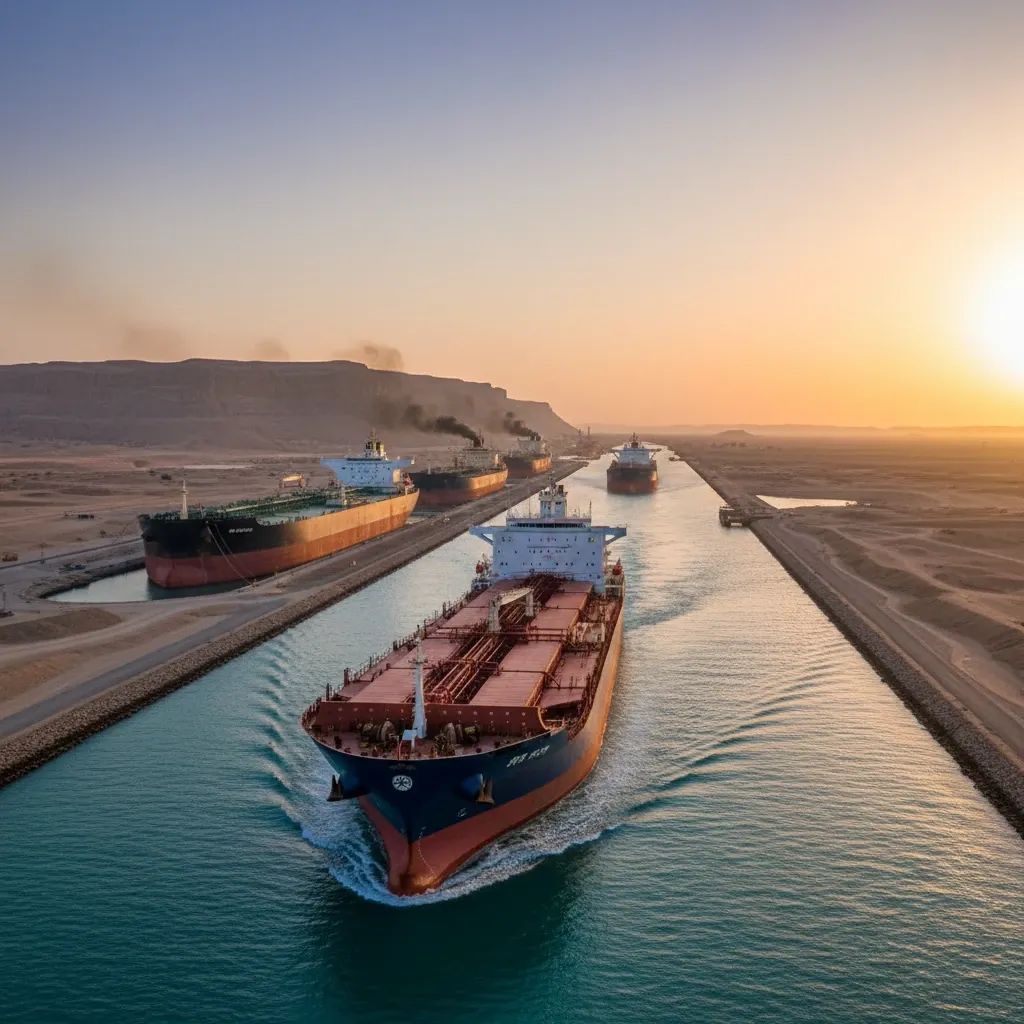
By late April, approximately 150 ships had anchored in holding areas outside the Strait, waiting for conditions to stabilize before transiting. Normal passage typically consumes 12 to 36 hours. Delays now stretch indefinitely. Vessels rerouting around the Cape of Good Hope add two to three weeks of transit time and tens of thousands of dollars in additional fuel surcharges per voyage. For time-sensitive cargo—perishables, pharmaceuticals, components for manufacturing assembly—the reroute is economically unviable.
What This Means for UAE-Based Logistics and Commerce
The United Arab Emirates, home to the world-class container facilities of Jebel Ali and the regional transhipment hub at Port Rashid, faces a structural challenge. The predictability that allowed these ports to capture market share has evaporated. Vessels that would normally transit the Strait in daylight are now anchoring outside it for days. This disrupts throughput projections and revenue forecasts for UAE port operators. Dwell times increase, berth occupancy becomes irregular, and operational efficiency declines.
For freight forwarders and vessel charterers based in Dubai and Abu Dhabi, compliance risk has multiplied in ways that go beyond traditional sanctions exposure. The US blockade operates on deliberately broad intelligence criteria. Any vessel flagged as having a connection to an Iranian entity—not merely carrying Iranian cargo, but being remotely linked to a designated sanctioned actor—can face interdiction and seizure. A charterer unknowingly engaging a counterparty with indirect ties to Iran now carries real legal exposure, potentially resulting in vessel arrest, fines, or criminal liability depending on jurisdiction.
Insurance markets have responded with visible dysfunction. Premium rates for Gulf transit coverage have doubled, tripled in some cases. More significantly, several major underwriters have implemented blanket exclusions for high-risk routes through the Strait and the Persian Gulf, effectively making coverage unavailable at any price. Smaller shipping firms operating on thin margins cannot absorb these costs and have temporarily abandoned Gulf operations, redirecting their capacity to other routes. The result is reduced capacity in the Strait, which further constrains traffic and extends delays.
Energy costs remain elevated despite recent crude-price moderations from April's peak. The UAE, as a petroleum exporter, benefits from higher oil prices—government revenue increases, supporting state budgets. But the collateral disruption to commerce—lost container volume, delayed manufacturing inputs, elevated logistics costs—offsets those macroeconomic gains for private businesses and consumers dependent on import flows.
How International Law Fractures Under Military Pressure
The legality of the US blockade splits the international community along predictable lines. Supporters argue that blockades are recognized instruments of warfare under the Geneva Convention. Professor James Kraska of the US Naval War College articulates this position explicitly: blockades are lawful measures when states exist in a condition of armed hostility. The UN Security Council Resolution 2817, passed in March 2026, recognized the existence of armed conflict and affirmed an "iron-clad guarantee of unimpeded passage" for non-belligerent traffic. This language, supporters contend, implicitly acknowledges the legality of military enforcement against belligerent traffic—in this case, Iranian commerce.
Critics offer a fundamentally different interpretation. They argue the blockade violates foundational international law principles enshrined in the UN Charter, which prohibits unilateral coercive measures absent UN Security Council authorization. The UN Convention on the Law of the Sea (UNCLOS) protects freedom of navigation through international straits. Neither the US nor Iran has ratified UNCLOS, but the instrument represents binding customary law for most maritime nations. Notably, Iran signed but rejected ratification specifically because it opposed provisions guaranteeing transit passage to foreign warships, demonstrating Tehran's historical opposition to the principle now invoked against it.
The practical legal ambiguity is acute: Resolution 2817 condemned Iranian attacks on Gulf states but did not explicitly mention US or Israeli strikes on Iran, leaving the legal hierarchy of claims deliberately obscure. Russia condemned the initial operations as "pre-planned and unprovoked armed aggression," though Moscow's rhetorical capacity is constrained by its own war in Ukraine. European nations fragmented in response. Britain, France, and Germany called for resumed nuclear diplomacy but did not participate operationally. Spain denied the US access to its military bases for offensive operations; Portugal permitted defensive use only; France authorized base access under narrowly defined conditions.
China expressed formal concern that directly reflects economic interest. Approximately 90% of Iran's daily crude, roughly 1.6 million barrels, enters Chinese refineries. Many "dark fleet" tankers have Chinese financing or end-buyer arrangements. The prospect of US forces seizing these vessels at sea constitutes a direct threat to Beijing's energy security. The Arab League, representing 22 nations in the region, condemned Iranian attacks as a "blatant violation of sovereignty" but notably included Oman—whose coastline borders the contested waters—where officials reportedly warned Washington: "This is not your war."
The Economics of Paralysis
Oil markets absorbed the disruption with visible volatility. Brent crude surged past $100 per barrel in early March 2026 and reached $126 in April, the steepest monthly increase in recent memory. The rally reflected genuine supply concerns as traffic through the Strait fell by more than 90%, reducing global liquidity of a commodity that typically flows freely.
For import-dependent industries operating from the UAE—pharmaceuticals, electronics, consumer goods, manufacturing—shipping delays and elevated fuel surcharges compress profit margins. A container of medical devices delayed by three weeks misses a hospital tender window. A shipment of semiconductor components arrives after a factory has already shifted orders to competitor suppliers. Manufacturing timelines predicated on just-in-time delivery models collapse when container arrival becomes uncertain. The broader economic impact extends beyond energy to every sector relying on predictable supply flows.
The US administration has stated the blockade persists indefinitely until a political settlement with Iran materializes. Yet no negotiations are scheduled. The Islamabad Talks collapsed in early April 2026 without resolution. Without a diplomatic off-ramp visible on the horizon, merchants, port operators, and residents across the UAE should anticipate continued uncertainty through summer and beyond.
What Boarding Operations Signal Strategically
The transition from static blockade to active boarding represents a shift in strategic intent. Warnings conveyed via radio demand compliance by choice. Boarding operations executed by armed sailors and marines physically compel it. When US personnel approach a suspect tanker under authorized "escalation force options," the probability of armed confrontation rises sharply. If a crew resists, if tanker owners attempt to defend cargo, if Iranian naval assets attempt intervention, a minor maritime incident can trigger kinetic escalation rapidly.
Each boarding requires legal justification—evidence that cargo involves sanctioned Iranian commerce or that the vessel connects to a designated entity. Those determinations occur at sea, under tactical conditions, by military personnel whose operational security depends on operational speed. International observers, maritime insurers, and trading partners will scrutinize each incident. A seizure later deemed unjustified could expose the US to international liability claims or fracture the fragile consensus currently supporting the operation.
For the United Arab Emirates and Gulf Cooperation Council members, the practical imperative is ensuring that legitimate non-Iranian traffic navigates safely. The US has stated that vessels transiting to and from non-Iranian ports face no interdiction. In operational reality, distinguishing Iranian-bound cargo from general Gulf commerce proves less clear when IRGC gunboats are broadcasting closure announcements and firing on unidentified contacts. Sustained coordination between UAE government authorities, US Naval command, and Iranian officials—itself fragmented by the ongoing hostilities—remains essential to preventing accidental escalation and protecting commerce that legitimately belongs to neutral parties.
The window for de-escalation through diplomatic channels narrows as military operations expand. What began as a blockade focused on Iranian ports has metastasized into a global enforcement operation targeting suspects across international waters. For anyone conducting business through Gulf shipping lanes, the message is unambiguous: expect disruption, higher costs, and operational uncertainty until a political resolution emerges.