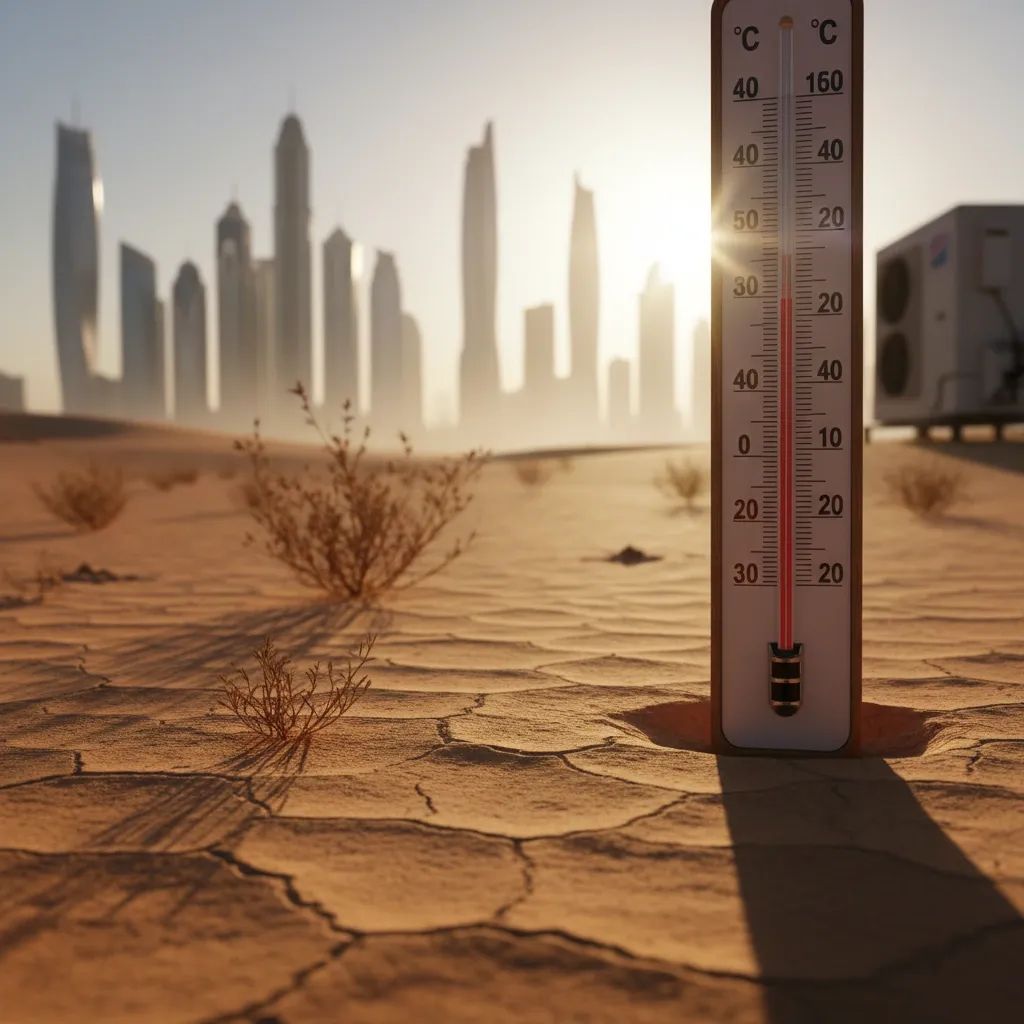
The World Meteorological Organization has confirmed El Niño's arrival in the tropical Pacific with a 90% certainty by November 2026, a shift that will compress already strained utilities, disrupt agricultural imports critical to the United Arab Emirates, and test whether the region's early warning systems can translate forecasts into tangible protection. What distinguishes this moment from previous climate shocks is institutional foreknowledge—there is enough lead time to prepare, and enough data to do so intelligently.
Why This Matters
• 80% probability of El Niño development by August 2026; 90% certainty it persists through November, giving planners a narrow window for concrete action.
• Subsurface tropical Pacific waters are running 6°C above baseline, storing thermal energy that will feed surface warming and atmospheric instability through autumn.
• The UAE's dependence on imported food (approximately 90% of supply) coincides with predicted drought stress in Southeast Asian rice-producing zones and Australian wheat regions, creating commodity price volatility through early 2027.
• Peak summer cooling demand could climb 15-20% above typical seasonal levels, testing grid stability and household budgets precisely when infrastructure is already stretched thinnest.
Reading the Ocean's Warning Signs
El Niño begins not in the atmosphere but in the ocean itself. Beneath the surface of the tropical Pacific, a reservoir of warm water has been accumulating—temperatures running 6 degrees Celsius above historical averages across vast subsurface zones. This heat is not static. It rises gradually to the upper ocean, feeding the surface warming that defines El Niño and triggering the atmospheric pressure oscillations that climatologists call the Southern Oscillation Index. What makes forecasters confident is consensus: dozens of independent climate prediction models from meteorological centers across the globe are in agreement about the trajectory.
The WMO synthesizes these forecasts through a rigorous collaborative process that includes experts from national weather services and international research institutes. The result is not a single prediction but a probability distribution—and the distribution is emphatic. An 80% likelihood between June and August. A 90% certainty by November. For operational planning, these margins leave little room for complacency.
Historical precedent adds weight. The 2023-24 El Niño ranked among the five strongest since reliable observations began, approximately 50 years ago. That event reshaped 2024's global temperature records and created visible disruption: agricultural stress in vulnerable regions, marine ecosystem damage from elevated sea temperatures, and supply chain friction across multiple commodity chains. Current model output suggests the 2026 variant could track similarly or potentially exceed that predecessor, meaning scenario planning must assume worst-case rather than median conditions.
The Arabian Gulf Under Compounding Heat
The United Arab Emirates enters El Niño season already operating at climate margins. Summer temperatures in lowland areas routinely exceed 45 degrees Celsius; combined with coastal humidity, apparent temperature—the subjective heat felt by the human body—approaches 55 degrees or higher, a physiological threshold beyond which sustained outdoor work becomes medically dangerous.
An El Niño-intensified summer will amplify cooling demand precisely when the UAE electricity grid faces its seasonal nadir. The Emirates Water and Electricity Company and regional utilities have pre-positioned reserve capacity during previous strong El Niño cycles, but operational margins shrink when demand spikes unexpectedly. Cooling load responds nonlinearly to ambient temperature—each additional degree above seasonal norms drives disproportionate air conditioning consumption.
The financial arithmetic for households and businesses becomes stark. Industry analysis suggests cooling costs rise 15-20% during extreme heat episodes compared to seasonal baselines. For a typical household paying 800 to 1,200 AED monthly during summer peak, an additional 120-240 AED monthly charge over four months represents meaningful budget pressure, particularly for lower-income residents and workers in labor camps. Businesses operating temperature-sensitive facilities—pharmaceutical warehousing, food storage, data centers—face comparable operational margin compression.
The Arabian Gulf itself represents a secondary vulnerability zone. Marine temperatures during 2023 and 2024 already pushed near coral bleaching thresholds, triggering documented reef mortality in localized zones. Continued thermal stress from El Niño's atmospheric influence—reduced cloud cover, intensified solar radiation, weakened coastal upwelling that normally brings cooler deep water to the surface—can compound damage. Fisheries dependent on reef habitat and associated small pelagic stocks face additional pressure, with implications for food security and the livelihoods of communities historically reliant on marine resources.
Food Security and Fragility in Global Supply Chains
The UAE sources approximately 90% of its food through imports, a structural dependency that transforms distant agricultural shocks into local consequence. Key supplier regions face predictable vulnerability during strong El Niño events.
Southeast Asia—the primary source for rice imports to the Gulf and broader Middle East—typically experiences rainfall deficit and extended dry conditions during El Niño peaks. Thailand, Vietnam, and Cambodia confronted severe droughts during prior strong events, with resulting paddy yield declines and export restrictions. Australia, a major wheat exporter absorbed by Middle Eastern bread-making traditions, faces similarly elevated drought risk in its grain belt during strong El Niño activity.
Commodity markets are already pricing in expected volatility. Wheat futures show measurable sensitivity to El Niño probability adjustments, with some analysts warning that prices could spike 15-25% above current levels if supply shocks materialize. Rice exhibits similar fragility. Less visible but equally consequential: coffee production in Brazil and Vietnam—source regions for significant volumes consumed in the UAE and broader region—faces potential disruption, with price implications extending to hospitality and food service sectors employing thousands of workers across the emirate.
Supply chain professionals in Abu Dhabi and Dubai have begun stress-testing procurement timelines and contingency budgets. Construction companies are reviewing cost overrun scenarios. Retailers are evaluating inventory accumulation strategies ahead of anticipated price spikes. The lead time between forecast and impact—several months—creates an unusually generous window for supply chain professionals to adjust rather than react.
How Atmospheric Circulation Reaches Every Continent
El Niño does not remain confined to the Pacific. The phenomenon redistributes energy and moisture across global atmospheric circulation patterns, creating weather imprints thousands of kilometers away.
The southern United States and Mexico typically experience wetter-than-normal conditions during El Niño peaks, occasionally bringing relief to water-stressed regions. Conversely, India and portions of Bangladesh experience reduced monsoon rainfall, stressing agricultural zones where rain-fed farming dominates. Southern Africa and East Africa historically face drier conditions, intensifying existing water stress. The jet stream patterns that define mid-latitude weather show El Niño fingerprints at higher latitudes, with implications for European and Asian weather into spring 2027.
For the UAE and neighboring regions, El Niño's influence is subtler than in equatorial zones but measurable: reduced maritime trade wind intensity modulates coastal atmospheric stability and cloud patterns. Marine ecosystems absorb the most direct blow. Coral reefs in the Arabian Gulf—already marginal ecosystems operating near thermal thresholds—face accelerated mortality when baseline temperatures rise 1-2 degrees Celsius above historical summer normals. Fish populations dependent on reef complexity and productivity suffer cascading impacts. Broader oceanographic zones face heatwave stress, triggering altered migration timing, reproductive success reductions, and food web disruptions.
Institutional Architecture: From Warning to Action
The WMO has issued updated seasonal climate outlooks incorporating El Niño's developing signature alongside other climate drivers. These updates synthesize data from ocean buoys, satellite sensors, and atmospheric models. National meteorological services, including the UAE National Centre of Meteorology, receive this guidance and translate it into actionable protocols for government agencies, humanitarian organizations, and private sector operators.
One institutional innovation gaining operational traction is anticipatory funding. The International Federation of Red Cross and Red Crescent Societies has updated its Early Action Protocols to enable automatic funding releases when specific scientific thresholds are breached. Rather than mobilizing response reactively after disasters unfold, the system pre-positions supplies and personnel when forecasted conditions meet pre-agreed triggers—such as sea-surface temperature anomalies exceeding defined limits or drought indices crossing particular percentiles. For vulnerable populations in water-scarce zones or coastal communities, this shift from reactive to anticipatory response can mean measurable difference between mitigation and catastrophe.
The UAE's Civil Defence Authority and Meteorology establishment routinely integrate WMO seasonal forecasts into operational planning cycles. Heat-related emergency protocols—guidance for public sector work hour restrictions, water distribution contingencies, and vulnerable population welfare checks—are adjusted based on seasonal forecasts. These administrative measures, while administratively routine, tangibly reduce mortality and morbidity during extreme episodes.
Economic Sectors: Risk and Adaptation
The tourism sector faces bifurcated consequences. Summer months in the UAE already see reduced visitation due to extreme heat; a stronger-than-typical El Niño could compress the summer valley deeper, reducing shoulder-season revenue for hotels. Conversely, winter and early spring weather patterns may stabilize, strengthening visitation during cooler months. Tourism operators and destination marketing organizations are adjusting promotional calendars and room inventory strategies.
Construction and outdoor industry face more direct headwinds. Extended work hour curtailments during peak heat compress project timelines and increase labor costs. Equipment requiring outdoor deployment—cranes, excavation machinery, compaction equipment—faces reduced daily operating windows. Project managers are reviewing milestone schedules and contingency budgets.
Financial markets are pricing climate risk more explicitly. Insurance companies are recalibrating underwriting models and premium rates to reflect disruption frequency. Project finance for major infrastructure undertakings now routinely incorporates climate risk scenarios. The UAE's banking sector, heavily exposed to construction and real estate, is monitoring climate impacts on project viability and borrower credit quality.
Renewable energy investments—already a cornerstone of UAE economic strategy—see potential acceleration. Increased cooling demand during prolonged heat episodes creates peak electricity consumption that aligns with peak solar generation. The marginal economics of solar photovoltaic installations improve when peak-hour electricity prices spike. Major projects in Abu Dhabi and Dubai are positioned to enhance capacity precisely as demand patterns crystallize, effectively converting climate risk into infrastructure opportunity.
What Preparation Actually Requires
For individuals, the practical checklist is direct: review home cooling systems for maintenance needs, ensure adequate hydration infrastructure and electrolyte supplies, monitor labor sector work restrictions, and track household energy consumption against utility projections. Families with elderly members, chronic illness, or outdoor occupations should revisit heat-related health protocols and emergency contact procedures.
Employers in logistics, construction, hospitality, and agriculture should revisit heat safety guidelines. Work schedules may require compression into cooler hours or geographic relocation to air-conditioned facilities. Personnel should receive training on heat illness recognition and response protocols. Supply chain managers should complete contingency procurement planning and accumulate inventory buffers ahead of anticipated commodity volatility.
Investors and business leaders should monitor WMO monthly updates, climate prediction briefings, and commodity futures markets for supply disruption signals. Agricultural futures—wheat, rice, soybeans—typically exhibit volatility during strong El Niño events, creating both hedging opportunities and forward-pricing incentives for informed operators.
The institutional response architecture is already in motion. UN Secretary-General António Guterres has characterized El Niño as an "urgent climate warning," framing the 2026 event not as isolated weather phenomenon but as manifestation of systemic climate instability requiring accelerated energy transition and renewable energy deployment. The framing converts risk into imperative—El Niño becomes not a passive hazard to endure but a catalyst for adaptive infrastructure investment and operational resilience.
The Utility of Foreknowledge
The coming months represent a test of adaptive capacity at global and regional scale. El Niño is neither unprecedented nor unpredictable. The 2023-24 event was successfully forecast months in advance. What distinguishes 2026 is that institutional foreknowledge arrives with sufficient lead time to permit genuine preparation rather than improvisation.
The cost of preparation—adjusting schedules, accumulating buffers, reviewing protocols, investing in renewable capacity—is modest relative to the cost of surprise when extreme conditions arrive. The UAE's position as a climate-vulnerable import-dependent economy makes this calculus particularly sharp. The difference between planned adaptation and reactive response can determine whether El Niño represents managed disruption or systemic stress.
For residents, businesses, and policy makers in the Emirates, the responsibility is clear: acknowledge the forecast, act on it, and recognize that the months ahead will measure institutional maturity against climatic reality.