
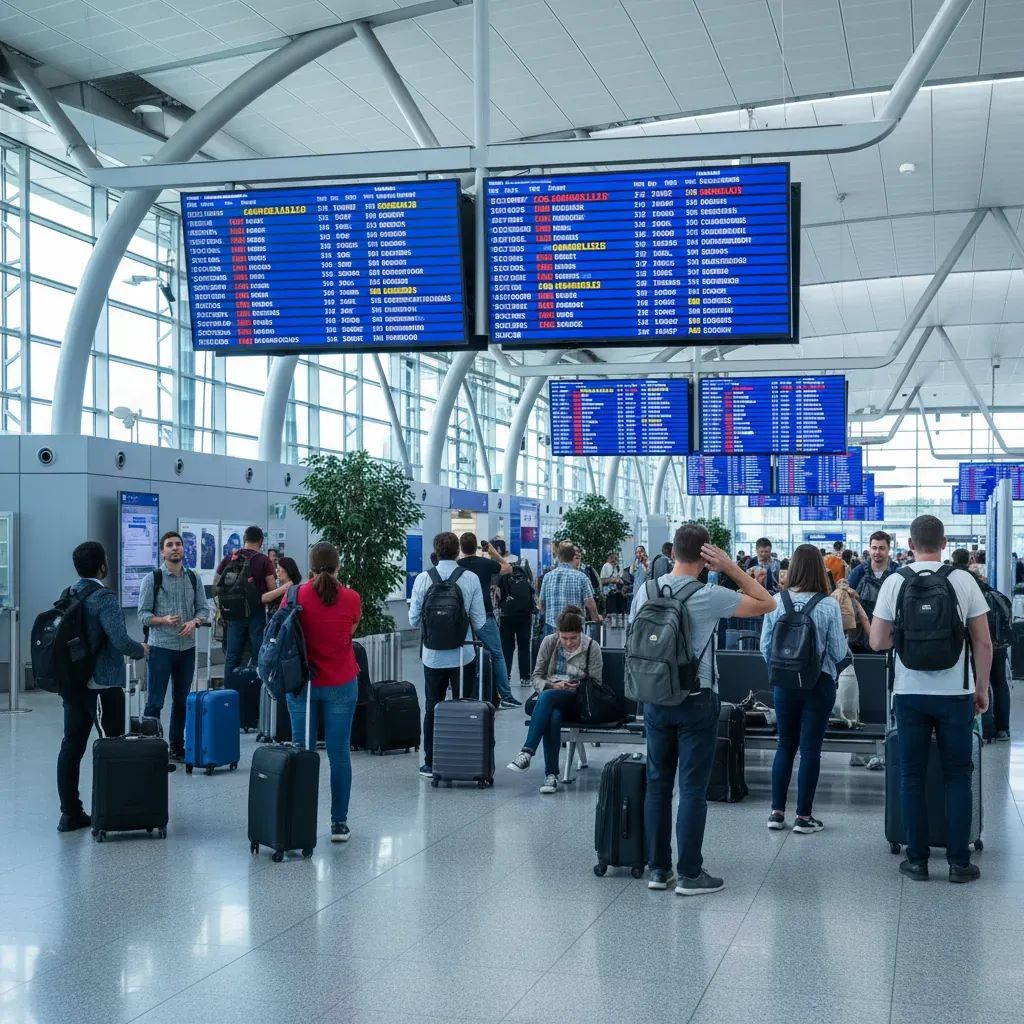
The United Arab Emirates has become a hub for bargain-hunting travelers this season, with flight data revealing a stark split between summer 2026's inflated fares and the approaching autumn window—one that rewards flexibility and timing. As families settle into the new school year, prices on regional and international routes are collapsing by as much as 40%, creating a rare opportunity for those without academic calendars tying them down.
Why This Matters
• Riyadh flights plummet to AED607 in September 2026, delivering significant savings compared to peak summer weeks—the most dramatic bargains for Gulf travelers
• Budget "sweet spot" emerges after early September, when school-bound return flights subside and demand temporarily eases
• Hidden-gem destinations like Georgia and Nepal offer compelling alternatives to traditional hotspots, combining affordable airfares with lower ground costs
The Mathematics of Summer Versus Autumn Travel
The United Arab Emirates aviation market operates under ruthless seasonal economics. Summer 2026 airfares to regional destinations spiked significantly compared to earlier months, driven by school holidays, fuel volatility, and aircraft shortages. These weren't anomalies; they reflected systematic demand patterns shaped by seasonal travel surges.
The pattern held through August. Flights to various destinations ranged widely depending on the specific route and date—a spread that suggested airlines were pricing dynamically based on real-time demand signals.
Then the calendar flipped. As the academic year began in late August, return-to-school demand collapsed within days. Airlines, holding inventory and facing empty seats on outbound routes, adjusted. By early September 2026, prices on major regional routes had normalized to levels unseen since spring. The arithmetic of demand cliffs: airline pricing software sees the event coming, doesn't smooth it gently, and lets prices crater when it arrives.
Where Money Stretches Longest
For travelers planning escapes in the next two months, the geography of value has clarified. Muscat remains the year-round champion at AED672 return—the baseline against which all regional value gets measured. It's also become a victim of its own popularity; everyone from the United Arab Emirates knows Oman represents value, which has softened the discount compared to less-obvious options.
The summer 2026 budget roster reads like an atlas of proximity and convenience. Larnaca, Cyprus at AED811 caters to beach seekers willing to endure a three-hour flight. Madinah at AED982 serves pilgrims and religious travelers. Baku, Azerbaijan at AED1,174 delivers European architecture without the European price tag. Budapest's thermal baths cost AED1,358 return—a reasonable ask for Central European exploration. Goa beaches run AED1,383, capturing Indian leisure travel at package-holiday scale.
September 2026 shifts the value proposition entirely. Riyadh emerges as the headline bargain at AED607 return—underpricing even Muscat and offering quick access to the Saudi capital's evolving entertainment landscape and business districts. Salalah at AED648 captures the tail end of Oman's monsoon season, when hospitality prices drop and tourist density evaporates. Mumbai at AED748, Istanbul at AED836, and Karachi at AED944 create a tier of South and West Asian options that cost less than European alternatives. A cluster of secondary destinations—New Delhi, Cairo, Madinah, Larnaca—hover near AED1,000, representing substantial discounts compared to their summer peaks.
The Overlooked Alternatives That Redefine Budget Travel
Beyond mainstream search results, a tier of destinations exists that combines affordable airfares with lower ground costs—places that haven't yet saturated Instagram feeds or been overrun by tour groups. These matter because cheaper airfares become truly valuable when combined with reasonable accommodation and dining costs.
Georgia stands out as the archetypal example. A direct flight from Dubai takes just under 3.5 hours to Tbilisi, where daily expenses are significantly lower than in the United Arab Emirates, making it an attractive option for budget-conscious travelers. The Georgian capital offers old-town architecture, an emerging international restaurant scene, mountain day trips, and visa-free entry for up to 90 days. For someone from Dubai or Abu Dhabi, Georgia delivers European cultural experience at substantially lower costs than comparable Western destinations.
Armenia's capital, Yerevan, operates in similar territory. Direct flights land after just over 3 hours. The city walks like a European capital but costs considerably less. History drenches the place—ancient churches, Soviet-era monuments, Armenian genocide memorials—set against a mountain backdrop. Food culture has accelerated in recent years, making it increasingly competitive with much more expensive cities.
Nepal presents the extreme affordability argument for airfares. Kathmandu sits about 4.5 hours from Dubai, accessible with visa-on-arrival (eliminating bureaucratic friction). Temple culture, Himalayan access, and vibrant urban scenes combine with low daily expenses. The journey appeals primarily to younger travelers or those with time rather than strict budget constraints.
Sri Lanka splits the difference. Colombo flights take roughly 4.5 hours, delivering to an island with beaches, tea estates, national parks, and cosmopolitan dining. It offers structured experiences—tea plantation stays, whale watching, and colonial-era architecture—at accessible price points.
Kazakhstan's Almaty, roughly 5 hours from Dubai, has emerged as Central Asia's accessible gateway. Visa-free entry for United Arab Emirates residents removes planning friction. Mountains enable hiking and skiing. The city itself blends Soviet infrastructure with modern restoration. It appeals to adventure-oriented travelers rather than resort-bound vacationers.
Azerbaijan's Baku, despite appearing on various affordable destination lists, deserves deeper consideration. The city represents something unique in the region—a successful remaking of Soviet industrial infrastructure into a modern capital with cultural swagger. The "land of fire" mythology (natural gas fires on hillsides) attracts the curious. It's become a weekend hotspot for UAE residents seeking quick-turnaround escapes with walkability and reliable service.
Practical Booking Strategy for the Next Eight Weeks
The window separates into two phases. Early September through mid-September sees elevated demand as families return to school, which temporarily supports pricing on inbound routes. Airlines know this and hold fares firm. Mid-September through October represents the genuine discount zone, when demand settles but hasn't yet spiked for Diwali holidays, autumn breaks, or early winter holiday planning.
Strategic players book within the next 7 to 10 days for mid-September departures. Airlines employ real-time dynamic pricing that adjusts instantaneously based on remaining seat inventory, competitor moves, and algorithmic predictions. The "fares from AED500" promotions that carriers advertise typically apply to 5 to 15 seats per flight—inventory that evaporates within hours. But booking tools now flag seat counts and recency of price drops, giving informed travelers advantages.
Alternative airport options matter. Ras Al Khaimah International and Sharjah Airport sometimes feature different airline networks and occasionally lower fares than Dubai or Abu Dhabi. Ground transport adds an hour each way, but on routes where pricing gaps exceed 15%, the math favors the drive north.
Flexibility on destinations reshapes the entire equation. If someone wants European city culture, Budapest delivers comparable experience to Vienna or Prague at significantly lower cost. Beach seekers weighing Maldives might find Sri Lanka's coastline competitive while offering more ground-level exploration. Religious travelers considering traditional pilgrimage-adjacent trips might discover that smaller Saudi cities provide spiritual experience without the premium that major holy cities command.
The Structural Reality Beneath the Numbers
United Arab Emirates travelers shouldn't interpret September 2026's prices as a return to historical norms. Fuel costs remain volatile, tied to geopolitical tensions and broader global factors. Aircraft deliveries continue at constrained levels—Boeing and Airbus backlogs won't clear for years, meaning carriers operate with perpetual capacity limitations. Middle Eastern airlines remain the region's most profitable carriers, which means they discipline pricing rather than wage aggressive discount wars.
The United Arab Emirates itself remains an economic growth story—expansion projections sustain underlying demand. That demand prevents the kind of cliff-diving fares that appeared in previous downturns. Airlines will fill seats, but they know another peak approaches in November when winter holiday bookings mature and Diwali-adjacent travel accelerates.
What has genuinely shifted is the volatility pattern. The days of last-minute deals have largely evaporated except on routes with chronic oversupply—basically nowhere significant. "Cheap" has recalibrated upward across the industry. Today's budget destinations were yesterday's moderate-cost options. Travelers perceive value differently; expectations have adjusted.
The advantage falls to those who can pivot away from peak periods and reconsider where they actually want to go. Someone bent on Paris or London will pay peak prices whenever they travel. Someone willing to imagine Tbilisi or Yerevan instead gets both affordability and authenticity. The data makes that trade-off increasingly unavoidable.


