
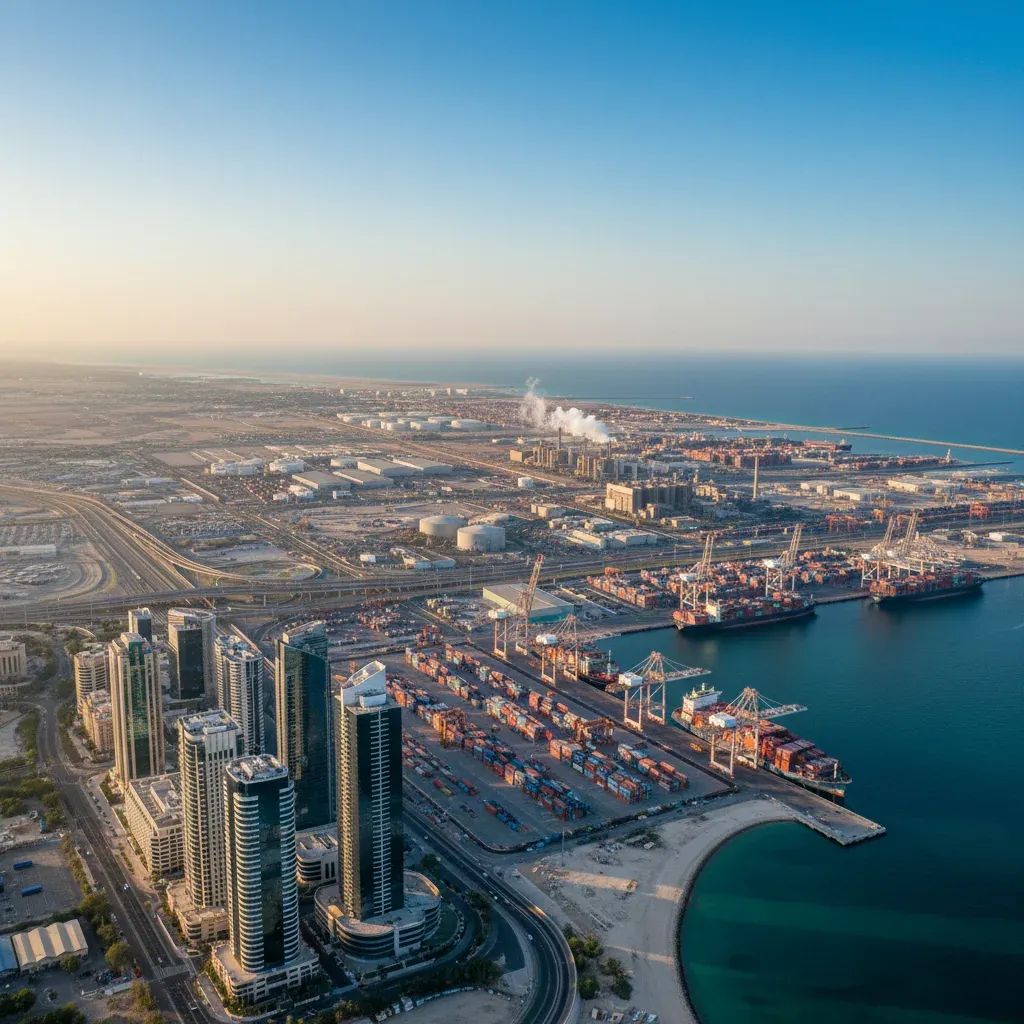
Global energy markets tightened their grip on Thursday as crude futures climbed modestly but meaningfully, with Brent crude rising 9 cents to settle at $105.72 per barrel and West Texas Intermediate adding 15 cents to settle at $101.17 per barrel. The seemingly incremental daily movements mask a far more dramatic reality: oil has become fundamentally scarce, and for residents of the United Arab Emirates—a nation attempting to navigate life after OPEC departure—the implications are immediate and tangible.
Why This Matters
• Fuel costs are climbing: Petrol and diesel prices at pumps throughout the Emirates will remain elevated through at least mid-2026, with full market exposure for most expatriate residents despite government subsidies protecting citizens.
• Transportation and logistics face margin squeeze: Airlines, shipping companies, and last-mile delivery services are already implementing surcharges that trickle down to household budgets and business expenses.
• Investment portfolios depend on market direction: Energy-exposed holdings face persistent volatility, with prices potentially reaching $125-$132 per barrel under certain scenarios, or stabilizing in the mid-$60s if diplomatic progress materializes.
The Anatomy of Supply Collapse
What's driving prices higher isn't speculation—it's arithmetic. The effective closure of the Strait of Hormuz has created a genuine deficit in global oil availability. According to Haitong Futures analyst Yang An, global output fell by 1.8 million barrels per day in April alone, with cumulative losses reaching 12.8 million barrels daily since February. For Gulf producers, the situation is even more acute: regional output now sits 14.4 million barrels per day below pre-conflict levels.
The Strait of Hormuz, which ordinarily carries approximately 21 million barrels daily of crude and refined products, has become a maritime gauntlet. Iran claims roughly 30 vessels successfully transited on Thursday, yet the seizure of a commercial vessel just one day earlier underscores why insurers are hiking premiums and shipping companies are rerouting around Africa. This adds weeks to delivery timelines and significant cost burdens.
For the United Arab Emirates—which formally departed OPEC on May 1—this strait problem creates particular headaches. The Emirates' own production and export infrastructure faces identical constraints affecting neighboring producers. Domestic refineries must contend with expensive feedstock arriving via longer, riskier routes.
Inventories Are Running Dry
Beyond daily price movements, the market's physical tension becomes evident in stockpile data. Global observed inventories fell by 129 million barrels in March, followed by a preliminary 117 million barrel draw in April. This sequential depletion leaves precious little buffer if disruptions worsen.
The U.S. Energy Information Administration projects inventory falls will persist through the second quarter of 2026. More concerning, J.P. Morgan analysts warned in mid-May that global stockpiles could face "operational stress" by early June if current draw rates hold. When inventory buffers thin to critical levels, prices tend to spike violently on any hint of additional supply losses.
Demand Isn't Riding to the Rescue
One potential price dampener—robust global demand—remains muted. The International Energy Agency has slashed its 2026 demand forecast, now expecting consumption to contract by 420,000 barrels daily year-on-year, leaving it 1.3 million barrels below pre-conflict expectations. Aviation and petrochemicals, two major demand drivers, face feedstock constraints and reduced operations.
OPEC, by contrast, maintains greater optimism, projecting global demand growth of 1.17 million barrels daily for 2026, down from an earlier 1.38 million barrel forecast but still pointing to modest expansion. This divergence between forecasters highlights genuine uncertainty about how much high prices will suppress consumption.
OPEC+ Adjustments Pale Against the Crisis
Eight OPEC+ nations (including Saudi Arabia and Russia) approved a modest 206,000 barrel-per-day production increase for May, representing a cautious unwinding of voluntary cuts implemented in April 2023. A further 188,000 barrel daily increase from seven members is scheduled for June following a May 3 virtual meeting.
These adjustments tell a revealing story: even as the alliance attempts to capitalize on elevated prices, the increments are almost completely dwarfed by the 12.8 million barrels daily currently offline. Production tweaks amount to rearranging deck chairs while the fundamental supply shortage persists.
What This Means for United Arab Emirates Residents
Higher crude prices ripple through everyday costs across the Emirates in measurable ways. Airlines operating from Dubai International and Abu Dhabi International airports have already implemented fuel surcharges on routes, with further adjustments virtually certain if crude maintains current levels. Construction and real estate development—sectors deeply reliant on diesel equipment and petroleum-derived materials—face margin compression, with developers holding fixed-price contracts signed before the price surge experiencing particular pressure.
The logistics and transportation sectors, which power the Emirates' trading and commerce backbone, will pass increased operating costs to consumers through higher freight rates and delivery fees. For households, this manifests in elevated food prices, imported goods costs, and general inflation pressure.
Investors holding energy-linked allocations should brace for continued volatility. Markets have whipsawed on diplomatic signals: hopes that the U.S.-China summit in Beijing on May 15 might produce Iranian de-escalation proved unfounded, refocusing attention on potential military escalation and extended Strait closure scenarios.
The Forecast Spectrum
Expert predictions diverge sharply depending on assumptions about conflict duration. The EIA expects Brent to average $106 per barrel through June before retreating to $89 in the fourth quarter and $79 in 2027 as Middle Eastern production gradually recovers. This represents the base-case consensus view.
More bullish scenarios emerge from forecasters like Long Forecast: they model WTI potentially reaching $125.28 in June and Brent climbing to $132.09. These prices assume persistent supply tightness and geopolitical friction extending through the summer months.
Fitch Ratings takes a more optimistic stance, assuming the Strait of Hormuz closure lasts roughly one month, with prices subsequently retreating to the mid-$60s by late 2026. This implies a relatively near-term diplomatic resolution.
At the extreme end sits Macquarie Group, which assigns a 40% probability to Brent reaching $200 per barrel if the conflict extends into June. Worst-case modeling—involving infrastructure damage to alternative pipeline routes—theoretically pushes prices to $370 in theoretical maximums, though such scenarios carry minimal probability.
The Practical Calculus Ahead
For residents and businesses in the United Arab Emirates, prudent planning assumes sustained elevated energy costs through at least Q3 2026, with potential relief arriving only if diplomatic breakthroughs materialize in the coming weeks. Transportation-dependent sectors should lock in hedging strategies where possible. Real estate investors should scrutinize contractor fuel-cost clauses and consider flexible contract terms. Households should absorb the reality that petrol and diesel prices will remain above historical averages for months, affecting everything from commuting expenses to food and goods pricing.
The market fundamentals are clear: a genuine supply shortage exists, inventories are draining, and demand remains soft. Until either Strait of Hormuz transit resumes meaningfully or diplomatic developments dramatically shift sentiment, oil will trade in a range likely between $95 and $110 per barrel, with occasional spikes higher on geopolitical headlines. For an economy like the UAE's, heavily exposed to energy prices through both domestic consumption and regional trade dynamics, this represents the new operating environment for the remainder of 2026.


