
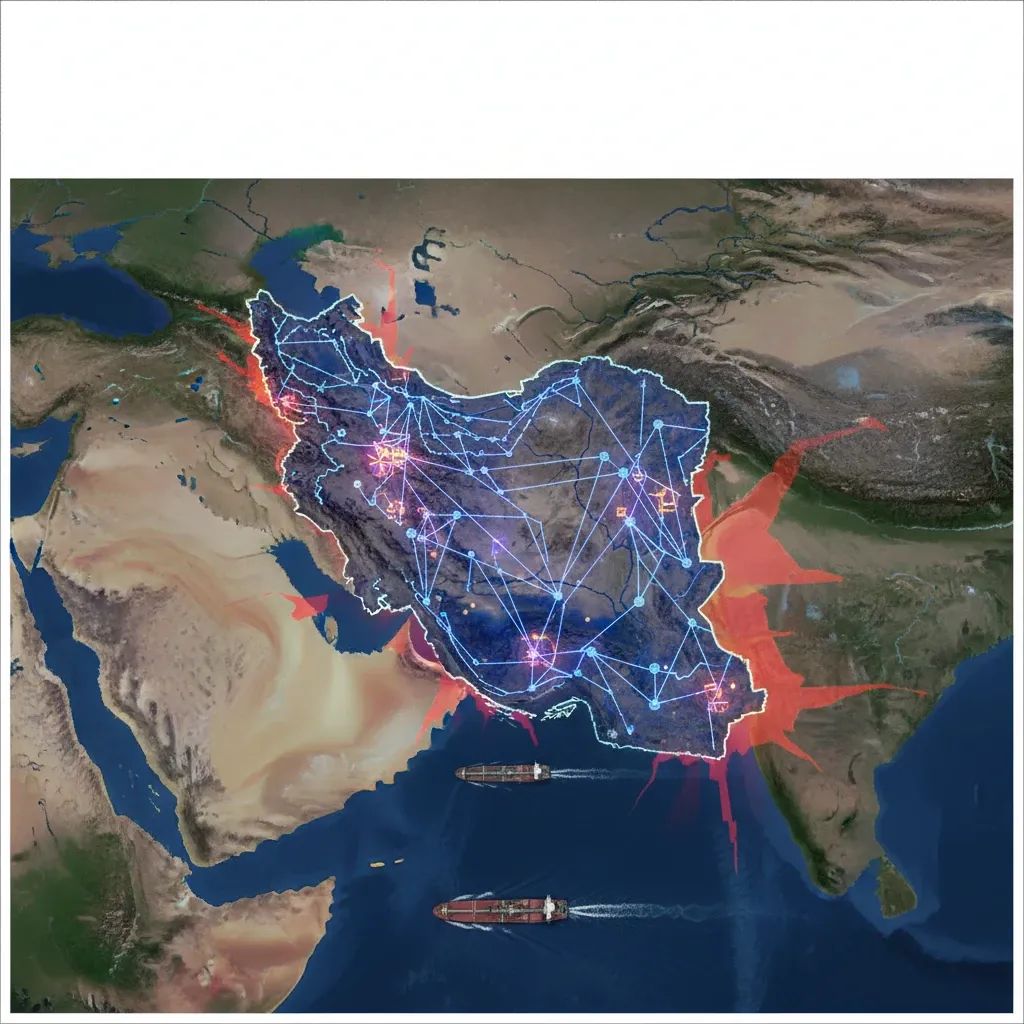
The United States military has launched precision strikes on military installations at Kharg Island, Iran's vital oil export nerve center, while explicitly leaving the island's massive petroleum infrastructure intact—for now. The message from President Donald Trump was unambiguous: interfere with shipping through the Strait of Hormuz, and those oil facilities will become the next target.
Why This Matters
• Oil prices have surged: Brent crude has jumped from roughly $70 to over $110 per barrel in a matter of days, translating to higher fuel costs across the United Arab Emirates and the wider Gulf region.
• Strategic shipping threat: Iran has threatened to close the Strait of Hormuz, through which 20% of the world's traded oil passes—a move that would cripple regional energy exports, including those from the UAE.
• Retaliation warning: Tehran has vowed to strike energy infrastructure belonging to companies cooperating with Washington, potentially putting UAE-based oil assets in the crosshairs.
• Market volatility: Global stock indices have tumbled, and analysts warn of prolonged inflation and recession risk if the conflict escalates further.
What Happened on Kharg Island
On Friday, March 13, 2026, U.S. Central Command carried out targeted strikes on Iranian military assets stationed on Kharg Island, a small but strategically crucial landmass in the northern Persian Gulf. According to President Trump's statement released Saturday morning, the operation "totally obliterated" air defense systems and a naval base positioned on the island.
What makes this strike particularly significant is what was deliberately spared. Kharg Island handles approximately 90% of Iran's crude oil exports—roughly 1.8M barrels per day under normal conditions—and hosts storage tanks capable of holding up to 30M barrels of petroleum. Despite this concentration of energy infrastructure, Trump confirmed the oil facilities were intentionally left untouched.
The calculus is simple: the White House is using the threat of economic devastation as leverage. If Iran moves to block or attack commercial vessels transiting the Strait of Hormuz, the sprawling network of loading terminals, pipelines, and storage tanks on Kharg Island will be destroyed in follow-up strikes.
Iranian state media, including the Fars news agency, acknowledged Saturday that the island's oil infrastructure sustained no damage, though they provided no details on casualties or the extent of damage to military sites.
Impact on Residents & Investors in the UAE
For expatriates, businesses, and investors in the United Arab Emirates, this conflict is no longer a distant headline—it's a live risk to daily life and financial planning.
Fuel and living costs are climbing. The 30%+ spike in global crude prices is already filtering through to petrol stations, utility bills, and transportation networks. The UAE government has historically subsidized some energy costs, but sustained high prices may force adjustments in coming weeks. Residents should monitor fuel price announcements, which the UAE typically adjusts quarterly based on global market movements. For essential supplies, stockpiling non-perishable items is a reasonable precaution if supply chain disruptions extend beyond a few weeks.
Aviation and shipping disruptions are mounting. Several international carriers have suspended flights over Iranian airspace, and maritime insurers are charging hefty premiums for vessels transiting the Gulf. The Port of Jebel Ali, one of the world's busiest container hubs, has seen scheduling delays as shipping companies reroute to avoid potential conflict zones. Residents and businesses relying on international shipments should expect longer delivery timelines and possible cost increases.
Financial markets are jittery. The Dubai Financial Market General Index and the Abu Dhabi Securities Exchange have both posted significant losses, tracking broader declines in global equities. Investors with exposure to energy, aviation, or emerging market funds should review their portfolios for concentration risk. For expat workers with savings denominated in home currencies, the current volatility presents both risk and opportunity—the UAE dirham's peg to the US dollar has provided relative stability compared to other regional currencies, but currency volatility in remittance corridors remains elevated for workers sending money to South Asia, Southeast Asia, and Africa.
Most concerning is Iran's explicit threat to target energy infrastructure owned by firms cooperating with the United States. The UAE hosts significant American military installations and has historically aligned with Washington on Gulf security. Should Tehran make good on its warnings, UAE-based oil facilities, ports, and refineries could face drone or missile attacks similar to the 2019 strikes on Saudi Arabia's Abqaiq complex. Residents and business owners should verify that their insurance policies cover conflict-related disruptions—standard commercial policies often exclude war or political violence. Specialized maritime, energy, and aviation insurance providers operating in the UAE can advise on coverage options and costs.
The Strait of Hormuz Choke Point
The Strait of Hormuz is a narrow waterway—just 21 nautical miles wide at its narrowest point—that separates Iran from Oman and the UAE's Musandam exclave. It is the single most critical energy chokepoint on the planet, channeling roughly 21M barrels of oil and significant liquefied natural gas (LNG) volumes daily.
Iran's Islamic Revolutionary Guard Corps (IRGC) has repeatedly demonstrated its ability to harass, seize, or disable vessels transiting the Strait using fast attack boats, mines, and anti-ship missiles. In recent days, Tehran has issued statements suggesting it could effectively close the waterway in retaliation for U.S. strikes.
Such a closure—even partial—would constitute the largest energy supply disruption in modern history. Gulf producers including Saudi Arabia, Kuwait, Iraq, and the UAE have already begun cutting output in response to the uncertainty, collectively removing an estimated 10M barrels per day from global markets. Qatar's LNG exports, a crucial supply source for Asia and Europe, have also faced interruptions.
For the UAE, the implications are severe. The country exports approximately 3M barrels of crude per day, much of it via the Strait of Hormuz. However, the UAE maintains strategic redundancy through the Abu Dhabi Crude Oil Pipeline to Fujairah on the Gulf of Oman, which can handle roughly 1.5M barrels per day and provides an alternative export route bypassing the Strait. This pipeline network gives the UAE greater resilience than many regional peers, though it cannot fully offset a prolonged Strait closure.
Why Kharg Island Is Iran's Economic Lifeline
Kharg Island is not merely an oil terminal—it is the economic lifeline of the Iranian state. Located about 25 kilometers off Iran's southern coast, the island hosts deep-water loading berths capable of servicing supertankers, as well as extensive pipeline networks connecting it to Iran's largest onshore fields, including Ahvaz, Marun, and Gachsaran.
The island's facilities can theoretically handle up to 7M barrels per day and service multiple supertankers simultaneously. Roughly 18M barrels of crude are typically stored on Kharg at any given time, equivalent to 10-12 days of normal export volume.
Because Kharg is so central to Iran's revenue, it has been targeted before. During the Iran-Iraq War in the 1980s, Iraqi forces repeatedly bombed the island's infrastructure. Despite heavy damage, Iran managed to repair facilities and maintain a flow of exports, demonstrating both the island's resilience and its strategic indispensability.
The U.S. decision to strike only the military installations—air defenses, radar sites, and a naval base—while sparing the oil infrastructure reflects a deliberate escalation strategy. Washington is signaling that it can cripple Iran's economy at will, but is choosing not to—yet.
What Comes Next
The conflict, now entering its third week, shows little sign of de-escalation. Iran's leadership has framed the U.S. strikes as an act of aggression and vowed to respond. The Iranian Armed Forces have explicitly stated that any attack on the country's oil and energy infrastructure will trigger retaliatory strikes on energy assets owned by firms cooperating with the United States in the region.
The International Energy Agency (IEA) has already agreed to release 400M barrels from strategic petroleum reserves in an effort to stabilize markets, but analysts caution that this measure will only provide temporary relief if the conflict expands.
For businesses and residents in the UAE, the priority is scenario planning grounded in practical steps. Companies should immediately: assess exposure to energy price volatility, review supply chain dependencies on routes through the Strait of Hormuz, and consider hedging strategies for currency and commodity risk. Individuals should: monitor official UAE government announcements regarding fuel price adjustments and price stabilization measures; verify that insurance coverage—home, auto, travel, and business policies—includes conflict-related disruptions; review remittance arrangements and currency exposure if sending money abroad; and prepare contingency plans for potential disruptions to air travel and fuel availability, including maintaining adequate fuel reserves and alternative transportation options.
The next few days will be critical. If Iran retaliates by targeting shipping or regional energy infrastructure, the White House has made clear that Kharg Island's oil facilities—and potentially other Iranian energy assets—will be destroyed. That outcome would send oil prices into the stratosphere, trigger a global inflation shock, and push the Middle East deeper into a conflict with no clear exit strategy.


