
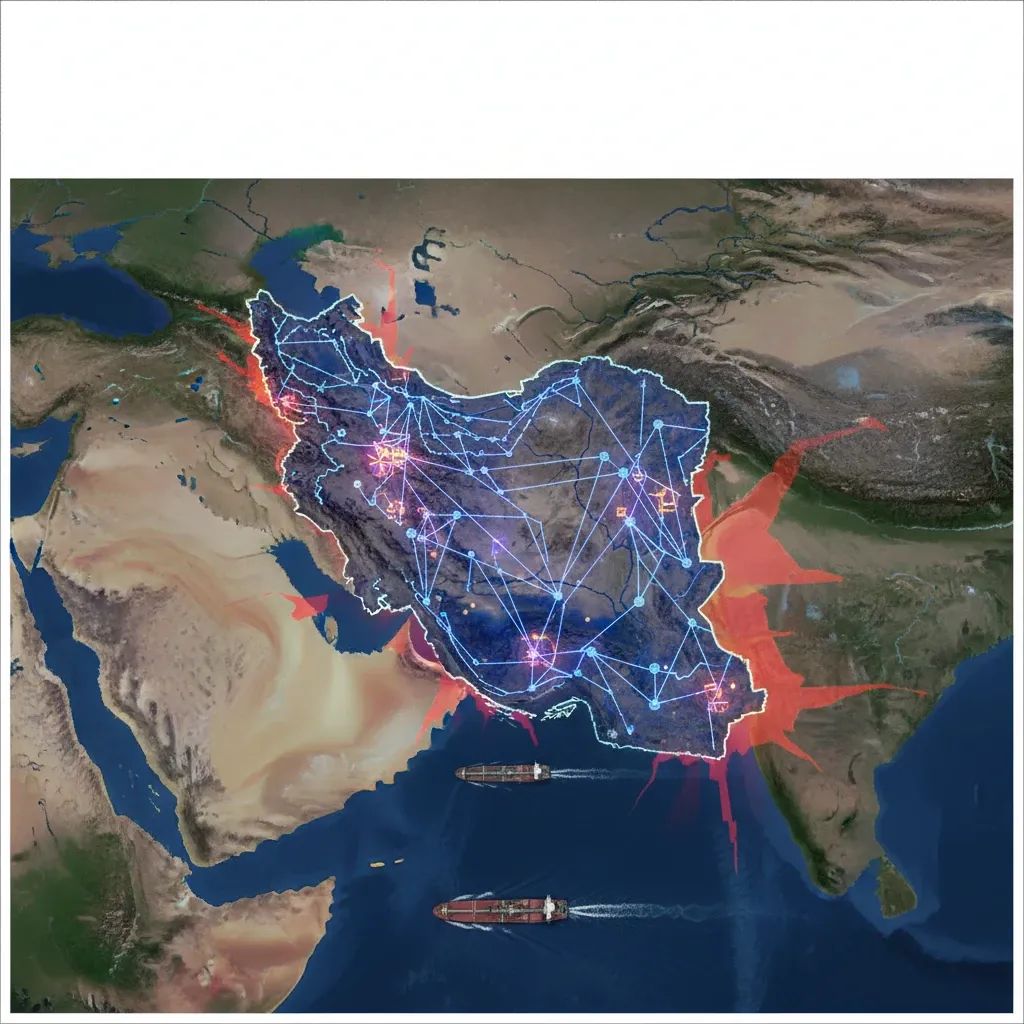
Nuclear Tension Reshapes Gulf Security and Cost of Living
The cycle of military strikes on Iran's nuclear infrastructure has entered a new phase, and residents across the United Arab Emirates are already feeling the ripple effects through rising insurance premiums, volatile oil markets, and deepening geopolitical uncertainty. Fresh damage confirmed this week at the Natanz Fuel Enrichment Plant marks the third major targeting of Iran's atomic complex in less than a year, a pattern that analysts warn may be approaching a critical threshold for regional escalation.
Why This Matters
• Oil and fuel prices volatile: Strikes near the Strait of Hormuz corridor create supply-chain anxiety; energy markets historically spike following similar incidents.
• Insurance costs climbing: Shipping and aviation premiums have risen measurably for companies operating across the Gulf, directly hitting business operating budgets.
• Uncertainty ahead: The next 6-12 months will likely determine whether Iran accelerates its nuclear program or pursues negotiations, either scenario carrying consequences for UAE stability and commerce.
The Damage: What Satellite Evidence Reveals
Geospatial firms Vantor and Maxar Technologies released imagery on March 2-3, 2026, showing precision strikes targeting the administrative and logistical nerve centers of the Natanz complex. Three structures were destroyed: a personnel entry building, a vehicle access ramp serving the underground facility, and a power distribution station. These are not the enrichment halls themselves—those lie buried beneath reinforced concrete and earth—but rather the gateways through which workers and supplies access the plant's most sensitive operations.
The Institute for Science and International Security analyzed the damage patterns and concluded at least two distinct strikes hit access points simultaneously. This distinction matters considerably. The entrance buildings and support infrastructure can be rebuilt within months. The underground enrichment machinery, if truly undamaged, represents Iran's functional capacity to resume operations once surface repairs conclude.
Initial claims by the International Atomic Energy Agency on March 2 stated "no indication" of damage. By March 3, the agency reversed course after reviewing satellite imagery, acknowledging "some recent damage to the entrance buildings" while emphasizing that no radiological contamination is expected and core facilities remained untouched. This reversal—from denial to partial admission in 24 hours—reflects the friction between what imagery shows and what officials initially claim for diplomatic reasons.
A Longer Pattern of Attrition
The March 2026 strikes do not occur in isolation. They represent the latest chapter in a 20-month campaign of targeting that has fundamentally reshaped Iran's ability to pursue rapid nuclear advancement.
In June 2025, Israeli forces executed "Operation Rising Lion," a 12-day aerial campaign striking military and nuclear installations across Iran. Days later, the United States intervened directly, deploying GBU-57 bunker-buster ordnance—weapons designed to penetrate reinforced underground facilities—against three locations: Natanz, Fordow, and Esfahan. Satellite photos from November 2025 confirmed the destruction was extensive. The above-ground Pilot Fuel Enrichment Plant at Natanz, where Iran had been enriching uranium to 60% purity, appeared flattened. Underground halls sustained structural damage. Repair crews worked slowly, and operational centrifuges remained largely dormant.
Between June and February 2026, Iran engaged in damage assessments, fortification work, and concealment efforts. Intelligence analysts observed Iranian teams covering anti-drone defenses with camouflage netting—a signal that repair work was proceeding but perhaps not at pace. Then, on February 28, 2026, coordinated US-Israeli strikes resumed. Within days, Mohammad Eslami, Iran's atomic energy chief, accused Washington and Tel Aviv of "brutal attacks" on Natanz. The IAEA's March 3 confirmation validated his claims, even if the agency tried to minimize the significance.
The Nuclear Math: What Iran Lost and What Remains
The strategic question underlying these strikes is straightforward: Can Iran reconstitute a weapons-capable nuclear program despite repeated physical damage?
Before the June 2025 offensive, Iran had accumulated 182 kilograms of uranium enriched to 60% purity—a threshold that places the material in the category of "near-weapons-grade." According to the IAEA, that stockpile represented enough material, if further enriched to 90%, to produce multiple nuclear warheads. The same agency reported in May 2025 that Iran's inventory of this high-enriched material had surged roughly 50% in just three months, suggesting an accelerating trajectory toward weapons capability.
The June strikes created what military strategists term "major bottlenecks" in that weaponization pathway. They destroyed Iran's primary route to weapons-grade plutonium. They crippled centrifuge production. They halted active uranium enrichment at the main sites.
Yet the threat has not vanished. Satellite observation has identified construction activity at an underground site south of Natanz, colloquially known as "Pickaxe Mountain," where Iran is reportedly building an advanced centrifuge assembly facility. Iran announced in late 2024 intentions to install 32 additional centrifuge cascades—machinery that, once operational, would substantially expand enrichment capacity. While current damage has delayed or disrupted those plans, Iran's long-term industrial capacity to reconstruct remains largely intact.
This creates an uncomfortable reality: Iran faces setbacks and delays, not permanent incapacity. Historical precedent reinforces this calculation. After a mysterious explosion damaged Natanz's centrifuge production plant in July 2020 (widely attributed to Israeli sabotage), Iran responded not by retreating but by accelerating uranium enrichment to 60%—a provocative escalation in response to physical destruction.
Costs Rippling Through the UAE Economy
For residents and businesses in the United Arab Emirates, the military campaign against Iran's nuclear sites translates into measurable economic consequences.
Energy and fuel volatility presents the most immediate concern. Roughly 20% of global crude oil supplies transit the Strait of Hormuz daily, a waterway lying within 300 kilometers of Natanz and other Iranian facilities. Traders price geopolitical risk into oil futures constantly. Following similar regional incidents, fuel and electricity costs in the UAE have spiked intermittently. Companies budgeting for 2026 operations now face uncertainty around energy expense forecasts.
Marine and aviation insurance represents a second-order effect often overlooked by casual observers. Insurers covering vessels transiting toward Jebel Ali, Fujairah, or Ras al-Khaimah have raised premiums to reflect heightened risk. A standard maritime policy for cargo moving through contested waters now costs measurably more than it did six months ago. For import-export enterprises relying on Gulf logistics, this translates directly to bottom-line margin pressure.
Financial sector exposure has attracted less public discussion but concerns compliance officers at UAE-based banks and investment firms. Many regional financial institutions hold equity exposure to energy companies or have clients with significant holdings in oil and gas equities. Political risk in the Persian Gulf generates volatility in those positions. Additionally, the reimposed UN snapback sanctions on Iran—triggered in September 2025 after Tehran violated nuclear commitments—have complicated compliance frameworks for any entity with historical or ongoing business ties to Iranian counterparts, even indirect ones through third-party intermediaries.
Diplomatic positioning remains ambiguous. The UAE government has publicly called for restraint and de-escalation while quietly reinforcing air defense systems. Expatriates monitoring travel advisories and embassy guidance should expect updates could change rapidly if military tensions reignite.
The International Sanction Regime Tightens
In September 2025, France, Germany, and the United Kingdom jointly triggered the reimposition of snapback sanctions on Iran—mechanisms built into the defunct Joint Comprehensive Plan of Action (JCPOA). These nations cited Iran's violations of "the near entirety" of its nuclear commitments, leaving them no diplomatic alternative.
The reimposed sanctions prohibit transfer of nuclear technologies and missile-development components. They authorize member states to inspect cargo entering and leaving Iran. The stated objective is "zero nuclear enrichment"—a goal that appears increasingly distant given Iran's continued construction and underground activity.
Economic pressure on Tehran remains intense. Decades of sanctions, compounded by currency devaluation and inflation exceeding 40% in certain periods, have eroded state revenue and constrained Iran's ability to fund reconstruction projects. Oil exports have diminished. Access to international financial systems remains restricted. Yet Iran has historically prioritized nuclear and defense spending even during severe economic hardship, suggesting that financial constraints alone will not halt enrichment ambitions.
What Happens Next: The Strategic Uncertainty
Rafael Grossi, the IAEA's Director-General, issued a public appeal for "maximum restraint" following the March damage confirmation. He underscored the inherent hazards of armed attacks on nuclear facilities—radiological contamination risks, wider conflict escalation, precedent-setting dangers. The agency attempted to contact Iranian nuclear regulatory authorities through its Incident and Emergency Center but reportedly received no response as of March 3.
The silence is telling. Iran has historically responded to physical setbacks with accelerated enrichment activity, not capitulation. Whether the March 2026 strikes trigger a similar escalatory cycle remains the central question occupying analysts in capitals from Washington to Abu Dhabi.
Iran's centrifuge infrastructure, while degraded, remains functional. Underground enrichment halls at Natanz are nominally operational, though access has been compromised and surface support systems damaged. The regime's diplomatic calculations—whether to pursue negotiation, pursue clandestine advancement, or accelerate publicly announced enrichment—will shape the next phase.
For residents and businesses across the United Arab Emirates, that period of uncertainty is likely to persist for months. The next round of satellite imagery may reveal either renewed military targeting, evidence of Iranian reconstruction efforts, or signals of diplomatic movement. Until then, cost-of-living pressures, insurance volatility, and geopolitical anxiety will remain elevated features of life in the Gulf.


