
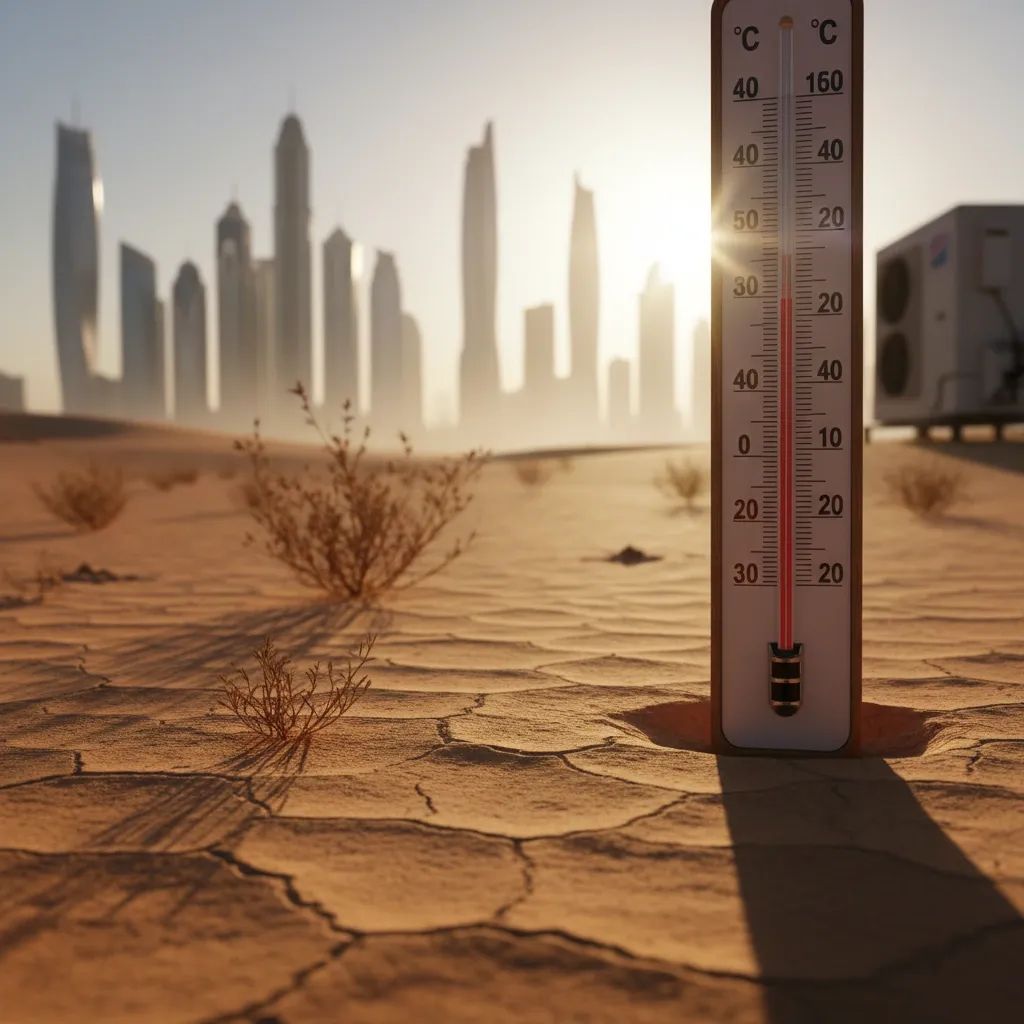
The Heat Is Arriving Earlier Than Expected
The United Arab Emirates National Centre of Meteorology has issued its May climate assessment, and the outlook confirms what residents have already begun to feel: the familiar seasonal progression is compressing. This month marks not just another warm period but an inflection point where the buffer between spring and the crushing summer heat has effectively vanished. Average temperatures will settle around 33°C, with daytime highs climbing toward 37°C to 40.7°C and inland zones potentially touching 44°C or higher as May progresses. For residents and businesses, this reality reshapes three critical dimensions of daily life: personal health, energy infrastructure, and the rhythm of work itself.
Why This Matters
• Heat emergencies may peak earlier: Hospital admissions for heat-related illness typically spike in June; May 2026 could trigger that surge weeks ahead of schedule.
• Electricity bills will spike dramatically: Air conditioning demand is expected to surge 40% to 70% above baseline, with single-family villas seeing utility costs potentially double.
• Outdoor work windows are narrowing: Construction and logistics sectors are already restructuring schedules, shifting labor from afternoon to early morning to avoid the worst heat.
The Mechanics of the Warming Trend
May sits at the meteorological crossroads between seasons. The Siberian high-pressure system, which dominated winter weather patterns, loses its grip as the sun's apparent movement shifts northward across the equator. This seasonal handoff is entirely normal—what is not normal is the baseline temperature at which it occurs.
Historically, May across the UAE averages 32.2°C, with coastal cities like Dubai and Abu Dhabi near 32°C to 32.5°C and interior areas such as Al Ain trending slightly cooler. This year, forecasters expect the month to track above those norms. Last May—May 2025—demonstrated the trajectory: the average maximum temperature reached 40.4°C, compared to the 39.2°C long-term average, making it the hottest May on record for the country. The highest single temperature ever recorded in May was 51.6°C in Sweihan in 2025.
The underlying driver is not meteorological mystery. The UAE is among the fastest-warming regions globally, with average annual temperatures climbing approximately 1.8°C between 1980 and 2017. Climate models project further increases of 1°C to 2.8°C through 2050 and 1.9°C to 4.15°C by 2080, depending on emissions pathways. This sustained warming means May 2026 is not an outlier—it is the new pattern.
What This Means for Residents
The temperature forecast translates into immediate, tangible consequences for how people live.
Health and Safety: Heat-related illness operates on a spectrum that moves quickly. Early symptoms—excessive sweating, dizziness, rapid pulse—can deteriorate into heatstroke within hours if someone remains exposed. The UAE National Climate Change Adaptation Program has documented a steady rise in heat-related hospital admissions during summer, a curve that appears set to shift leftward. Children, the elderly, and outdoor workers face the highest risk, but no one is immune. Beyond the acute physical dangers, prolonged heat exposure correlates with anxiety, depression, disrupted sleep, and social withdrawal due to reduced outdoor activity. The psychological toll is real and worth acknowledging: residents confined indoors for much of daylight have measurably worse mental health outcomes during summer months.
Work Schedules: The United Arab Emirates enforces outdoor work restrictions during peak summer (typically mid-June through mid-September) from 12:30 PM to 3 PM, a ban designed to prevent heat-related fatalities among construction workers, delivery personnel, and landscapers. May's early heat is forcing sectors to preempt this schedule. Construction sites across the emirates are already shifting to split schedules: labor-intensive work begins at 5 AM to 7 AM, pauses during midday peak, and resumes in the late afternoon. This restructuring adds coordination overhead and extends project timelines, yet it is the only viable approach when daytime temperatures approach 40°C.
Daily Routines: Families are adjusting when they run errands, exercise, and allow children outdoor time. The window for safe outdoor activity is compressed to early morning (5 AM to 10 AM) or evening (after 6 PM), a constraint that ripples through school schedules, recreational facilities, and social calendars. Residents must carry water constantly, monitor vulnerable family members—children and elderly relatives particularly—and ensure hydration is not treated as optional.
The Energy Grid Is About to Feel the Strain
Air conditioning consumes 40% to 60% of household electricity in the UAE during normal months. This ratio climbs to 60% to 70% when summer arrives. May's heat will trigger that spike weeks earlier than usual.
The practical outcome: electricity bills are on track to double or triple for May compared to cooler months. A family in a three-bedroom villa in Dubai could expect their utility bill to jump from approximately AED 400–600 in April to AED 1,000–1,500 in May as cooling systems run almost continuously. Apartments are somewhat insulated from this because shared infrastructure distributes costs, but single-family homes and large commercial properties face the full burden.
Beyond individual bills, the demand surge strains the national grid. Power generation plants must burn more fuel, placing pressure on natural reserves and increasing carbon emissions. In extreme scenarios, localized outages occur when demand exceeds supply capacity, though the UAE's integrated grid management has become sophisticated enough to avoid wholesale blackouts. Still, appliance failures—particularly air conditioning units that have not been serviced—become more common when systems are pushed to their limits continuously.
Atmospheric Conditions: Rain, Fog, and Dust
May is officially a dry month. The long-term average rainfall is approximately 1mm for the entire month, and many years see zero measurable precipitation. However, atmospheric dynamics do shift in early May. The weakening Siberian high-pressure system creates an opening for depressions arriving from the east and west. When these systems align with westerly upper air troughs, cloud formation increases.
The result: isolated, brief rain showers are possible, though not probable. The highest rainfall ever recorded in a single May was 134.4mm in Al Fali in 1981, an extreme outlier. More realistic May weather brings a 10% to 20% chance of light, scattered showers in localized areas—useful for gardens but not transformative for water reserves.
Fog and mist are more likely during May's first half, particularly over coastal areas and scattered inland zones during early morning hours before sunrise. The NCM recorded May 2021 as the foggiest May on record, with 4 distinct fog events and 10 misty days. These conditions reduce visibility on highways and coastal roads but typically dissipate by mid-morning. The frequency of fog declines sharply after mid-May as humidity levels drop slightly.
Wind and Dust: The Secondary Hazard
Mean wind speeds hover around 13 km/h, a gentle breeze that rarely commands attention. However, gusts can strengthen significantly, particularly over western zones and desert regions, reaching 30 km/h to 40 km/h. The highest wind speed ever recorded in May was 117.2 km/h at Jabal Mebreh in 2010, a storm-force event that remains rare.
When winds freshen, they carry blowing dust and sand that reduce visibility, especially across desert highways and exposed areas. Visibility can drop below 1,000 meters during active dust episodes. Beyond the traffic safety concern, dust combined with heat and humidity aggravates respiratory conditions. People with asthma, allergies, or chronic obstructive pulmonary disease (COPD) experience noticeable symptom flare-ups.
The NCM issues dust advisories when conditions warrant—available on their mobile app and website. Residents planning highway travel, particularly to destinations like Al Ain or the eastern region, should check these forecasts before departing.
The Longer Trend: What Five Years of Data Tells Us
May 2026 is not occurring in isolation. Nighttime temperatures in the UAE are rising faster than daytime highs, a phenomenon driven by increased atmospheric moisture that traps heat. This explains why residents report feeling less recovered from the heat overnight and why sleep quality deteriorates during warm months. The phenomenon is expected to intensify as the climate continues shifting.
Historical data from May 2025 provides a near-term benchmark. Last year's average maximum temperature of 40.4°C exceeded the 39.2°C historical average by 1.2°C—a significant margin in meteorological terms. This year is likely to either match or slightly exceed that performance, given the underlying warming trajectory.
Practical Guidance for the Month Ahead
Residents can navigate May's heat effectively by adopting straightforward adaptations:
Hydration is the foundation. Carry water or electrolyte drinks whenever leaving air-conditioned spaces. Dehydration develops silently; thirst is not a reliable indicator in extreme heat.
Dress deliberately. Light-colored, loose-fitting fabrics—linen, cotton, or bamboo—allow air circulation and reduce body temperature. Avoid dark colors and tight clothing that trap heat.
Limit peak-hour exposure. The window between 11 AM and 4 PM is the danger zone. Accomplish outdoor tasks before 10:30 AM or after 5 PM.
Check on others. Monitor children, elderly relatives, and anyone with pre-existing conditions like diabetes or heart disease daily. Heat stress can develop rapidly in vulnerable populations.
Service cooling systems now. Air conditioning units running 16+ hours daily are prone to failure. Professional maintenance before May begins prevents mid-month breakdowns when you need the system most.
Budget for higher bills. Expect electricity costs to increase significantly. Plan household finances accordingly and consider energy-saving measures like programmable thermostats or reflective window treatments.
The United Arab Emirates National Centre of Meteorology publishes daily forecasts and weather advisories via its website and mobile app. Consulting these resources regularly throughout May allows residents to adjust plans and anticipate changing conditions before they become dangerous.


