
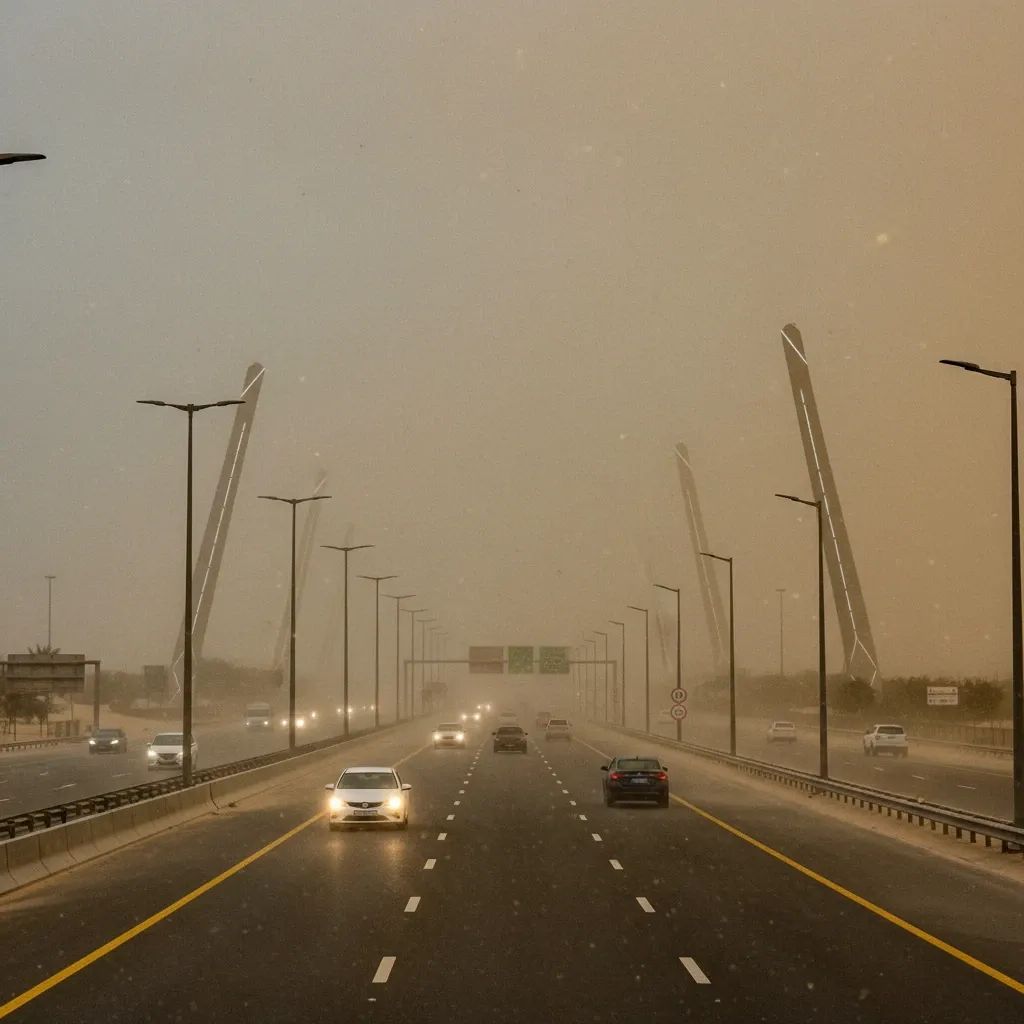
The next five days will test the patience of drivers, ferry captains, and outdoor workers across the United Arab Emirates as a significant low-pressure system brings rain, dust, and treacherous visibility to the region from March 11 through March 15. Unlike the UAE's typical spring predictability, this meteorological event demands real adjustments to daily routines, commute planning, and workplace operations.
Daily Weather Breakdown: March 11-15
Wednesday, March 11 – Peak Disruption DayPartly cloudy to cloudy and dusty conditions dominate throughout the day. Strong northeasterly winds reach 50 km/h, creating hazardous visibility on highways, particularly on intercity routes like Sheikh Zayed Road. The Arabian Gulf becomes rough with wave heights reaching approximately 2 meters in exposed areas, while the Oman Sea remains moderate. This is the most severe wind day of the five-day window and requires maximum caution from drivers and maritime operators.
Thursday, March 12Morning humidity and light fog formation possible westward, then partly cloudy to cloudy skies develop. Scattered rainfall occurs over various areas. Northeasterly winds moderate to 15–25 km/h, occasionally reaching 35 km/h. The Arabian Gulf becomes moderate to slight, showing improvement from Wednesday's rough conditions. Temperatures remain relatively stable.
Friday, March 13Morning fog concentrates near coastal zones and burns off by mid-morning. Light rainfall occurs over some western, coastal, and island areas during the daytime. Northeasterly winds sustain 15–25 km/h with occasional 35 km/h surges. Sea conditions continue moderating across both maritime zones. Temperatures begin climbing, signaling the system's retreat.
Saturday, March 14Coastal morning fog dissipates quickly. Daytime skies clear toward fair to partly cloudy conditions. Winds ease to 10–20 km/h, occasionally reaching 30 km/h. Sea conditions flatten to slight across both the Arabian Gulf and Oman Sea. Morning humidity persists but poses no safety concern.
Sunday, March 15Fair to partly cloudy skies persist with minimal mist over coastal areas. Temperatures approach typical spring warmth. Wind speeds and sea conditions mirror Saturday's gentler regime. The National Centre of Meteorology expects full stabilization by day's end.
Why This Matters
• Highway visibility collapses Wednesday: Wind gusts climbing to 50 km/h combined with dust and light rain will force slower speeds and wider following distances, particularly Wednesday across intercity routes like Sheikh Zayed Road.
• Rough seas disrupt maritime services Wednesday: The Arabian Gulf will shift to rough conditions, potentially closing ferry routes between the mainland and offshore island communities through Thursday morning.
• Temperature swings strain comfort systems: Early cooling followed by warming will cycle heating and air conditioning demands, affecting power grid load and personal comfort during sleep hours.
Practical Navigation: What Residents Must Adjust
Commuters and transportation users should prepare for significant congestion Wednesday through Friday. Reduced visibility combines with rain-slicked roads to create a friction hazard unfamiliar to drivers accustomed to dry asphalt. The United Arab Emirates Ministry of Interior advises maintaining following distances of at least 50 meters on highways, limiting speeds to 80 km/h during fog or heavy dust, and avoiding high-beam headlights when visibility deteriorates below 100 meters.
Ride-sharing demand typically spikes during poor weather, creating longer wait times and surge pricing. Residents who can shift departure times by 30–60 minutes often bypass peak congestion. Carpooling arrangements through workplace contacts or neighborhood networks distribute traffic more evenly and reduce frustration. Public intercity bus services may experience schedule slippage but are unlikely to suspend entirely; however, travelers should confirm departure times with operators before heading to terminals.
Aviation operations at Dubai International Airport and Abu Dhabi's Zayed International Airport remain vulnerable to cascading delays. Rain combined with dust can trigger temporary visibility-related runway closures lasting 30–90 minutes per incident. Travelers on Wednesday through Saturday should monitor flight status through airline apps rather than relying on terminal announcements, which often lag actual conditions by 15–20 minutes. Ground transportation—taxis, ride-sharing, and airport shuttles—will experience extended response times; budget an additional 20–30 minutes for airport transfers during the disruption window.
Maritime Sector and Coastal Operations
Initial rough-sea conditions pose the primary operational challenge for maritime industries. Ferry operators connecting the mainland to outer islands—particularly services originating from Abu Dhabi and Sharjah's coastal hubs—typically suspend sailings as a precautionary measure when wave forecasts exceed 2 meters. Passengers with planned island trips should confirm service status 24 hours ahead rather than arriving at terminals unannounced.
Recreational water-sports operators—dive centers, paddleboard rental services, private boat charters—will likely issue advisories or temporary closures. Beach clubs and waterfront restaurants may restrict seating areas near the shoreline. These restrictions typically ease by Saturday afternoon, allowing recreational activity to resume by Sunday. Commercial shipping and cargo operations face minor delays but generally continue under careful navigation protocols.
Workplace and Site Operations
Construction sectors require immediate material-management adjustments. Dust suppression systems must receive reinforcement before Wednesday's peak winds; loose sheets, equipment covers, and temporary fencing need securing before winds accelerate. Precision work—concrete pours, high-access scaffolding installations, and steel assembly—should be rescheduled to Monday or Tuesday, after conditions stabilize. Most United Arab Emirates–based contractors have absorbed weather-delay buffers into project timelines, but project managers should communicate delays to clients proactively to manage expectations.
Outdoor maintenance crews managing landscaping, road repairs, and utility infrastructure face reduced productivity. The Ministry of Infrastructure Development typically advises departments to prioritize safety over schedule adherence during unstable-weather windows. Workers should relocate to sheltered tasks or reduce daily hours when wind speeds exceed 40 km/h. Low-income migrant workers—a significant portion of the UAE's 88% expatriate workforce—may experience reduced work hours during the disruption window, with potential wage impacts depending on employment arrangements. Advocacy groups and labor NGOs have flagged equity concerns during previous weather disruptions.
Government and private-sector office workers in administrative roles typically have access to remote-work arrangements. Employers should activate flexible policies proactively Wednesday morning rather than waiting for explicit employee requests, which reduces commute burden and transport system strain. Customer-facing roles in retail, hospitality, banking, and healthcare often lack that flexibility; these employees face unavoidable exposure to traffic delays.
Educational institutions remain open under current guidance. Historical precedent shows that school and university closures occur only during exceptional scenarios—flooding-level rainfall or visibility below safe driving thresholds—rather than routine dust-and-rain events. Parents should monitor official announcements from individual institutions but should not assume automatic closures. Remote-learning capabilities exist but remain underutilized for typical weather disruptions.
Urban Drainage and Flood Risk Assessment
The UAE's drainage infrastructure, engineered for an arid climate, faces renewed scrutiny each time rainfall arrives. Dubai's Tasreef project, a Dh 30 billion investment designed to manage century-scale rainfall events, remains under phased construction. Segments of older drainage systems in Dubai, Abu Dhabi, and Sharjah—particularly infrastructure from the 1990s and early 2000s—remain vulnerable to localized pooling during concentrated showers.
This week's expected rainfall volume ranges from 5–15 mm across most areas, with potential peak concentrations reaching 20–25 mm in western regions. While sufficient to test existing drainage capacity, these volumes fall well short of the 300 mm rainfall recorded in Al Shiweb during March 2016, which triggered widespread urban flooding. Current forecasts do not suggest catastrophic drainage failure, but localized ponding in low-lying residential districts, older commercial areas, and inadequately maintained underpasses remains probable.
The National Emergency Crisis and Disaster Management Authority (NCEMA) has activated monitoring protocols and positioned specialized response teams in historically vulnerable zones. Residents in flood-prone neighborhoods should monitor local drainage patterns and report standing water to municipal authorities via official channels. The Ministry of Interior has reiterated that residents should rely exclusively on official channels for updates and avoid social-media speculation, which historically amplifies public anxiety and prompts unsafe decisions—such as attempting to cross flooded underpasses in vehicles.
Economic Ripple Effects
Short-term weather disruption carries measurable economic weight. Tourism operators, including desert safari companies, heritage-site tour groups, and adventure-travel agencies, typically experience booking cancellations when dust and rain advisories circulate. Hotel occupancy rates may decline marginally if international arrivals delay travel by 24–48 hours. Retail and hospitality venues see reduced foot traffic during poor-weather days; weekly sales in shopping malls and dining establishments typically contract 15–25% during disruption windows.
Construction and project-based economic activity slows visibly. Material deliveries face delays, site productivity declines, and labor hours compress. For the broader economy, this represents absorbed project costs and potential deadline slippage.
For individual workers, particularly migrant laborers in construction, landscaping, outdoor maintenance, and delivery services, weather disruptions can result in reduced work hours and temporary income loss, depending on employment contracts and compensation structures.
March 2026 in Meteorological Context
March 2026 is tracking significantly wetter and more variable than historical baselines. Long-term rainfall records show a declining trend since 1999, yet the first two weeks of March 2026 have already logged rainfall across Dubai, Abu Dhabi, Ras Al Khaimah, and Umm Al Quwain—unusual for the early month. The National Centre of Meteorology notes that upper-air troughs occasionally pivot southward from Central Asia, creating these low-pressure systems that depart from the UAE's typical spring predictability.
Historically, March produces 6–24 mm total rainfall across just 1–4 days. This year's extended 5-day disruption window reflects a more persistent atmospheric pattern, though volumes remain moderate compared to extreme outlier events.
Preparing for the Week Ahead
Residents should check official National Centre of Meteorology forecasts daily, as conditions can intensify or weaken faster than initial predictions suggest. Employers and schools should communicate flexibility policies proactively to reduce workplace stress and decision-making paralysis. Outdoor property—garden furniture, trash bins, construction materials—should be secured Tuesday evening before Wednesday's peak winds. Drivers should verify vehicle maintenance, particularly tire tread depth and wiper-blade condition, before Wednesday morning.
By Sunday evening, the unstable window closes substantially. Rising temperatures, clearing skies, and calming winds should restore the sun-soaked reliability that defines the UAE's shoulder season and makes the region attractive for expatriates and international tourists. Until then, patience and preparation will define the week's success.


