
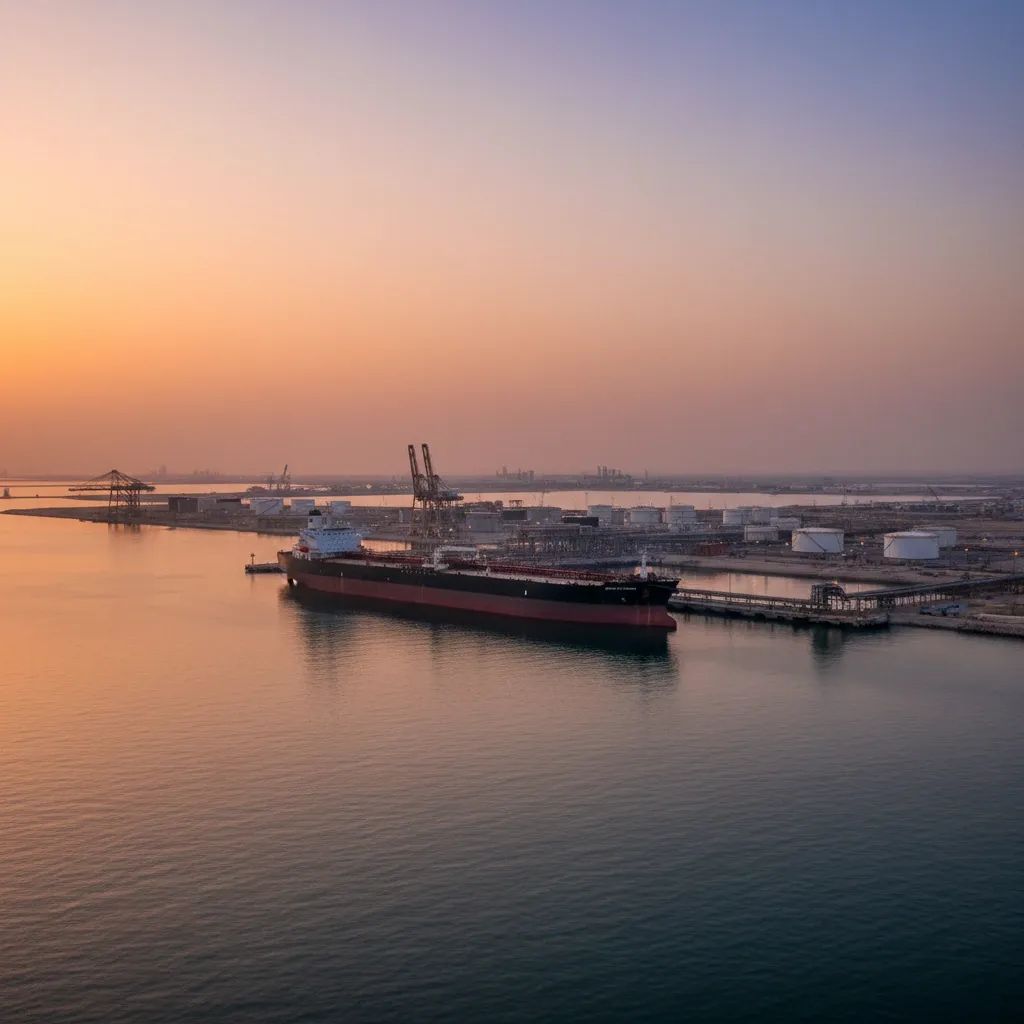
When the world's energy insurers stopped covering tanker movements through the Strait of Hormuz on March 5, global oil markets didn't just tighten—they fundamentally fractured. The International Energy Agency coordinated a release of 400 million barrels from member reserves to combat what's unfolding as the most severe energy supply crisis in decades, but the real story for people living in the United Arab Emirates is far more intricate than a headline about strategic stockpiles. This is about regional vulnerability, infrastructure strain, and how quickly geopolitical tremors become practical, financial problems.
Key Takeaways
• Supply bottleneck is real: Export volumes through Hormuz have collapsed to under 10% of normal, eliminating roughly 18-20 million barrels daily that would otherwise reach global markets.
• Limited window for relief: The 400 million barrel release equals only four days of global consumption—temporary cushioning, not a fix.
• Shipping has essentially halted: Over 150 vessels now sit idle outside the strait; at least 18 have been attacked since late February.
How We Got Here: The February 28 Turning Point
Military strikes on Iran in late February triggered a cascade that transformed abstract geopolitical risk into supply-chain catastrophe. The killing of Iran's Supreme Leader Ali Khamenei prompted the Islamic Revolutionary Guard Corps to effectively seal the Strait of Hormuz by March 2, though the actual closure happened gradually—through insurance cancellation, shipping company withdrawals, and drone attacks on merchant vessels.
The strategy was asymmetrical and effective. Rather than a formal blockade, the IRGC used operational disruption: shipping insurers fled, major carriers like Maersk, MSC, and Hapag-Lloyd suspended service, and security risks became prohibitive. By mid-March, even though Iran's Foreign Ministry claimed the passage remained open to non-American and non-Israeli vessels, the practical reality was marine paralysis. Insurance cancellation eliminates liability protection; without it, no rational shipping company operates.
This matters for the UAE in direct ways. The federation's logistics ecosystem depends on consistent throughput, and sitting tankers produce nothing. Refineries in the region face inventory pressures. Storage capacity fills faster than product can move. Production cuts follow storage limits—a mechanical consequence of a geographic chokepoint.
The Reserve Release: Scale, Speed, and Substance
On March 11, the IEA announced that 32 member nations would collectively release 400 million barrels, with supplies reaching Asian markets immediately and European/American allocations arriving by late March. The United States contributed 172 million barrels from its Strategic Petroleum Reserve, which holds an authorized capacity of 714 million.
Mathematically, this sounds monumental until placed against actual demand. Global oil consumption runs roughly 100 million barrels daily. The 400 million barrel release—roughly the equivalent of one-third of the IEA's total 1.2 billion barrel reserve—translates to four days of global production. It's not nothing. It's also not a solution.
The practical question traders monitored obsessively was pace. Fast injection creates market impact. Slow trickling of reserves proves psychologically ineffective. The IEA declined to specify exact injection timelines, a detail that mattered enormously to price-setting and risk premium calculations. Fast releases imply confidence and abundance; slow releases suggest that supplies will remain tight.
European jet fuel traded above €200 per barrel by March 8. Diesel futures exceeded €140. Crude itself oscillated above $100 per barrel, touching $126 at peaks—levels not seen in four years. These numbers flow backward through supply chains: higher aviation fuel means costlier flights and freight; diesel increases affect trucking, construction, and logistics. Residents in the UAE don't see oil futures; they see airfare creep and product costs rise.
What This Crisis Actually Disrupts Beyond Crude
The Strait of Hormuz moves roughly 20% of global oil daily, but that's incomplete. It also carries significant volumes of liquefied natural gas from Qatar and the UAE—together these two nations represent roughly 20% of global LNG exports. There is currently no alternative maritime route for LNG cargoes. These aren't interchangeable with pipeline oil. Pipelines exist for crude; liquefied gas requires specialized terminals and carriers.
The disruption cascades through unexpected sectors. Nearly 50% of global urea exports travel via Gulf ports—fertilizer essential for agriculture. Copper, nickel, and cobalt shipments stall. Helium supplies tighten, creating semiconductor manufacturing constraints. These don't immediately spike consumer prices for someone in Abu Dhabi, but they suppress supply in industries that feed downstream manufacturing. Three months of disruption begins eroding inventory buffers in global production networks. Six months risks supply failures in sectors most exposed to Gulf sourcing.
For the UAE specifically, the disruption presents asymmetric risk. Unlike nations entirely dependent on Hormuz passage for hydrocarbon exports, the federation operates the Habshan-Fujairah Pipeline, which transports crude from Abu Dhabi fields directly to Fujairah on the Gulf of Oman, sidestepping the closure entirely. This infrastructure—handling roughly 1.5 to 1.8 million barrels daily—provides the UAE operational flexibility its neighbors lack. Kuwait, Qatar, and Bahrain have no such alternatives. Their exports are hostage to strait conditions.
The Saudi East-West Pipeline connects Riyadh's eastern fields to the Red Sea port of Yanbu, capable of moving 5 to 7 million barrels daily. Combined bypass capacity across all alternatives runs roughly 2.6 to 5.5 million barrels daily—meaningful but insufficient against the 20 million barrels daily normally transiting Hormuz.
OPEC+ Cuts Meet Reserve Releases: A Strategic Contradiction
Simultaneously with emergency reserve releases, OPEC+ maintains production cuts totaling approximately 5.86 million barrels daily—roughly 5.7% of global demand. This creates an odd dynamic: one policy injects emergency supply while another maintains supply constraints. These aren't coordinated; they're parallel strategies pulling in opposite directions.
Saudi Arabia and Russia lead these cuts, which were announced in December 2025 with conditional plans to gradually unwind 2.2 million barrels daily starting April 2026. The condition was "if markets stabilize." Markets haven't. The unwinding now faces postponement or reversal because reserve releases ending coincide with OPEC+ cuts potentially increasing—a potential double shock.
Some market analysts have argued this dynamic is "extremely bullish" for prices. Here's why: immediate reserve releases reduce future stabilization options. If Hormuz remains closed for six months, the 400 million barrels deplete. Then no reserves exist to cushion subsequent shocks. Producers and traders price this in. The release paradoxically reinforces the notion that future supply will remain constrained, justifying higher price floors now to compensate for perceived scarcity later.
Regional Consequences for Energy-Dependent Economies
The UAE economy is diversified beyond energy—finance, logistics, tourism comprise enormous shares. But energy remains foundational infrastructure. Elevated fuel costs ripple through every cost structure: power generation, desalination, cement production, airline operations based in Dubai and Abu Dhabi.
The Dubai Financial Market and Abu Dhabi Securities Exchange both experienced increased volatility in March as investors reassessed risk premiums attached to regional assets. Companies with heavy fuel exposure—aviation, shipping, logistics—absorbed margin pressure. Insurance companies pricing geopolitical risk repriced regional exposure upward.
Trade partners matter enormously. China and India—top destinations for UAE exports and sources of imports—face disproportionate exposure due to energy import dependence. If global recession concerns surface, demand for UAE goods weakens. If Asian economies contract, UAE logistics hubs face reduced throughput. The federation's position as a neutral, stable hub makes it valuable precisely when volatility spikes elsewhere; prolonged disruption tests that stability thesis.
Military Escalation as a Market Variable
U.S. President Donald Trump appealed to allies—China, the UK, Japan, France, South Korea—to contribute naval assets for strait corridor protection. Response was muted. Japan and Australia declined to send warships. The UK contemplated deploying minesweeping drones as a lower-escalation option. The U.S. Navy itself signaled potential escort operations by late March for tanker protection against Iranian drones and missiles.
This introduces another risk layer: naval presence itself could trigger escalation. Military convoys reduce accident risk but increase confrontation risk. If an escort vessel is attacked, escalation accelerates. If escorts aren't deployed, insurance won't cover passages anyway. The policy choice between military protection and restraint became another pressure point on oil prices and regional stability calculations.
The Trump administration also temporarily lifted sanctions on Russian oil—a pragmatic choice prioritizing energy security over sanctions regime consistency. Iranian oil exports, though officially under blockade, continued covertly through vessels disabling transponders. Market participants knew these flows existed but couldn't track them officially.
The UAE's Infrastructure Advantage and Comparative Position
The Habshan-Fujairah Pipeline infrastructure suddenly matured from routine asset to strategic advantage. The federation could export crude while neighbors couldn't. This advantage was temporary—it depends on crude availability from Abu Dhabi fields—but it positioned the UAE as more resilient than regional counterparts facing the same international price shocks but without export flexibility.
This resilience doesn't translate to immunity. The UAE imports energy inputs, relies on regional trade, and depends on global economic stability. Resilience is relative. A nation that can export despite disruption remains stronger than one that cannot, but both face margin compression if global demand weakens.
What Traders Watched Most Closely
The critical variable was not reserve magnitude but injection velocity. Announcing 400 million barrels meant little without specifying delivery schedules. Markets speculated endlessly about whether supplies would flood markets instantly—creating short-term price suppression—or trickle slowly, maintaining elevated premiums. The IEA's refusal to specify injection timing suggested either uncertainty about logistics or deliberate ambiguity to maintain strategic optionality.
Crude oil futures, energy stocks, and shipping valuations all hinged on this single question. Fast injection implies abundance, lower prices, economic resilience. Slow injection implies persistent scarcity, sustained elevated prices, recessionary risk. For UAE residents and businesses, the difference meant everything—it determined whether energy costs stabilized within weeks or remained elevated through mid-2026.
The reality is that by mid-March, the market remained in discovery mode. Traders didn't yet know if Hormuz would reopen through diplomatic negotiation, military intervention, or exhaustion. They didn't know if the reserve releases would stabilize or merely delay inevitable price acceleration. They didn't know if OPEC+ would proceed with planned production cuts unwinding in April or postpone indefinitely. This fundamental uncertainty persisted, keeping risk premiums elevated and volatility sustained across energy, currency, and equity markets affecting anyone living in the UAE with exposure to broader economic conditions.


