
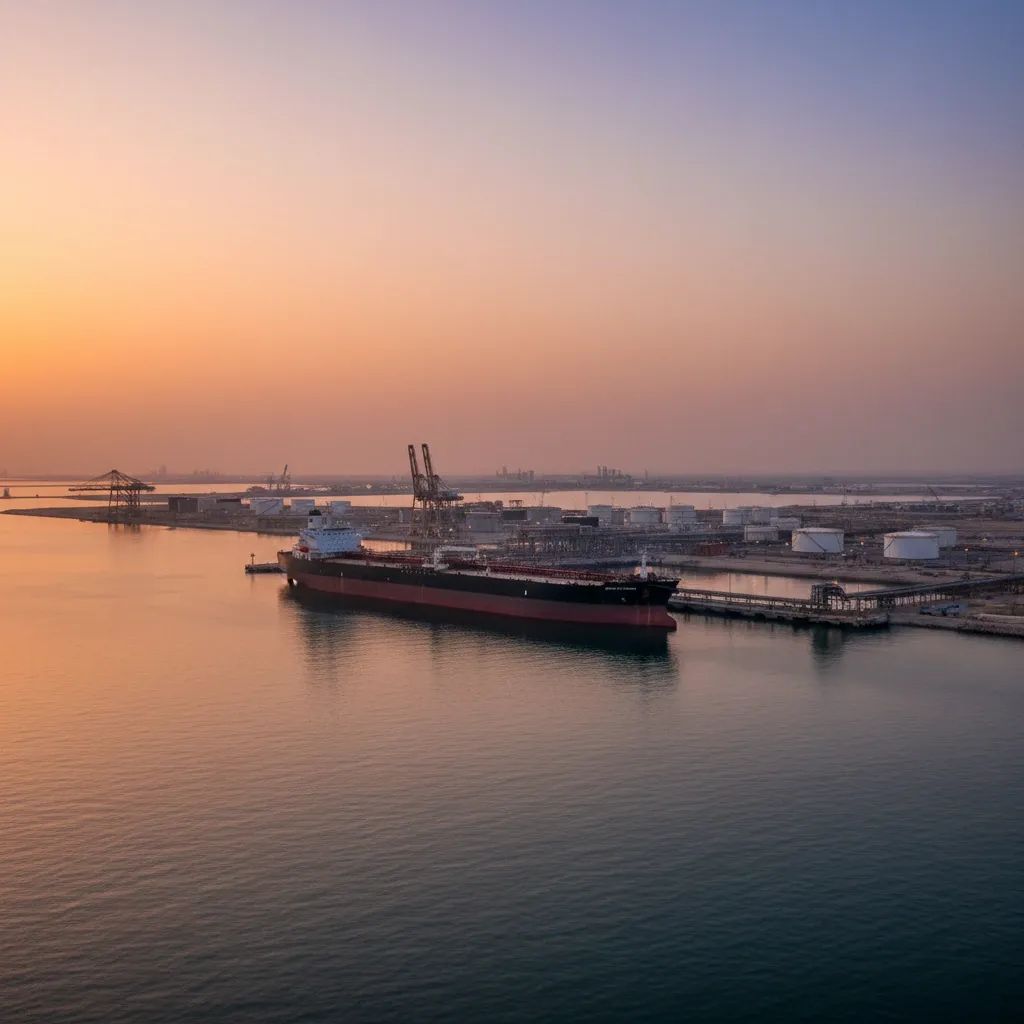
The Kuwait Petroleum Corporation has quietly recalibrated its operational strategy, cutting crude production and refining capacity as a hedge against the escalating military standoff across the Gulf. While the announcement centers on Kuwait's risk management, the decision carries significant implications for anyone with a stake in United Arab Emirates energy, business, or fiscal planning. This production adjustment signals that regional oil-producing economies are shifting from optimistic production regimes into a conservative holding pattern, one that could reshape crude supply, electricity rates, and government budgets across the Gulf if the disruption persists.
Why This Matters
• Crude prices have surged 28–36% in days: Brent crude now trades at $92 per barrel, with analysts flagging a potential breach above $100 if tanker disruptions continue.
• Your utility bills and transportation costs could face pressure if the crisis persists: Government subsidies on fuel and electricity become harder to sustain when global crude climbs, potentially forcing tariff adjustments across the United Arab Emirates.
• Storage capacity, not supply volumes, is driving production cuts: Gulf producers face a math problem—output cannot be exported, so tanks overflow or production retreats.
• Coordinated GCC production reductions are possible if disruptions continue: Iraq has trimmed, Qatar declared force majeure, and Saudi Arabia and the UAE are widely expected to follow Kuwait's template if the Hormuz closure persists.
The Mechanics: Why Kuwait Is Cutting, Not Selling
The setup appears straightforward. On February 28, Iran launched drone and missile strikes directly against Kuwaiti soil, targeting Kuwait International Airport, military installations, and armed forces personnel. Days later, an Iranian Islamic Revolutionary Guard Corps commander publicly declared the Strait of Hormuz closed to commercial vessels, threatening to "set ablaze" any ship attempting passage. The rhetoric was not ambiguous, and the military capability to execute it is credible.
As of early March, the waterway—which ordinarily channels roughly 20% of global daily oil supply—has become a near-ghost corridor. Over 150 tankers now sit anchored in Gulf anchorages, unwilling to risk transit through Iranian-controlled waters. Major shipping carriers have suspended operations entirely, rerouting cargo around the Cape of Good Hope, a detour adding 10–14 days and multiplying freight costs. War risk insurance premiums have become prohibitively expensive, effectively pricing merchants out of the Strait.
For Kuwait, the consequences are unforgiving. The country produced approximately 2.6 million barrels per day heading into this crisis, with a national economy almost entirely dependent on crude export revenue. Unlike Saudi Arabia, which operates the Petroline pipeline to the Red Sea and enjoys export optionality, Kuwait has no meaningful alternative to Hormuz. Domestic storage tanks are finite. Export contracts are stacking up unfulfilled. Refineries are producing fuel for a market that cannot accept delivery.
The Kuwait Petroleum Corporation faced a cascading choice: maintain maximum production and watch storage tanks overflow—a scenario risking operational hazards, asset damage, and environmental exposure—or scale back preemptively and preserve operational flexibility. The company chose the latter. This is not an emergency shutdown. It is deliberate, measured inventory management before an uncontrolled event forces chaotic decision-making.
The Context That Changes Everything for the UAE
The escalation trace is instructive. Iran's strikes on Kuwait were framed explicitly as retaliation for joint US-Israeli military operations against Iranian targets conducted in late February. Kuwait responded with a formal statement asserting its right to self-defense under Article 51 of the UN Charter, filed formal complaints with the UN Security Council, and watched as the US Embassy in Kuwait City suspended operations and evacuated personnel. Regional military postures visibly tightened.
For the United Arab Emirates, this scenario reactivates a persistent strategic vulnerability. Historical Iranian statements have systematically bracketed all Gulf Cooperation Council members as potential targets when tensions flare. The Al-Durra gas field dispute—a three-way territorial claim involving Iran, Kuwait, and Saudi Arabia—sits unresolved in the background. Diplomatic engagement on the field stalled years ago; the current military environment has extinguished any near-term prospect of negotiated resolution. Iran has historically rejected maritime border demarcation with neighboring states and previously threatened unilateral drilling operations within disputed zones.
What has changed is the credibility of Iranian action. When threats are backed by demonstrated military capability and active use, the calculus shifts. The United Arab Emirates, like Kuwait, depends overwhelmingly on Hormuz passage for crude and liquefied natural gas exports. The Abu Dhabi National Oil Company (ADNOC) has partial relief via the Abu Dhabi Crude Oil Pipeline terminating at Fujairah on the Gulf of Oman, providing approximately 1.5 million barrels per day of Hormuz-bypass capacity—roughly 40-50% of UAE crude export capability. This offers significantly more optionality than Kuwait's position but still leaves substantial vulnerability if the Strait remains closed long-term.
The Immediate Shock to Energy Markets and Your Wallet
Oil markets have already processed the risk calculus. Brent crude, which traded comfortably below $72 per barrel in late February, has rocketed to over $92—a staggering 28% gain in roughly one week. American benchmarks similarly jumped above $90, reflecting a 36% increase in the same timeframe. This is not ordinary volatility. Traders are pricing in the assumption that the Strait remains contested or closed for weeks or months, a scenario that systematically drains inventories and compels consuming nations to tap strategic reserves.
If Iranian interdiction persists or escalates to include attacks on export terminals or loading facilities, analysts project that Brent could exceed $100 per barrel—a threshold not breached since Russia's invasion of Ukraine. For the United Arab Emirates, that price level would become a watershed. Households have planned household and business budgets around a benign energy environment; government ministries have structured fiscal allocations assuming current price ranges.
Crude above $100 would trigger urgent review. Government fuel and electricity subsidies, which anchor household purchasing power and industrial competitiveness, would come under acute pressure. Utility tariffs could face upward revision. Industrial input costs—petrochemicals, aviation fuel, solvents—would escalate sharply. The construction sector, already capital-intensive, could absorb margin compression. Retail and logistics businesses could pass increased transportation costs to consumers. Employment in energy-dependent sectors could face headwind pressure as companies recalibrate margins and capital allocation.
What Other Gulf Producers Are Already Doing
Kuwait's production adjustment is part of a wider regional recalibration. Iraq has already trimmed field output at multiple facilities. Qatar, the world's largest liquefied natural gas exporter, declared force majeure on gas shipments—a critical signal indicating that commercial obligations cannot be honored under current security conditions. That declaration alone ripples through global energy markets, as Asian buyers and European power generators suddenly face supply uncertainty from their largest LNG partner.
The cascade continues. Energy economists and Gulf state officials now anticipate that Saudi Arabia and the United Arab Emirates could adopt comparable production management strategies if the Hormuz disruption persists beyond a few weeks. When multiple major producers cut output simultaneously, global markets feel the supply squeeze acutely. Inventories deplete faster. Price pressure intensifies.
The apparent paradox is that this coordinated GCC production management—though painful for Gulf treasuries—actually represents the more orderly response. The alternative would be chaotic stockpiling, panic buying by consuming nations, panic selling by producers fighting storage limits, and even more violent price swings. Measured, precautionary cuts spread the pain across time rather than concentrating it in a sudden shock.
What This Means for UAE Residents and Businesses
For anyone living or working in the United Arab Emirates, the implications could cascade in predictable sequence if production cuts extend and the Hormuz closure persists. When government crude revenue contracts—as it would inevitably do if production cuts extend and prices spike—fiscal tightening would become mandatory. Discretionary spending could contract. Infrastructure projects could get delayed or mothballed. Government hiring freezes could emerge. Development budgets could shrink.
The UAE Ministry of Energy and Infrastructure has not yet issued formal production guidance, but energy executives in Abu Dhabi and Dubai are clearly preparing for that announcement. Some are already warning suppliers and counterparties to expect demand adjustments. Private sector companies with supply chains dependent on petrochemicals, industrial gases, or energy-intensive manufacturing should prepare for potential input cost escalation and supply friction.
Utility tariffs warrant close monitoring. The UAE's General Authority for Regulating the Utilities Sector reviews electricity and water rates regularly, but crude price spikes could accelerate formal review processes. Any tariff increase could disproportionately affect lower-income households and energy-intensive businesses such as desalination facilities, data centers, and heavy manufacturing. Wage pressures could follow if inflation expectations adjust to the new energy price environment.
Employment in the energy and construction sectors could face vulnerability if the crisis extends. Project deferrals could mean delayed hiring or reduced staffing. Contracting companies facing margin compression could impose recruitment freezes. Expatriate workforces on contract terms could become subject to repatriation if companies downsize.
The Cascading Questions for April and Beyond
For residents and businesses in the United Arab Emirates, three leading indicators deserve close attention over the next 4–8 weeks to assess whether these scenarios materialize.
Tanker movement data signals whether the Strait is stabilizing. Are vessels beginning to return to Gulf loading terminals, or does the anchorage of stranded ships continue to expand? If the trapped fleet grows, that indicates shipping companies believe the security situation will persist, not resolve. A shrinking anchorage suggests confidence in near-term passage restoration.
Force majeure declarations from other GCC producers would carry enormous fiscal implications. If Saudi Arabia or the United Arab Emirates formally declare force majeure on crude or gas exports, expect sharper government budget adjustments and more aggressive corporate cost restructuring. That threshold announcement would signal policymakers have concluded that the disruption would be substantial and sustained.
Official statements from the UAE Ministry of Energy and Infrastructure matter most. Any government production guidance or export projections would reveal whether planners expect near-term resolution or preparation for prolonged disruption. Silence from the ministry is itself telling—usually indicating either wait-and-see posturing or behind-closed-doors planning not yet ready for public disclosure.
The Strategic Vulnerability Beneath the Surface
This crisis exposes a structural weakness in Gulf energy strategy that predates the current conflict. For decades, producers assumed Hormuz would remain passable even during periods of heightened tension. That confidence has fractured visibly. If the Strait becomes a persistent flashpoint—or if Iranian threats normalize as a recurring negotiating tactic—Gulf states could face inevitable pressure to accelerate capital investment in alternative export infrastructure, additional storage capacity, and downstream processing that adds value before export.
For the United Arab Emirates, that calculus could likely mean renewed focus on Fujairah terminal expansion, enhanced petrochemical refining capacity to convert crude into higher-value products domestically, and deeper strategic partnerships with Asian energy buyers willing to accept longer transit times in exchange for stable, long-term supply contracts. The current vulnerability—overdependence on a single waterway for export—is ancient history. What is new is the demonstrated willingness of a regional military power to weaponize it as statecraft.
The Kuwait Petroleum Corporation's precautionary action is not an isolated corporate decision. It is part of a broader regional recalibration of energy geopolitics, one that will test the resilience of Gulf economies and challenge the adaptability of global markets. For those living and working in the United Arab Emirates, the arithmetic depends on how long the disruption persists: disruptions to the Strait of Hormuz could eventually ripple through government budgets, business costs, employment prospects, and household financial stability. The region has entered a holding pattern. The duration and outcome of that wait will shape every energy-dependent decision across the Gulf.


