
On March 1-2, 2026, the attack wave that swept across the Gulf exposed a stark reality: the region's energy lifeline and civilian safety are more intertwined than anyone would prefer. Within 48 hours, Iran launched hundreds of drones and missiles at targets across the United Arab Emirates and Saudi Arabia, forcing the UAE Ministry of Defence to mount an unprecedented air-defense response that, while effective, left collateral consequences scattered across Abu Dhabi's industrial and residential zones.
Why This Matters
• Your fuel costs are about to rise: A major Saudi refinery shutdown triggered an immediate 15% spike in crude prices; sustained disruptions could push costs into triple digits, directly hitting transportation and imported goods pricing for UAE residents. The UAE government has yet to announce subsidies or price caps, so residents should prepare for increased spending on petrol and transportation costs.
• Flight schedules are unpredictable for now: Airspace closures grounded all international traffic; travelers should expect delays and price volatility on bookings over the next 2-4 weeks.
• Insurance and security protocols will tighten: Expect higher property and vehicle premiums; according to preliminary market assessments, premium increases of 8-15% are anticipated for renewals in March-April. Residents can contact the UAE Insurance Authority to understand their rights regarding premium adjustments and file disputes if increases appear excessive. Employers in critical sectors are mandating new emergency drills and shelter-in-place procedures.
• Shipping delays are coming: Damage to Jebel Ali Port and heightened maritime risk through the Strait of Hormuz will slow re-export logistics and increase freight costs by an estimated 10-20%, potentially delaying consumer goods and imported food items on retailer shelves.
The Energy Shock
When the interceptor debris settled on the morning of March 2, one fact became impossible to ignore: the Saudi Aramco Ras Tanura refinery—processing over 550,000 barrels of oil daily—had gone offline. An Iranian Shahed-136 drone struck the facility, igniting a contained fire that Saudi technicians extinguished within hours. But Aramco took no chances. The company halted both refining and loading operations at what amounts to one of the world's most critical petroleum chokepoints.
That single decision rippled through global markets instantly. Brent crude futures jumped to $82 per barrel when Asian bourses opened, before settling around $80—a surge that reflected traders' anxiety about cascading supply failures. The facility draws crude from Ghawar, the world's largest conventional oilfield, as well as from Abqaiq and Khurais, making it central to the region's export architecture. When Ras Tanura goes dark, Europe and Asia notice within minutes.
What amplified the shock was context. A week earlier, the Juaymah liquefied petroleum gas terminal—one of the planet's largest exporters of natural gas liquids—had also sustained a hit, forcing temporary curtailment of shipments. Two consecutive blows to Saudi energy infrastructure within 7 days created legitimate concerns about a third wave. Energy analysts warned publicly that protracted conflict could push Brent toward $100-$120 per barrel, a threshold that would fundamentally disrupt cost structures across the United Arab Emirates economy. Transportation expenses would climb, consumer goods prices would follow, and construction timelines tied to imported materials would stretch.
The UAE's own oil and gas operations had narrowly avoided direct hits, though intelligence briefings circulating among government and industry circles suggested Iranian targeting teams had attempted multiple strikes on downstream facilities. Analysts and defense specialists consistently stated that substantial damage to Emirati hydrocarbon infrastructure would take years to remediate, a fact that underscored how vulnerable the region's economic foundation actually was.
When the Debris Falls
The UAE air-defense network's success rate exceeded 95%, according to ministry statements—impressive by any standard. However, the sheer volume of incoming projectiles altered the tactical equation. Hundreds of drones and ballistic missiles meant that even highly effective interception left fragments descending across populated zones.
In the ICAD industrial complex and Mussafah commercial district, warehouse structures absorbed minor damage from falling shrapnel. Near Etihad Towers in central Abu Dhabi, a woman and child sustained injuries that required hospital treatment but proved non-life-threatening. The most consequential incident unfolded at Zayed International Airport on March 1, where a direct drone strike killed one person and wounded seven others—a toll that reflected the reality that even robust air defenses cannot eliminate all risk in densely populated urban environments.
A separate strike targeted Al-Salam Naval Base, where an Iranian drone impacted a warehouse storing general materials. The resulting fire consumed two containers but produced no casualties, a narrow escape that suggested either lucky timing or alert personnel actions. According to UAE Ministry of Interior statements, verified casualty figures reached at least 3 deceased—nationals from Pakistan, Nepal, and Bangladesh—with 58 injured representing multiple nationalities. The demographic composition of the casualties underscored an unavoidable truth: the UAE's expatriate-majority population absorbs disproportionate risk when regional conflicts materialize.
Government and Market Response
The Abu Dhabi Emergencies, Crises and Disasters Management Authority declared full mobilization within hours. By midday March 1, all airspace over the United Arab Emirates had been closed, grounding departing and arriving flights at Abu Dhabi, Dubai, Sharjah, and Ras Al Khaimah airports. Thousands of travelers faced sudden cancellations, airport personnel worked extended shifts processing rebookings, and airline revenue management systems went into crisis mode.
Financial markets responded with defensive protocols. The Abu Dhabi Securities Exchange and Dubai Financial Market suspended trading activities as a precautionary measure—a rare action reflecting genuine concern that further missile strikes could damage critical infrastructure or force emergency government spending. Both exchanges resumed trading on March 2 with heighted security, though investor mood remained distinctly risk-averse.
The U.S. Mission in the United Arab Emirates issued formal shelter-in-place orders for American personnel and nationals, a directive that rippled through multinational corporations. Companies including financial institutions, consulting firms, and energy sector operators activated business continuity plans, transitioning non-essential staff to remote work arrangements and implementing staggered schedules to reduce facility occupancy. Schools in Abu Dhabi and Dubai moved to temporary distance-learning protocols, disrupting routines for families across the country.
Maritime authorities adopted equally defensive postures. The UK Maritime Trade Operations center elevated threat assessments for the Strait of Hormuz region to the highest category, while the Norwegian Maritime Authority raised the MARSEC/ISPS security protocol to Level 3 for all flagged vessels transiting Gulf waters. That bureaucratic language carries profound economic weight: shipping insurance premiums spiked 12-15%, voyage planning became more complex, and schedules slipped to accommodate mandatory detours around declared high-risk zones.
Port Damage and Logistics Fallout
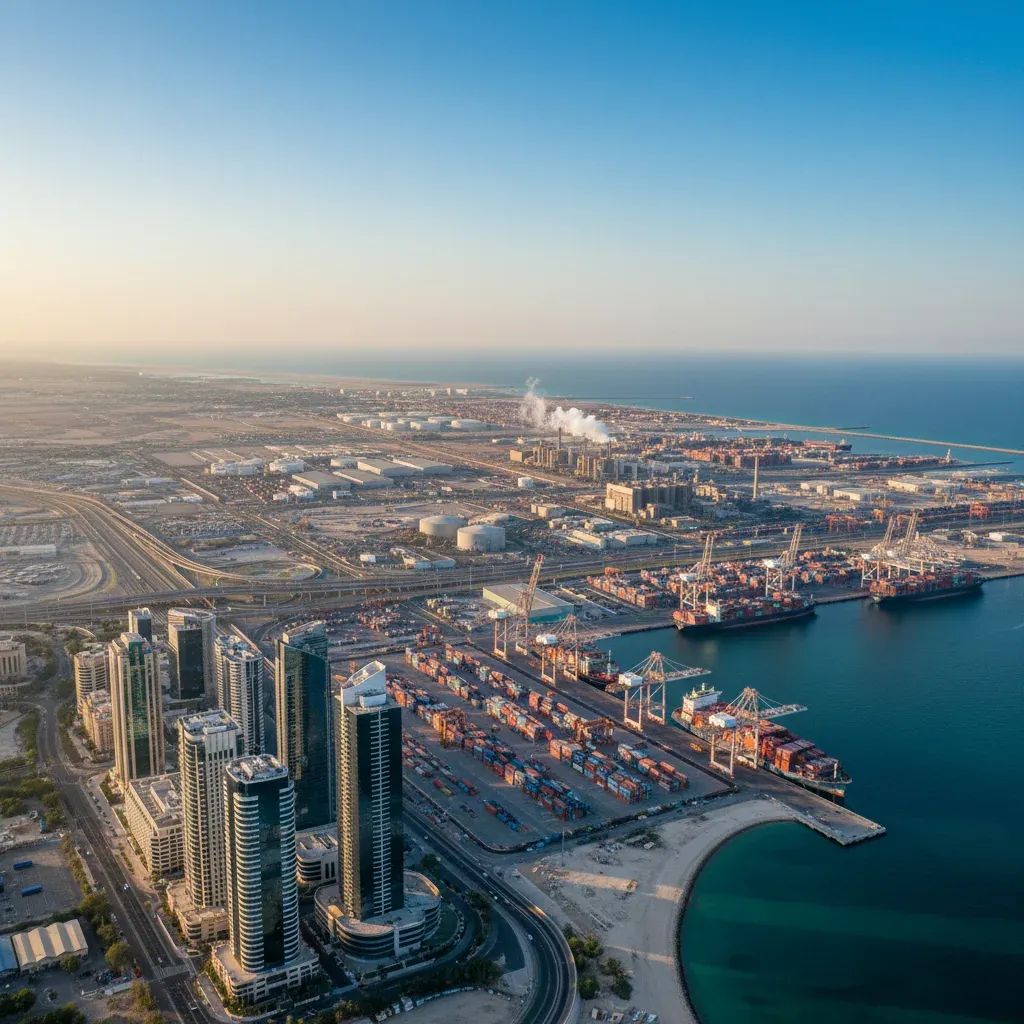
Beyond the closed airspace and market halts, Jebel Ali Port—the region's primary re-export hub and a critical node in the global supply chain connecting Asia, Europe, and East Africa—sustained damage to one berth facility. Port authority technicians immediately launched damage assessments, but preliminary indications suggested repair timelines measured in weeks rather than days.
For UAE-based import-export firms, the timing proved particularly damaging. March typically marks the beginning of peak shipping season following Ramadan, when merchants restock inventory and fulfill delayed orders. Instead, they confronted a narrowing port capacity, elevated maritime risk premiums, and predictable transit delays. A container that normally arrives in Dubai within 3-4 weeks from Shanghai faced uncertain scheduling and incremental cost additions at every stage. Businesses with thin supply-chain margins—retailers, manufacturers dependent on just-in-time delivery, cold-chain operators moving perishables—braced for margin compression.
For residents, this means expecting delays in fresh produce deliveries, consumer electronics, and packaged goods typically shipped through Asian routes. Supermarket shelves may experience temporary gaps in certain imported items by mid-to-late March, and pricing on available alternatives could increase 5-10% above typical levels. Port operations are expected to normalize within 3-4 weeks, though maritime insurance costs will remain elevated for several months.
Diplomatic Architecture and Security Consolidation
The UAE Ministry of Foreign Affairs summoned Iran's ambassador to deliver a formal protest, characterizing the attacks as a "blatant act of aggression" and "flagrant violation of national sovereignty and international law." The ministry affirmed the country's prerogative to respond through available legal mechanisms, though the phrasing carefully avoided immediate military escalation rhetoric. Historically, the UAE had positioned itself as a potential mediator in regional disputes, maintaining rhetorical distance from explicit anti-Iran positioning. That neutrality posture fractured decisively on March 1.
Within 24 hours, the Gulf Cooperation Council convened its 50th extraordinary Ministerial Council via secure videoconference. Bahrain chaired the session, and the result was unprecedented solidarity among six normally fractious nations. The GCC collective statement declared the Iranian strikes "heinous" and "treacherous" violations of the UN Charter, explicitly invoking the principle that GCC security is indivisible—meaning an attack on any member state triggers mutual defense obligations applicable to all six nations.
That language marked a dramatic shift in regional architecture. Saudi Arabia and the UAE had previously maintained that shared airspace would not be utilized for operations directed at Iran, a diplomatic posture that telegraphed restraint and a preference for coexistence over confrontation. The sheer scale of the March attack—hundreds of projectiles targeting civilian areas, airports, and economic infrastructure—collapsed that carefully calibrated restraint almost instantly. Defense experts and diplomatic analysts began acknowledging privately that if Iranian strikes continued, collective GCC military responses were no longer theoretical possibilities but probable outcomes.
Maritime Chokepoint Under Pressure and Impact on Residents
The Strait of Hormuz absorbed particular attention from strategists and shipping-industry planners. This 21-mile-wide waterway processes roughly 20% of the world's seaborne petroleum supply daily—a staggering volume that makes the passage more economically critical than any other maritime chokepoint on the planet. Qatar's liquefied natural gas exports, combined Saudi and Emirati crude shipments, and Kuwaiti oil all converge through these waters on their routes to European refineries and Asian energy markets.
For UAE residents, sustained disruption means prolonged delays in goods arriving from Asian suppliers, which affects retail pricing and availability. The Joint Maritime Information Center upgraded the regional maritime threat assessment to CRITICAL following confirmed reports of Iranian missiles striking multiple merchant vessels. That designation carried substantial operational and financial consequences. Insurers recalculated risk models and adjusted premium structures upward. Vessel operators began requesting hazard pay supplements for crews transiting the zone. Routing algorithms shifted to longer, costlier passages around the Cape of Good Hope—a detour that adds 3-4 weeks to transit time and increases fuel consumption by 40%, costs that shipping companies pass directly to importers and retailers.
Industry analysts publicly warned that sustained disruption of shipping through the Strait could trigger the largest global energy crisis in generations. However, most experts expect the current incident to be contained with shipping normalizing within 4-6 weeks, though with elevated costs through mid-April.
Cascading Consequences for Residents and Business
For the 3+ million residents of the United Arab Emirates, the immediate implications split between the tangible and the contingent. Fuel prices were certain to rise within 2-3 weeks as storage inventories adjusted to supply constraints. A gallon of petrol at the pump, already climbing steadily post-pandemic, would climb further. The cost of goods transported by road—everything from food to household items—would absorb that increment and pass it forward to consumers.
Flight availability and pricing became unpredictable. Airlines facing airspace closures had canceled thousands of bookings; when flights resumed, seat availability tightened and fares climbed 20-30% relative to typical March pricing. Families planning spring holiday travel or business professionals managing conference attendance needed to rebuild flexibility into their plans and budget substantially higher ticket prices.
Insurance markets moved quickly. Property insurers and vehicle underwriters began adjusting risk models within 48 hours of the first strikes. Residents renewing policies in March and April faced premium increases of 8-15%, a silent tax that accumulated across the expat-heavy population. If your renewal notice shows increases beyond industry norms, contact the UAE Insurance Authority to file a query or complaint. Employers in sectors flagged as critical infrastructure—energy, aviation, ports, telecommunications, financial services, healthcare—initiated mandatory emergency-response drills and revised shelter-in-place protocols, changes that filtered down to employee handbooks and HR training schedules.
The business community responded with contingency planning. Supply-chain professionals identified backup suppliers for critical components and repositioned inventory to hedge against further disruptions. Construction projects dependent on imported materials slowed or paused. Real estate activity, which had been gaining momentum in early 2026 after post-pandemic recovery, cooled as investor risk appetite recalibrated. Tourism bookings for April and May weakened as international travelers reassessed Gulf security perceptions.
Strategic Recalibration
What March 1-2, 2026 revealed was a region fundamentally more vulnerable than its glossy economic narratives typically acknowledge. The United Arab Emirates' decades-long emphasis on stability, predictability, and investor confidence collided abruptly with geopolitical realities that remained outside the country's direct control. The government's ability to intercept hundreds of projectiles was technically impressive but could not eliminate all consequences. The distinction between frontline combatant nations and rear-area safe havens—a distinction the UAE had cultivated carefully through diplomacy and strategic positioning—effectively dissolved within hours.
For the millions of expatriates who migrated to the United Arab Emirates specifically for its reputation as a stable, prosperous alternative to their home countries, the events of early March represented an uncomfortable recalibration. The risk profile had shifted, not catastrophically but measurably. The future promised continued security, most experts believed, but no longer guaranteed immunity from regional upheaval.
Residents proceeding into April and beyond needed to factor these developments into practical decisions: building extra time into travel schedules, maintaining deeper household emergency supplies, reviewing insurance coverage with the UAE Insurance Authority if increases seem excessive, and staying attentive to government alerts and employer guidance. The United Arab Emirates remained a functional, economically dynamic country, but the margin of geopolitical isolation that had previously insulated it had narrowed perceptibly.


