
The United Arab Emirates Ministry of Defence has confirmed that falling debris from intercepted aerial threats struck two residential properties in Dubai on March 1, 2026, injuring two residents—the latest in a series of collateral impacts stemming from a major aerial defense operation that the UAE attributes to Iranian forces, involving 209 drones and 137 ballistic missiles targeting the country.
Why This Matters
• Residential risk: Drone debris is now a documented threat to Dubai homes, despite high interception success rates.
• Medical response: Both injured residents received immediate treatment; injuries are described as minor.
• Legal recourse: Federal Decree-Law No. 35 of 2024 guarantees "fair compensation for harm caused by civil defence operations," with a 60-day application window.
• Airspace closure: The UAE General Civil Aviation Authority (GCAA) suspended all drone, glider, and recreational aircraft permits for one week as a precautionary measure.
The Escalation Behind the Interceptions
The debris incidents occurred during what the UAE Ministry of Defence termed a "dangerous escalation" and "breach of national sovereignty." The operation involved intercepting a coordinated barrage of 209 drones and 137 ballistic missiles, triggering one of the largest air defense responses in the country's recent history. The UAE government attributes these attacks to Iranian forces. While the interception rate exceeded 93%, the sheer volume of threats meant debris inevitably rained down on populated areas.
The Ministry has formally condemned the attacks as violations of international law and affirmed the UAE's right to take all necessary measures to protect its territory and citizens. The scale of the assault—more than 346 aerial threats in a single wave—underscores a sharp uptick in regional tensions.
Wider Pattern of Collateral Damage
The two residential injuries in Dubai are part of a troubling broader pattern. On February 28, debris from another interception ignited a minor fire on the outer facade of the Burj Al Arab, one of the world's most recognizable luxury hotels. No injuries were reported in that incident, but the symbolic and economic implications were immediate.
That same day, falling debris caused a fire at a berth in Jebel Ali Port, one of the largest container terminals globally, and minor damage to Dubai International Airport (DXB), where four staff members were hurt. Both DXB and Dubai World Central (DWC) suspended operations temporarily, and UAE airspace experienced a partial closure as a precautionary measure.
The most serious incident occurred at Zayed International Airport in Abu Dhabi, where one civilian of Asian nationality was killed and seven others injured by falling shrapnel. The UAE government conveyed condolences to the victim's family and reiterated that targeting civilians violates international humanitarian law.
What This Means for Residents: How to Apply for Compensation
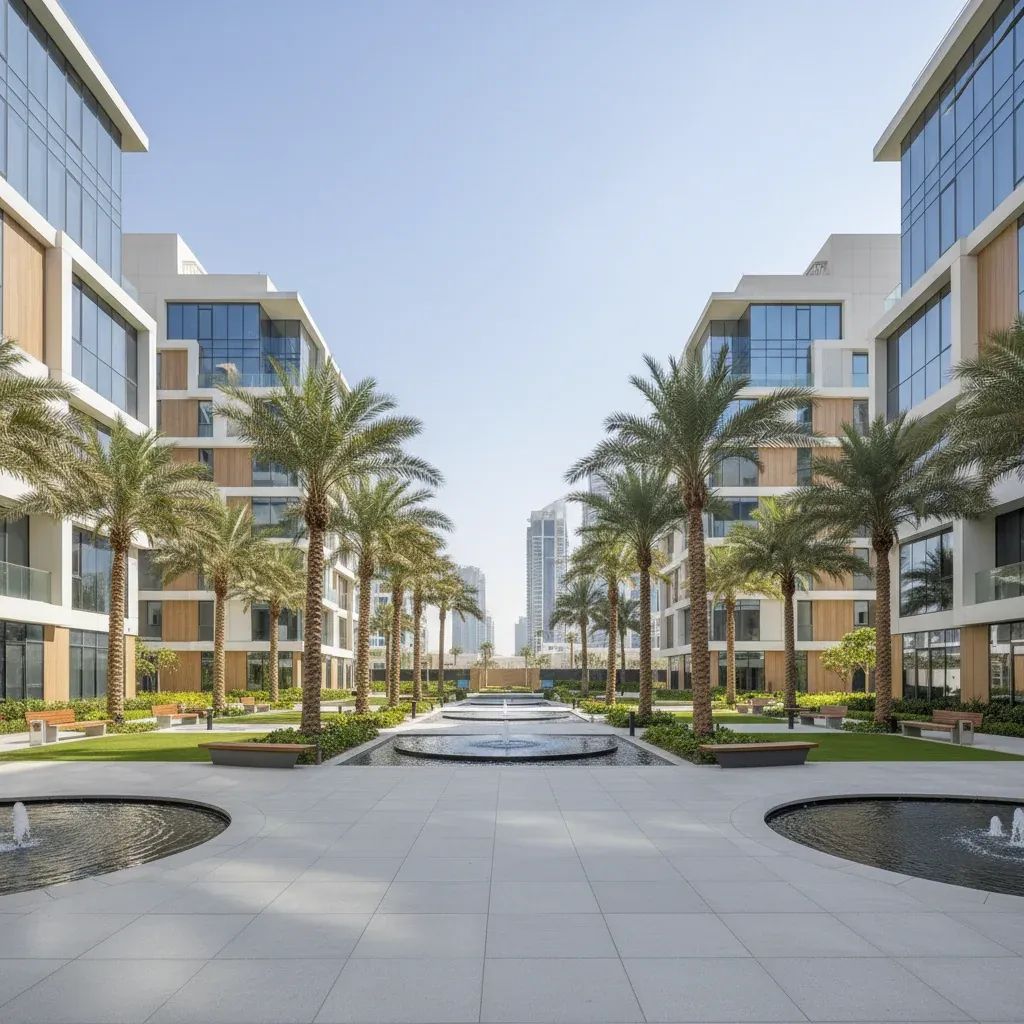
For the 3.3 million residents of Dubai, the incidents mark a shift from abstract geopolitical risk to tangible household threat. The two homes struck by debris are located in residential courtyards—private, enclosed spaces traditionally considered safe from external hazards. The fact that interception debris can penetrate these zones has prompted urgent questions about protective infrastructure and early warning systems.
Filing Your Compensation Claim:
Under the Federal Decree-Law No. 35 of 2024, residents who suffer property damage or injury from civil defense operations can apply for compensation within 60 days of the incident. Here's what you need to know:
• Where to Apply: Submit your claim to the National Emergency Crisis and Disaster Management Authority (NCEMA) or contact the Dubai Municipality for guidance on the claim process.
• Required Documentation: Prepare photographs of property damage, medical records (for injuries), property valuations, repair estimates, and your identification documents. Keep receipts for any emergency repairs undertaken.
• Contact Information: Reach NCEMA through their official channels or contact the Dubai Statistics Center for referral to the appropriate compensation authority. Your local municipality office can also provide specific submission details.
• Timeline: A dedicated committee reviews claims and must issue a decision within 60 days. If dissatisfied, claimants can appeal to NCEMA within 30 days.
• Emergency Support: Inquire with NCEMA regarding temporary housing or emergency financial assistance while claims are processed.
The law explicitly guarantees "fair compensation" for harm caused during lawful defense operations, recognizing that even successful interceptions carry collateral risk.
Residents are also advised to heed emergency alerts issued via the UAE Drones app and official channels, which may instruct them to avoid open areas and seek shelter during active threat periods.
Counter-Drone Arsenal Deployed
The UAE's ability to neutralize 93% of incoming threats is the result of years of investment in layered air defense systems. Among the technologies deployed or developed:
• DAMITA, introduced by Calidus Holding Group in 2025, is the UAE's first integrated, multi-layered counter-drone system. It uses AI-powered algorithms, advanced radar, full-spectrum RF scanners, and Electro-Optical/Infrared sensors to distinguish drones from birds. The system combines "hard kill" (high-energy lasers, air-burst interceptors) and "soft kill" (precision jamming) methods, designed to operate safely in urban environments without collateral damage.
• Coyote Counter-Unmanned Aircraft System (C-UAS), produced locally under a partnership between Raytheon and the UAE's Tawazun Council, is combat-proven against drone swarms at extended ranges and higher altitudes.
• Radio frequency and radar detection systems offered by firms such as TechnoAi and Dronedubai (a DJI Gold Partner), which can block drone communications or deploy laser-based attacks as a last resort.
Despite these capabilities, the sheer volume and velocity of the recent attack—346 aerial threats detected—pushed the systems to their operational limits. Interception debris is an inevitable byproduct when shooting down missiles and drones over populated areas.
Regulatory Tightening
In response to the escalating threat, the Dubai Civil Aviation Authority (DCAA) and the GCAA have tightened regulations:
• No-fly zones prohibit recreational drone use in main city areas, over buildings, or within 200 meters of residential areas, roads, and public property.
• All drones must be registered with the DCAA, and operators require appropriate licenses. Altitude limits are capped at 120 meters (400 feet).
• The UAE Drones app, launched by the Ministry of Interior, NCEMA, and GCAA, streamlines registration and compliance.
• As of March 1, 2026, the GCAA suspended all flight permits for drones, gliders, and recreational aircraft for one week, a measure designed to reduce airspace congestion during heightened threat conditions.
The UAE Cybersecurity Council, in collaboration with Reach Digital and Shieldworkz, is also finalizing the country's first Drone Cybersecurity Guidelines, expected to be fully operational in 2025. These aim to mitigate vulnerabilities in drone operations and protect critical infrastructure.
Regional Context: A Sevenfold Surge
The UAE is not alone. The Middle East recorded 417 drone-related incidents in the 12 months following October 7, 2024—a sevenfold increase from the 59 incidents reported in the prior year. Many of these attacks, particularly those attributed to Houthi operations, originated from Yemen.
The proliferation of inexpensive drone technology—drone systems can cost significantly less than interception systems, with interception costs exceeding $3 million per engagement—has democratized aerial warfare, enabling both state and non-state actors to strike across vast distances. In Iraq, Gaza, Sudan, and now the UAE, drone strikes have resulted in casualties, displaced civilians, and damage to infrastructure.
For Dubai, a global hub for trade, tourism, and finance, the threat poses not only a security challenge but an economic and reputational one. The temporary closure of DXB, the world's second-busiest airport by international passenger traffic, sent ripples through the aviation industry. Hotels, ports, and landmarks—symbols of the emirate's economic resilience—are now on the front line of a new kind of conflict.
Living Under the Dome
The loud sounds residents heard throughout the emirate on March 1 were the audible signature of successful interceptions—evidence that the UAE's air defense capabilities are functioning. Yet the debris in two Dubai courtyards is a sobering reminder that no system is perfect.
For now, residents are navigating a new reality: emergency alerts on their phones, temporary airspace closures, and the knowledge that the sky above is an active battleground. The UAE government has pledged to take all necessary measures to protect its people, and the legal framework for compensation is in place. For those affected, understanding your rights under Federal Decree-Law No. 35 and taking prompt action to file claims is essential. As the region grapples with evolving security challenges, the question for residents is no longer only whether the defense systems work—it's how to recover and rebuild when incidents do occur.


