
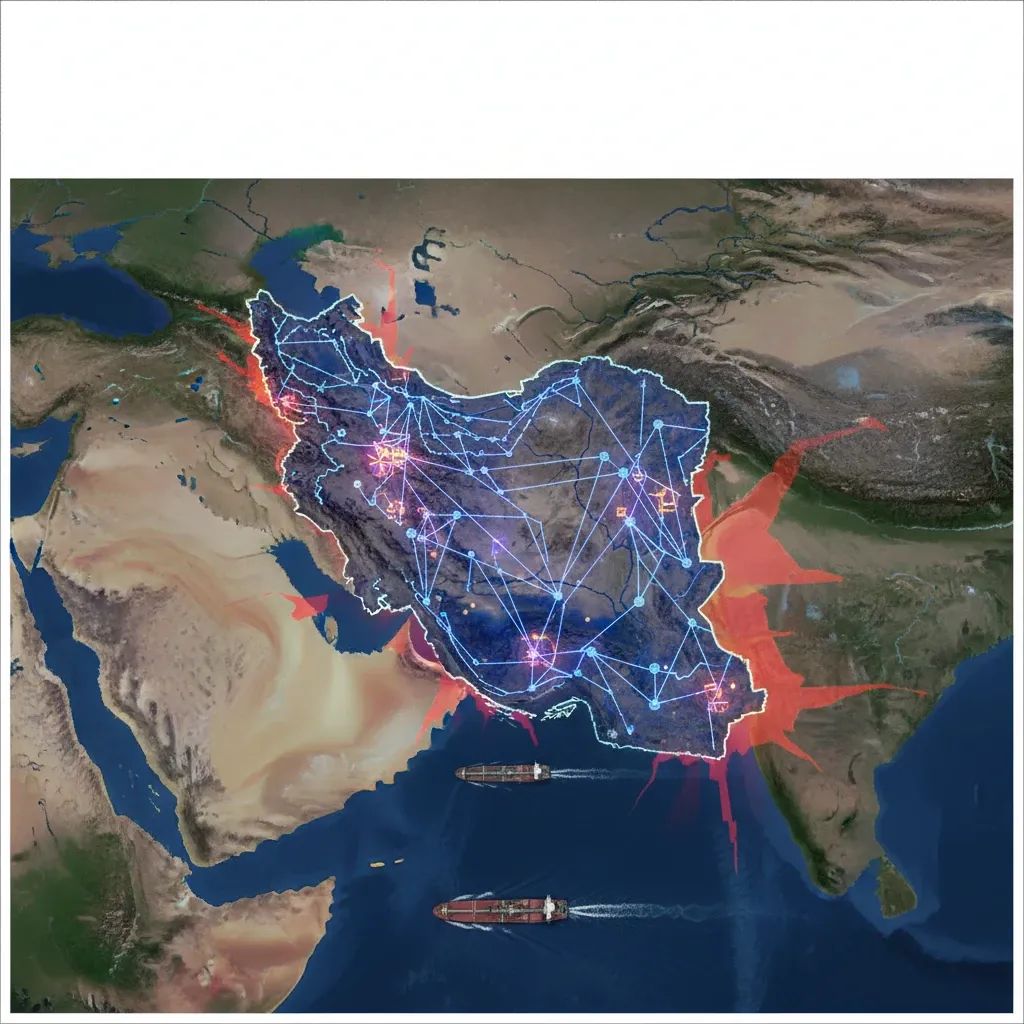
The United States has announced a complete naval blockade on all Iranian ports set to begin Monday, April 14, 2026, a move confirmed by U.S. Central Command (CENTCOM) that immediately pushed oil markets into crisis mode as Brent crude surged above $102 per barrel and West Texas Intermediate (WTI) jumped to roughly $104, marking increases exceeding 7-8% in early Sunday trading.
Why This Matters
• Fuel costs expected to climb: The blockade targets Iran's remaining oil exports—estimated at 1-1.5M barrels per day (bpd)—and comes as the Strait of Hormuz, which handles 20% of global oil shipping, faces ongoing navigation restrictions.
• Supply chain delays worsen: Vessel rerouting around the Cape of Good Hope is adding 10-20 days to shipping times, directly impacting freight rates and delivery schedules for goods entering the United Arab Emirates.
• Energy security concerns deepen: The International Energy Agency (IEA) has labeled the current crisis the "greatest global energy security challenge in history", signaling prolonged volatility ahead.
• Alternative energy investments accelerate: Regional governments and private investors are pivoting toward renewables and nuclear power as geopolitical risks surrounding fossil fuels intensify.
What Triggered the Blockade
The naval cordon was announced on April 13, 2026, to take effect the following Monday, following the collapse of peace negotiations between Washington and Tehran in Pakistan. President Trump authorized the action, which CENTCOM confirmed targets all maritime traffic entering and exiting Iranian ports and coastal areas, including those along the Arabian Gulf and Gulf of Oman. While the blockade aims to sever Iran's oil export revenue stream, CENTCOM has stated that vessels transiting the Strait of Hormuz to and from non-Iranian ports will maintain freedom of navigation—a crucial distinction for Gulf Cooperation Council (GCC) member states and shipping operators serving the United Arab Emirates.
This escalation builds on an already fragile situation. Conflict between the U.S. and Iran erupted on February 28, 2026, when Iran initially closed the Strait of Hormuz, cutting off a vital artery for global energy supplies. Despite a temporary ceasefire, traffic through the strait remained limited, and the upcoming blockade effectively eliminates Iran's ability to export the 1-1.5M bpd it had still been shipping—predominantly to China, which absorbed over 90% of Iranian crude exports in 2024.
How This Reshapes Global Energy Markets
Iran ranked as the seventh-largest crude oil producer globally in 2025, pumping 4.19M bpd, and holds the world's third-largest proven oil reserves at 208.6 billion barrels. Removing even a fraction of that supply from global markets creates immediate imbalances, particularly when OPEC+ producers have demonstrated limited spare capacity to compensate.
In May 2026, OPEC+ agreed to a modest production increase of around 206,000 bpd—a figure analysts have called "symbolic" given the scale of disruption. Many member states face infrastructure damage and heightened risks operating in the Persian Gulf region, constraining their ability to ramp up output. Saudi Arabia has maximized its East-West pipeline, transporting approximately 7M bpd to bypass Strait-related bottlenecks, but this capacity is finite and insufficient to offset a complete halt in Iranian exports.
The U.S. Energy Information Administration (EIA) had already revised its 2026 average Brent crude forecast to $96 per barrel before the blockade announcement. Current spot prices have breached that projection, and sustained disruption could drive quotations higher still. The ripple effects extend beyond crude oil: the Strait of Hormuz is also a critical conduit for Liquefied Natural Gas (LNG), with roughly 20% of global LNG supply typically passing through the waterway. Damage to Qatar's LNG infrastructure and shipping blockages have pushed Asian LNG spot prices up over 140%, while European natural gas benchmarks have nearly doubled. Analysts warn that a prolonged blockade could drive European gas prices beyond €100/MWh.
What This Means for Residents and Businesses in the United Arab Emirates
Energy importers, logistics operators, and consumers in the United Arab Emirates face a multi-layered impact. While the country is a net energy exporter, its economy is deeply intertwined with global shipping networks, regional stability, and the cost structure of goods and services.
Freight and supply chain costs are climbing as vessels reroute around Africa. The additional 10-20 days of transit time translates into higher fuel consumption, crew costs, and insurance premiums—expenses that will ultimately be passed through to importers and retailers in the United Arab Emirates. Sectors reliant on naphtha (used in plastics, textiles, and pharmaceuticals), aluminum, fertilizer, and helium are particularly vulnerable to both price spikes and supply shortages.
Inflation pressure is expected to intensify across consumer goods and services. Even though the United Arab Emirates produces its own hydrocarbons, global oil and gas prices set the benchmark for fuel subsidies, electricity generation costs, and industrial inputs. Sustained high energy prices could force adjustments to government subsidy programs or translate into higher utility bills for households and businesses.
Investment flows are also shifting. Regional governments and private capital are accelerating commitments to renewable energy, nuclear power, and energy storage infrastructure to reduce exposure to geopolitical volatility. The United Arab Emirates has long positioned itself as a leader in solar energy and clean technology, and the current crisis is expected to funnel additional capital into these sectors.
International Law and Diplomatic Fallout
Under international maritime law, blockades are considered acts of war and must adhere to strict rules: they must be publicly declared, effectively enforced, impartially applied, and must not impede access to neutral ports or coasts. Crucially, blockades are illegal if their sole purpose is to starve civilian populations or deny access to essential survival goods—actions that could constitute war crimes.
The legality of the U.S.-imposed blockade, particularly absent United Nations Security Council (UNSC) authorization, has become a major flashpoint. In April 2026, the UNSC failed to adopt resolutions aimed at ensuring freedom of navigation in the Strait of Hormuz, with Russia and China exercising vetoes and publicly blaming the U.S. and Israel for initiating the conflict. Ukrainian President Volodymyr Zelenskyy criticized the UNSC's inaction, drawing parallels to navigation challenges in the Black Sea.
The inability of the UNSC to broker a consensus reflects broader geopolitical divisions. While GCC member states are likely to find themselves in operational coordination with the U.S., a coalition including Turkey, Qatar, Russia, Egypt, and Saudi Arabia has been working to de-escalate tensions, driven by mutual interests in regional stability and uninterrupted energy trade.
The Long-Term Energy Security Calculus
The IEA's designation of this crisis as the "greatest global energy security challenge in history" is not rhetorical. The blockade, layered atop months of prior disruption, has exposed the fragility of fossil fuel supply chains and the vulnerability of economies dependent on a handful of chokepoints and producer nations.
China, Iran's largest customer, is pivoting aggressively toward solar panels, electric vehicles, and renewable energy technologies to insulate itself from future supply shocks. India is expanding its nuclear energy program. Even as these transitions gain momentum, the high upfront costs of renewables and rising interest rates pose affordability challenges, particularly for emerging markets.
For the United Arab Emirates, the crisis reinforces the strategic logic of economic diversification beyond hydrocarbons, energy storage innovation, and regional diplomatic engagement to prevent future conflicts from destabilizing the Gulf. The immediate focus remains on managing inflation, supply chain continuity, and business confidence, but the longer-term imperative is clear: energy security in the 21st century demands resilience, not reliance.


