
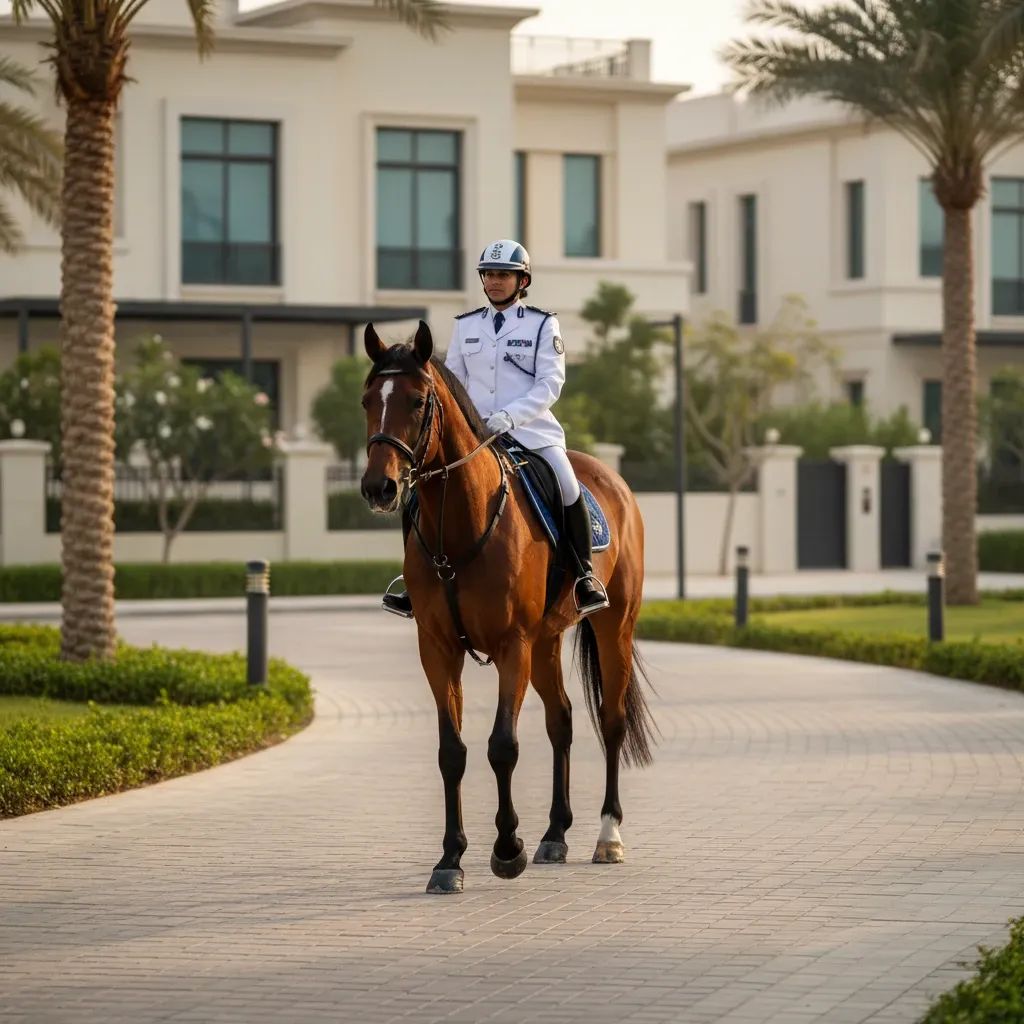
Why This Matters
• Access where vehicles can't go: Mounted officers navigate narrow service lanes, villa compounds, and crowded souks—terrain that stops patrol SUVs cold—allowing pursuit and presence in zones traditional policing overlooks.
• Event capacity multiplier: Securing 67 community gatherings and 6 sporting events in Q1 means publicly-driven activities have operational backing they'd otherwise lack in a dense, rapidly developing city.
• Year-round tactical presence: Nearly 380 patrols in three months signals this isn't ceremonial—it's consistent operational deployment across neighborhoods where residents actually live.
Dubai's security landscape quietly depends on a resource most residents never fully notice. Between January and March 2026, the United Arab Emirates Dubai Police Mounted Unit deployed officers on horseback 379 times across the emirate's residential pockets, bustling commercial corridors, and high-traffic tourist zones. This tactical choice reveals something fundamental about modern urban policing: some terrain simply demands a different approach.
The mounted patrol officer fills a genuine operational gap, not a ceremonial slot. In neighborhoods like Jumeirah, Al Barsha, and Emirates Hills, villa architecture intentionally discourages vehicle traffic. Service lanes narrow deliberately. Compound pathways restrict entry to residents and deliveries. Pedestrian walkways wind through developments designed to minimize automotive intrusion. A patrol SUV becomes useless in these environments. A mounted officer, however, covers the same ground in real time, maintains continuous deterrent presence, and gains the elevated vantage point horseback provides—critical advantage when monitoring crowded parks, beach areas, or marketplace activity.
The Operational Reality Behind Visible Patrols
Lieutenant Colonel Dahi Al Jallaf, Acting Director of the Dubai Police Mounted Police Station, positioned the unit's work squarely within Dubai Police's broader tactical infrastructure. This framing matters for understanding why the investment continues. The mounted force isn't supplementary—it addresses terrain and operational challenges that other methods cannot resolve.
Dubai's main policing framework relies on layered approaches. Vehicle patrols, equipped with smart technology and real-time coordination, maintain coverage across developed areas and primary thoroughfares. Mounted patrols operate in inverse terrain. They excel where traditional vehicles create hindrance rather than help: pedestrian zones, heritage districts of Old Dubai, public parks, and commercial walkways. The 379 deployments across Q1 demonstrate sustained operational utility. Officers can patrol continuously without refueling, weave through congested foot traffic, and naturally de-escalate tense situations through the calming psychological effect a horse presence provides.
Q1 2026: Public Gathering Security
The specific breakdown reveals operational scope: 67 community events and 6 sporting events secured by mounted patrols during the first quarter showcase the unit's dual function as both security asset and community presence. These gatherings included neighborhood celebrations and organized cultural programs, many coordinated through Dubai's community development initiatives.
The Mounted Police Station also operates therapeutic riding programs for students, merging security training with community service. This dual-purpose model underscores an evolving police philosophy: in Dubai's context, where public satisfaction correlates directly with perceived accessibility and approachability, operational units increasingly serve as community connectors alongside enforcement roles. The psychological benefit of visible, friendly security presence—officers on horseback rather than armored vehicles—strengthens public trust without sacrificing safety infrastructure.
How Mounted Strategy Complements Technology-Driven Policing
Dubai Police employ sophisticated technological systems for traffic enforcement, emergency response, and crime prevention. Real-time tracking, drone surveillance, and vehicle-to-dispatch communication networks form the primary backbone of urban security coverage.
Mounted units operate in a different strategic layer. They cannot respond to building emergencies across the city quickly. They cannot detect speeding violations using radar systems or issue parking citations. Their operational advantage centers entirely on sustained presence in areas vehicles cannot physically access, combined with the social benefit of approachable, visible community policing.
Dubai Police are experimenting with emerging technologies to overcome coverage limitations. Flying motorbike platforms and drone deployments aim to improve response times and reduce reliance on traditional patrol vehicles for congestion-affected areas. Until these platforms achieve operational maturity, however, horses remain unmatched in narrow-access terrain, and their psychological presence remains unmatched in community engagement contexts.
Emirates-Wide Context: Dubai's Distinct Commitment
Dubai's continued investment in mounted operations stands distinctly within the emirate's broader security strategy. The 379 patrols in Q1 2026 represent ongoing operational commitment, signaling that Dubai Police views the mounted unit as tactical necessity within Dubai's evolving security ecosystem.
Practical Implications for Residents
For expat families living in villa communities across Dubai, mounted patrols offer concrete reassurance in neighborhoods where vehicle access faces physical barriers. Security presence feels normalized and accessible rather than militarized or distant. For tourists navigating Dubai Marina, Jumeirah Beach, and heritage districts, visible mounted officers enhance perceived safety without creating the aggressive posture armored vehicles or heavy-handed enforcement might project.
Event organizers benefit from reliable crowd management capability through mounted security—effective, non-intrusive, and fundamentally community-aligned. The horses themselves often become focal points of positive interaction, particularly for children and families, reinforcing Dubai's reputation for balancing rigorous security infrastructure with genuinely community-centered policing.
For villa compound residents and pedestrian-zone users, the practical takeaway is straightforward: neighborhoods that would otherwise depend exclusively on intermittent vehicle patrol coverage now receive dedicated mounted presence. Service lanes, compound pathways, and pedestrian areas benefit from continuous, accessible security. Residents organizing community gatherings gain access to proven crowd management without logistical burdens of vehicle cordons or heavy security apparatus.
The 379 patrols logged in Q1 2026 establish baseline pacing likely to continue through 2026. As Dubai's mixed-use developments expand—blending residential, commercial, and recreational spaces in increasingly complex configurations—the tactical flexibility and terrain accessibility of mounted units will only increase in relevance. For most residents, this means one additional security layer operating precisely where they live, work, and gather, addressing gaps that technology and vehicle-based policing simply cannot fill.


