
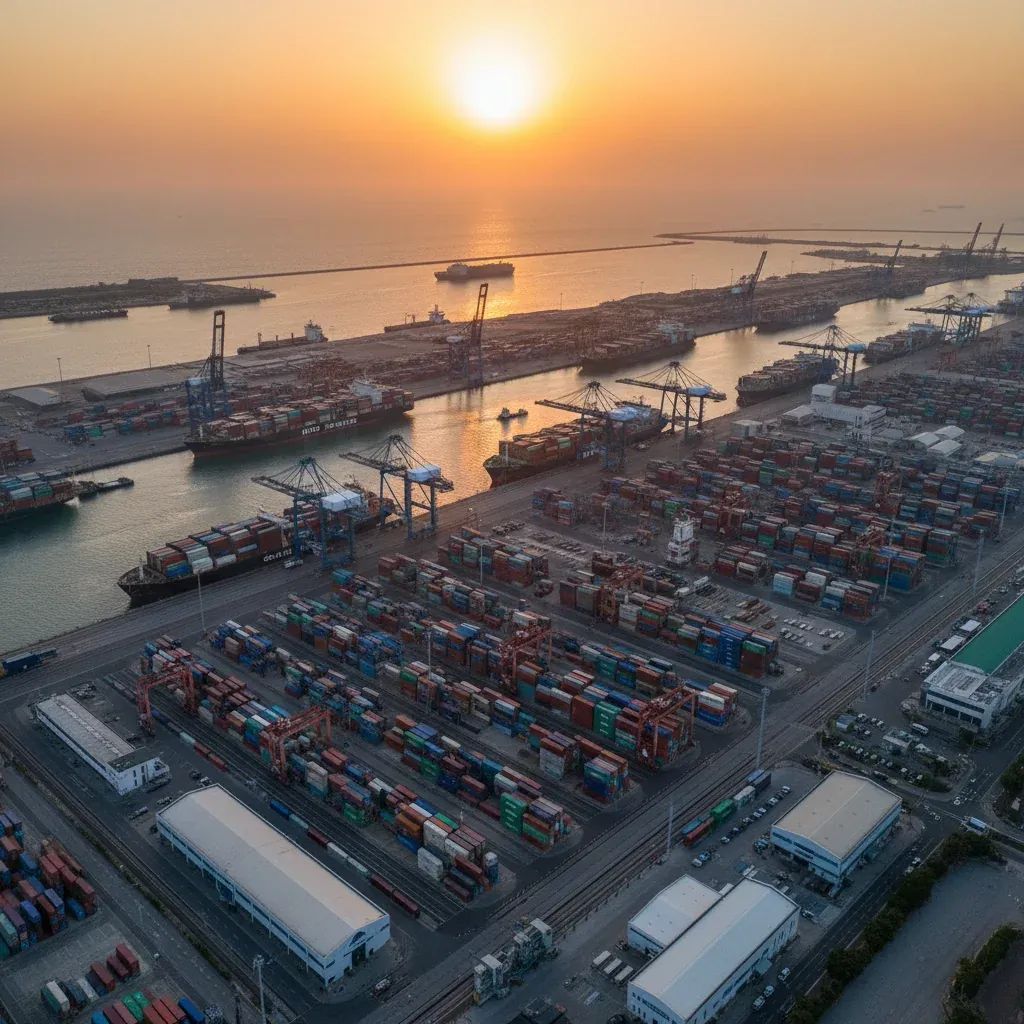
When one major artery tightens in the global oil circulatory system, demand for backup routes soars. Yet a hypothetical scenario of Strait of Hormuz closure—though not currently occurring—reveals an uncomfortable reality across energy markets: even the world's largest oil producer cannot reliably substitute for Middle Eastern crude if this critical waterway became inaccessible. As of March 2026, this scenario analysis shows how such a disruption would reshape petroleum economics across every continent, with especially acute consequences for the United Arab Emirates and its neighboring economies.
Understanding the Scenario: Risk Assessment, Not Current Crisis
Before examining the implications, it is important to clarify: as of March 2026, there are no reports of a Strait of Hormuz closure. This article analyzes a hypothetical scenario to assess UAE vulnerability to a potential future disruption. The Strait remains operational and critical to global energy commerce. However, examining this "what-if" scenario reveals important structural weaknesses in global energy security that UAE residents and business operators should understand.
Why This Matters
• Price sensitivity for UAE residents: In a Hormuz blockade scenario lasting only days, petrol prices would likely surge 30-50% higher, immediately impacting household transportation budgets and commercial logistics costs throughout the Emirates.
• Asian markets would lose 30% of oil supply: Countries importing Gulf crude would face potential shortages within weeks, triggering global recession risks that would reverberate through UAE financial markets and expat employment sectors.
• U.S. cannot mobilize spare capacity: American production has stalled at 13.5 million barrels daily—essentially flat from 2025—meaning no emergency surge capacity would exist despite political rhetoric about "energy dominance."
The Energy Paradox: Political Promises Meet Corporate Caution
The current U.S. administration routinely champions rapid drilling expansion through policy announcements and permit approvals. Yet boardrooms at ExxonMobil and Chevron—companies controlling roughly 40% of American crude output—have adopted a starkly different playbook than the one Washington imagines.
History explains this disconnect. The oil sector witnessed catastrophic bankruptcies in 2014 and 2020, wiping out capital and shareholder value for companies that chased production volume during volatile periods. ExxonMobil responded by allocating $20 billion toward share buybacks in 2025-2026 while dedicating merely $1 billion to exploration activities. This allocation pattern reveals corporate priorities with crystal clarity: financial stability and shareholder distributions trump volume expansion. When ExxonMobil executives described their environment as "very dynamic, very uncertain," they were essentially signaling that production decisions will ignore Washington's directives. Oil companies learned the hard way that political administrations change faster than geological formations allow wells to be developed.
Chevron runs an identical strategy, directing $10-20 billion annually toward buybacks while capping organic capital expenditure at $18-19 billion for 2026. This behavior represents what energy analysts term "capital discipline"—a deliberate strategy emphasizing balance-sheet strength over well-count expansion.
The mathematical outcome is measurable and sobering. The United States Energy Information Administration projects American production will average approximately 13.5 million barrels daily through 2026. This represents essentially flat output compared to 2025, marking the end of the shale revolution's characteristic explosive growth phase that characterized the previous decade. Oil majors are entering what industry observers call the maturity stage, where production growth slows substantially.
Why the Permian Basin Cannot Rescue Global Markets
The Permian Basin in West Texas remains Earth's most prolific shale formation. Operators have extracted crude from the most desirable geological zones—the ones delivering the highest output per well. Remaining drilling opportunities cluster in what industry professionals call "Tier-2" and "Tier-3" acreage. These formations produce substantially less crude per well and show steeper production declines, meaning drilling volume alone cannot compensate for these geological realities.
Industry consolidation during 2024-2025 further dampened expansion momentum. As independent producers merged into larger entities, the consolidated companies adopted more conservative development strategies. These behemoths optimize existing assets rather than aggressively chase growth targets, even when international pricing climbs above $85 per barrel. This behavior defies the simplistic "higher prices equal more drilling" formula that analysts outside the industry often assume.
Concrete physics and engineering impose hard constraints. Enverus and Rapidan Energy Group calculated that even with 6,000 newly approved drilling permits and sustained pricing in the favorable range, American producers could add roughly 600,000 barrels daily—but only after several months. The lag between permit issuance and first production means additional volume could not address immediate market disruptions. Drilling a shale well, completing the wellbore, installing collection infrastructure, and connecting to transport pipelines requires months minimum. Geological timelines cannot be compressed or accelerated.
Pipeline Alternatives Offer Limited Refuge
If the Strait of Hormuz were to become impassable, the region's pipeline infrastructure would provide only partial mitigation. Saudi Arabia's East-West Pipeline to Yanbu on the Red Sea accommodates 5 million barrels daily. The United Arab Emirates's route to Fujairah on the Gulf of Oman handles 1.5 million barrels daily. Combined, these bypass corridors would represent roughly 32% of normal Hormuz throughput—genuinely helpful but catastrophically inadequate against total closure of a waterway handling 20 million barrels daily.
This calculus becomes even bleaker when considering that most OPEC+ spare production capacity sits within the Persian Gulf itself, rendering it inaccessible if Hormuz remained blocked. Saudi Arabia, Iraq, Kuwait, and other regional producers could not physically evacuate crude if the primary export chokepoint became inoperable. Pipeline alternatives exist but could not suddenly triple their capacity to absorb the displaced volume.
OPEC+ production increases scheduled for April 2026 would offer marginal relief. The United Arab Emirates plans to boost output by 18,000 barrels daily—meaningful under normal circumstances but negligible against a 20-million-barrel disruption. Saudi Arabia and Russia would each add 62,000 barrels daily, while other members contribute lesser amounts. These increases were negotiated to gently support markets, not to address catastrophic supply shocks.
What Would Actually Happen If Hormuz Closed: The Real Backstop
In such a scenario, the immediate response would involve Strategic Petroleum Reserve (SPR) releases. The International Energy Agency has indicated member nations could collectively deploy 400 million barrels—a substantial initial buffer covering roughly 20 days of normal global consumption. However, this would represent a temporary safety valve, not a permanent solution. SPR stockpiles would deplete under sustained disruption, and refilling them would become costlier once prices spiked.
Non-OPEC production increases would provide incremental but slow relief. Canada is projected to increase output by 200,000 barrels daily in 2026. Brazil and Guyana would each add approximately 100,000-200,000 barrels daily through planned infrastructure projects. None of these would represent emergency surge capacity. They reflect long-term field development schedules that cannot be accelerated by international demand signals. Even if political pressure mounted, Guyanese production facilities, Canadian tar sands operations, and Brazilian deepwater platforms could not suddenly increase throughput beyond engineering limits.
This would leave a fundamental gap. Global markets depend on roughly 99 million barrels daily of petroleum liquids. A 20-million-barrel loss from Hormuz closure would represent roughly 20% of global supply. Emergency releases, OPEC increases, and non-OPEC growth would combine to cover perhaps 1-2 million barrels daily initially. The remaining shortfall would have to be absorbed through demand destruction—meaning economic contraction, rationing, or both.
The Cascade Effect Through UAE and Regional Economies
For residents and business operators throughout the United Arab Emirates, a Hormuz disruption would unfold across multiple fronts simultaneously.
Fuel costs would be the most visible immediate impact. Petrol station prices would advance sharply within days, directly impacting household transportation budgets. Commercial operators—logistics companies, delivery services, construction firms—would face immediate margin compression as diesel and gasoline prices spiked. Airlines operating out of Dubai and Abu Dhabi airports would absorb massive fuel surcharges, translating to higher ticket prices and reduced travel demand.
The secondary effects would cascade through supply chains. Companies importing raw materials from Asian markets or exporting finished goods to Asia would encounter disrupted supply routes and exponentially higher shipping costs. Vessels transiting Gulf waters already carry insurance premiums reflecting geopolitical risk. An actual Hormuz closure would multiply those premiums overnight. Shipping containers that move at current rates would become economically unviable to transport, forcing businesses to suspend operations or accept substantial margin deterioration.
The United Arab Emirates's economy—built substantially on financial services, trade logistics, and regional commerce—would face particular vulnerability. While the nation benefits from energy export revenues, its role as a gateway for regional trade and investment makes it exposed to global supply-chain disruption far beyond the energy sector itself. Businesses dependent on predictable international shipping and financing would face operational chaos during prolonged closure scenarios.
Stock markets would experience immediate distress. Energy company valuations would face downward pressure as exploration and production investments become uneconomical at disrupted price levels. Financial institutions with exposure to shipping companies and maritime insurance would face concentrated losses. Real estate markets could falter as economic uncertainty would suppress both consumer confidence and corporate capital spending.
The Strategic Mismatch Nobody Discusses Openly
U.S. policymakers promote rapid American production expansion as though it represents a solution to global energy security. The underlying assumption—that American shale could somehow substitute for Middle Eastern crude—fundamentally misunderstands the constraints facing the industry.
Oil companies operate within economic logic, not political logic. Executives learned through experience that chasing production during volatile periods destroys shareholder value. They prioritize financial flexibility, balance-sheet strength, and consistent shareholder distributions. Higher prices alone would not trigger production surges because executives understand that price spikes often prove temporary. Committing massive capital to drilling campaigns based on transient price movements invites the bankruptcies of earlier cycles.
The geological constraint is equally real. Premium shale acreage has been substantially developed. Remaining opportunities would deliver lower returns and steeper declines. Drilling Tier-2 and Tier-3 formations produces incrementally more output, but at declining efficiency. The shale revolution's explosive growth phase—the 17% production surges seen during 2016-2018—reflected the low-hanging fruit of best-in-class geology and brand-new operational techniques. That era has passed. The industry has entered a more measured, mature phase where annual growth rates measure in single percentages, not double digits.
Contingency Thinking for UAE Stakeholders
Prudent business planning in the United Arab Emirates should acknowledge these structural realities rather than assume American production would somehow backstop global markets during crisis scenarios.
Companies with significant exposure to Asian supply chains—importing raw materials or exporting finished goods—should stress-test scenarios including sustained oil-price volatility and temporary supply interruptions lasting weeks or even months. This planning reflects realistic assessment of vulnerability in a region where one narrow waterway controls a disproportionate share of global energy commerce.
Financial institutions should model derivative risks associated with a prolonged Hormuz closure scenario. Shipping companies should review insurance coverage adequacy and consider hedging strategies. Utilities and power generation operators should verify fuel reserves and alternative procurement arrangements. Manufacturers should identify geographic supply chain dependencies and develop contingency sourcing.
The honest assessment is that American oil production could not serve as a reliable security backstop for regional energy markets in such a scenario. The constraint is not political willingness or regulatory approval. It is geological maturity, corporate capital allocation discipline, and engineering timelines. Understanding this reality is essential for prudent contingency planning in the UAE.


