
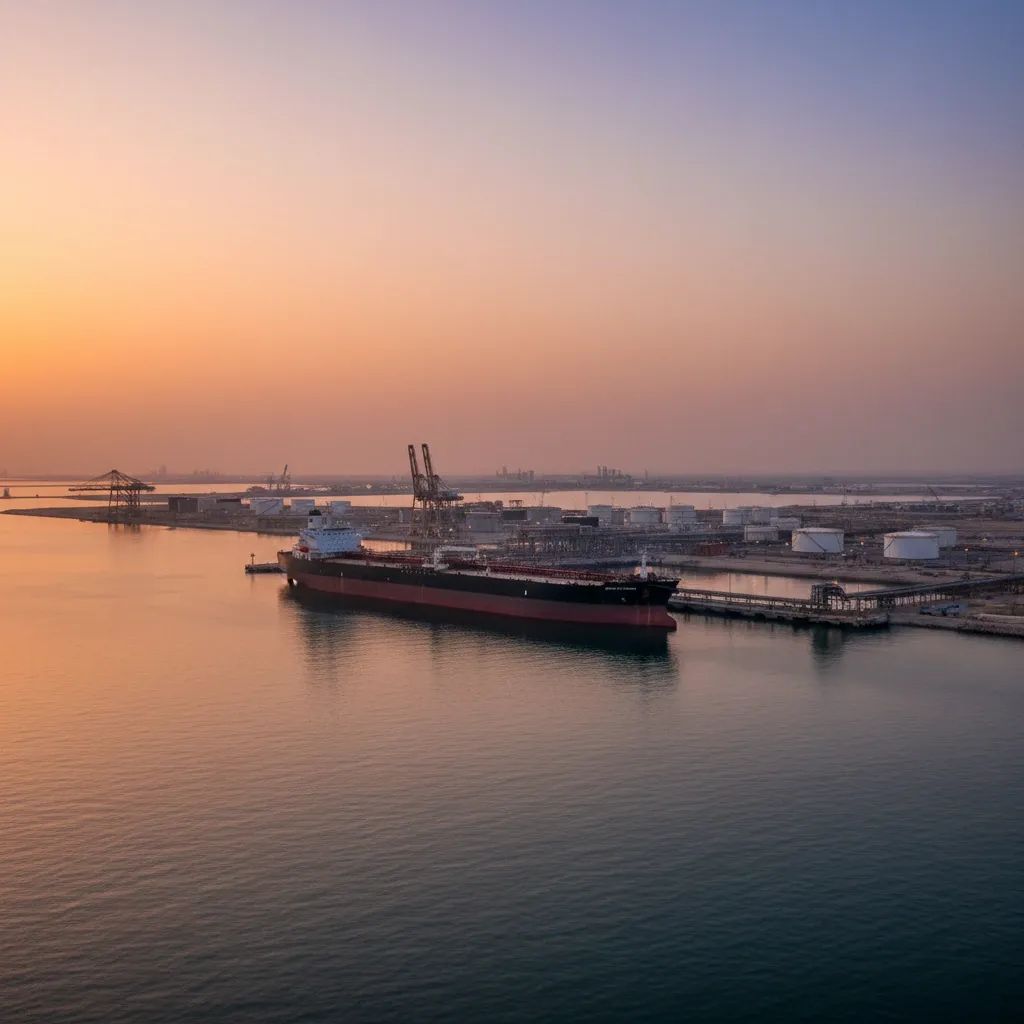
Russia and China have vetoed a United Nations Security Council resolution designed to protect commercial shipping through the Strait of Hormuz, effectively derailing international efforts to secure a waterway that handles roughly 20% of global crude oil traffic, equivalent to approximately 21 million barrels per day. The United Arab Emirates government expressed deep disappointment over the April 7 vote, which leaves the critical energy chokepoint under continued uncertainty as a fragile ceasefire with Iran takes hold.
Why This Matters
• Energy costs remain elevated: Brent crude has climbed to approximately $109 per barrel, nearly 80% higher than January 2026 levels, directly impacting fuel prices across the Emirates.
• Supply chains face prolonged disruption: Essential commodities including fertilizers, helium, and aluminum routed through the strait remain in shortage, threatening sectors from agriculture to semiconductors.
• Two-week ceasefire window: A U.S.-Iran temporary truce announced April 8 permits controlled passage under Iranian military management, but the long-term mechanism for free navigation remains unresolved.
The Veto and Its Fallout
The draft resolution, spearheaded by Bahrain and co-sponsored by the United Arab Emirates, Saudi Arabia, Kuwait, Qatar, Oman, and Jordan, secured 11 votes in favor but fell to dual vetoes from Moscow and Beijing. Colombia and Pakistan abstained. The text had called on member states to coordinate defensive naval escorts for commercial vessels and demanded Iran immediately cease interference with freedom of navigation—a demand that proved too confrontational for the resolution's opponents.
Russia's Ambassador Vassily Nebenzia argued the draft unfairly singled out Tehran while ignoring military strikes conducted by the United States and Israel beginning February 28. China's representative Fu Cong warned that adopting punitive language at a moment when Washington was openly threatening Iran risked escalating tensions rather than de-escalating them. Iran's envoy dismissed the measure as an attempt to "punish the victim" and provide legal cover for further Western military action.
For the United Arab Emirates Ministry of Foreign Affairs, the outcome represented a missed opportunity to restore stability to a waterway vital not only to the Gulf but to global commerce. Since early March, marine traffic data has shown vessel counts plummeting as shipowners and insurers reassess the security landscape. War-risk premiums have surged from 0.125% to as high as 1% of a vessel's insured value per transit, effectively pricing smaller operators out of the route.
Why the Strait Matters to Residents and Businesses
The Strait of Hormuz is more than a geopolitical flashpoint—it is the primary artery for energy and commodities that sustain daily life across the Emirates. Beyond crude oil, the waterway facilitates shipments of natural gas, urea, ammonia, methanol, sulfur, and helium. Disruptions since March 1 have reduced Middle Eastern crude and product exports to a near standstill, taking approximately 11 million barrels per day offline and adding a further 3 million barrels per day in refinery cuts.
The ripple effects extend well beyond fuel pumps. Qatar, a major supplier of industrial helium, has seen exports disrupted, squeezing global semiconductor manufacturing. Fertilizer shortages—roughly two-thirds of global seaborne urea typically transits the strait—threaten the spring planting season in agricultural importing nations, raising the specter of elevated food prices later in the year. The United Nations has flagged the cascading economic fallout, warning that sustained energy and input cost increases will entrench inflation and delay anticipated interest rate reductions by central banks.
For businesses operating in the United Arab Emirates, the supply chain instability complicates inventory planning and cost forecasting. Manufacturing sectors reliant on petrochemical feedstocks face input cost volatility, while logistics providers grapple with rerouting shipments via longer, more expensive alternatives such as the Yanbu-Red Sea pipeline corridor—itself vulnerable to attacks by Houthi forces operating from Yemen.
Ceasefire Terms and Control Dynamics
One day after the Security Council impasse, U.S. President Donald Trump announced a two-week ceasefire with Iran, conditional on Tehran allowing "complete, immediate, and safe opening" of the Strait. Iran accepted the terms but added a crucial caveat: passage would proceed under Iranian military management during the truce period. Tehran also claimed the arrangement was anchored in a 10-point peace plan it had proposed, which includes "continued Iranian control" over the waterway.
On March 30, Iran's parliament approved a legislative framework to govern strait operations, introducing navigation fees tied to Iranian currency and restricting passage for vessels flagged by countries enforcing sanctions against Tehran. This unilateral regulatory move raises questions about the sustainability of any temporary arrangement and whether international shipping norms will be restored after the ceasefire expires.
The United Arab Emirates government, along with its Gulf Cooperation Council partners, views the ceasefire as a narrow opportunity for diplomatic engagement but remains wary of Iran's longer-term intentions. The March 11 adoption of Security Council Resolution 2817, which condemned Iran's attacks on Gulf states and blockages in the Strait and Bab-el-Mandeb, had passed 13-0 with Russian and Chinese abstentions—a stark contrast to the April 7 veto, signaling hardening positions among major powers.
Regional Diplomatic Push and Global Anxiety
British Prime Minister Keir Starmer is scheduled to visit Gulf capitals this week to coordinate reopening strategies with regional leaders. His agenda includes discussions with senior officials in the United Arab Emirates and Saudi Arabia, focusing on confidence-building measures that could extend the ceasefire and lay groundwork for a multilateral security mechanism. The diplomatic push reflects European dependence on Middle Eastern energy—particularly as the continent seeks alternatives to Russian supply.
Meanwhile, foreign missions in the Gulf have escalated travel advisories. Australian embassies across the region have stepped up warnings to nationals, advising non-essential travelers to defer visits and urging residents to maintain heightened situational awareness. Similar guidance has been issued by embassies of several Western and Asian nations, reflecting the volatile security environment that has accompanied the crisis.
Broader Economic and Strategic Implications
The Strait of Hormuz closure represents the largest disruption to global energy supply since the 1970s oil shocks. The International Energy Agency coordinated a record release of 400 million barrels from emergency reserves in March, but these stockpiles are now severely depleted and cannot serve as a sustainable buffer if the closure extends. Global markets are drawing down inventories at roughly 6 million barrels per day, a pace that could exhaust remaining cushions within months.
For the United Arab Emirates, the crisis underscores both vulnerability and strategic importance. The Emirates has invested heavily in bypass infrastructure, including the Abu Dhabi Crude Oil Pipeline that links oilfields to the port of Fujairah on the Gulf of Oman, bypassing Hormuz entirely. This infrastructure now serves as a critical hedge, though its capacity is insufficient to offset the full volume of disrupted flows.
Gasoline prices in major consuming markets have climbed sharply—U.S. pump prices approach $4 per gallon, while jet fuel costs have surged 95% since late February, translating into higher airfares and freight charges. In Asia, where China and India rely on Gulf crude for the majority of their imports, governments are scrambling to secure alternative supply and manage domestic price controls. Reports from Bangladesh and other net importers detail fuel shortages and associated social unrest, illustrating the cascading human cost of the blockade.
What Comes Next
The two-week ceasefire offers a fragile window for diplomacy, but the failure to pass a UN resolution signals deep fractures in the international community's ability to coordinate a response. The United Arab Emirates and its Gulf partners are pushing for a follow-on Security Council session that could address the broader regional dynamics, including the February military operations by the United States and Israel that triggered the current cycle of escalation.
Whether the ceasefire holds beyond mid-April depends on Iran's willingness to relinquish control mechanisms and on the major powers' readiness to broker a face-saving compromise. For now, shipping firms, energy traders, and businesses across the Gulf remain in a state of cautious suspension—planning for both the best-case scenario of restored navigation and the worst-case prospect of a return to blockade conditions and spiking costs.


