
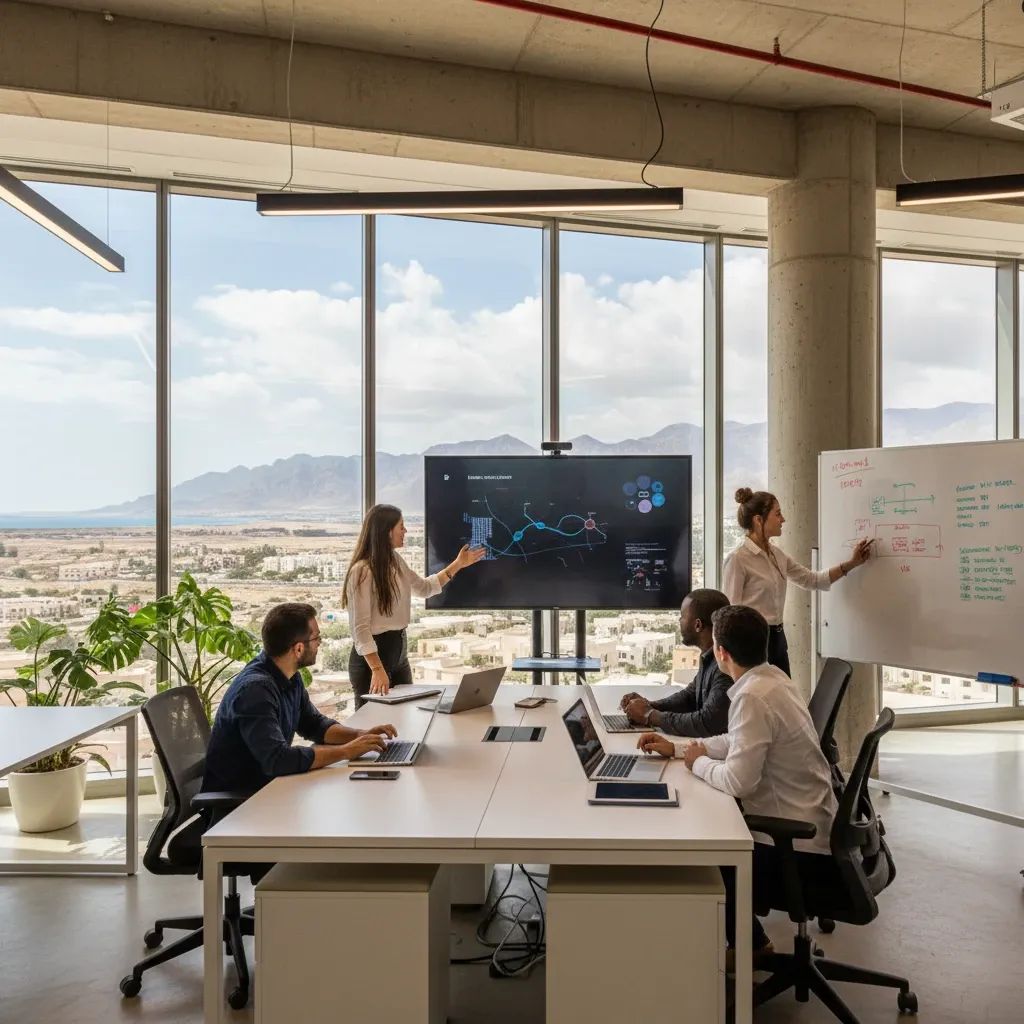
Northern Fujairah's Creative City free zone has quietly become a hub connecting entrepreneurs and media professionals across more than 180 countries—a geographic reach that fundamentally redefines where content creators and digital businesses can establish operations in the United Arab Emirates without absorbing the premium costs associated with Dubai's more established media infrastructure.
Why This Matters
• Dramatically lower entry barriers: Freelancer licenses cost AED 7,500 annually, with commercial and media licenses starting at AED 15,000, positioning the zone as accessible to bootstrapped startups and solo consultants priced out of traditional Dubai-based setups.
• Infrastructure partnerships create operational advantages: Direct ties to Fujairah International Airport and Fujairah Municipality reduce logistics friction that historically plagued remote-emirate businesses—faster equipment clearance, dedicated freight handling, and simplified local compliance.
• Dual licensing eliminates bureaucratic redundancy: A single application now enables companies to operate across both free-zone and mainland Fujairah jurisdictions, compressing what previously required two separate workflows and compliance calendars into one streamlined process.
The Emirate's Quiet Pivot Away from Traditional Dependence
Fujairah has spent decades positioning itself as a maritime and logistics gateway—container terminals, fuel distribution, regional shipping hubs. That identity made economic sense when the emirate's competitive advantage centered on port infrastructure and geographic positioning along the Strait of Hormuz. The Creative City expansion tells a different story about what the leadership now envisions.
The shift became formal during GITEX Global 2024, when the free zone signed explicit partnership agreements with both the airport and municipality. These weren't ceremonial memoranda; they represented infrastructure investment and operational integration. The airport, historically a secondary operator handling regional cargo flights, repositioned itself as a specialized logistics partner for media equipment and business aviation. This distinction matters more than it appears: international film crews can now arrange charter flights locally rather than routing through Dubai International Airport. Production companies relocating temporary staff face lower transport costs. Postproduction studios can source equipment faster without navigating Dubai's congested import channels.
For a wedding videography business or animation studio, these operational details translate directly into project timelines and margin preservation.
Where This Fits in the Regional Competitive Hierarchy
The United Arab Emirates creative sector operates as a pyramid. At the apex sits Dubai Media City, which has maintained market dominance since its 2000 launch. A standard media license there costs AED 58,800, and processing requires 20–25 days. That premium buys access to a global network that includes CNN, BBC, Reuters, Sony, and hundreds of multinational broadcasters and production companies. A multinational marketing agency pitching to Fortune 500 clients justifiably absorbs the higher cost for proximity to decision-makers and established industry relationships.
Twofour54 Abu Dhabi occupies a different tier entirely—catering to high-budget film production, gaming studios, and animation houses through a 30% cash-back rebate on production costs and state-backed financing for qualifying projects. Entry costs start at AED 15,000, but the true value proposition is production funding, not just workspace.
Sharjah Media City (Shams) and Creative City Fujairah compete in the emerging-business segment. Shams offers licenses from AED 5,750; Creative City matches that affordability at AED 7,500 for freelancers. The pricing similarity obscures a structural difference: Fujairah differentiates through infrastructure integration. The airport partnership and municipality alignment signal that the emirate is building toward operational advantages beyond mere cost reduction.
The practical distinction: A podcast producer, independent web designer, or social media consultant in the United Arab Emirates previously faced binary logic—either pay Dubai Media City premiums or operate outside a free zone, navigating mainland tax and labor frameworks. Creative City absorbed that middle market by providing a third option: cost-optimized setup with genuine infrastructure support.
Dual Licensing: The Bureaucracy Solver That Went Largely Unnoticed
Before 2024, a video production company needing to operate both inside Fujairah city (for local events, crew hiring, equipment storage) and within the free zone (for international clients and tax efficiency) required parallel licensing processes. Two separate applications. Two renewal cycles. Two compliance calendars. Two sets of documentation.
The municipality partnership eliminated that friction. One application now covers both jurisdictions. For event planning firms bidding on government contracts requiring a mainland presence while maintaining free-zone benefits on international revenue, this change genuinely compresses project delays. Wedding planners, consultants, and marketing agencies no longer lose weeks navigating parallel bureaucratic tracks during critical planning phases.
This is not revolutionary, but it is the kind of operational optimization that distinguishes a genuinely business-friendly emirate from one merely claiming such status.
What Changed Inside the Zone Itself
Creative City houses over 20,000 active companies across more than 2,000 distinct business activities. The headcount alone reflects market validation—organic growth indicating that the value proposition genuinely attracts entrepreneurs rather than relying on government subsidy or artificial incentives.
The zone operates under the standard regulatory framework for United Arab Emirates free zones: zero corporate tax on business profits (though the federal 9% corporate tax enacted in 2023 applies to certain activities and mainland operations), no personal income tax, unlimited visa quotas, and unrestricted currency repatriation. These terms are table stakes across most United Arab Emirates free zones, but Creative City differentiates operationally through office modularity and in-house support services.
Workspace options span flexi-desks available 24/7, furnished private offices with month-to-month rental flexibility, and hourly meeting room bookings. This modularity solves a genuine pain point for bootstrapped startups or consulting practices with uncertain growth trajectories—a designer can start at a shared desk, scale to a dedicated suite, and never lock into long-term capital commitments.
The in-house PRO (Public Relations Officer) service handles Emirates ID applications, visa processing, and labor card administration. This removes the historical friction that deters first-time United Arab Emirates entrepreneurs: outsourced PRO services exist throughout the emirates, but in-house provision reduces communication delays and ensures familiarity with zone-specific requirements and timelines.
The Artificial Intelligence Narrative: Marketing or Operational Reality?
Creative City markets itself as a hub embracing "advanced technologies, particularly artificial intelligence" to stay aligned with "the evolving global digital economy." The phrasing warrants scrutiny: Is the zone deploying AI internally to automate license renewals, visa processing, or tenant support? Or is it simply licensing AI-adjacent businesses?
Evidence points to permissive licensing rather than proprietary automation. The zone's broad activity catalog—animation, multimedia development, software development, media technology—naturally attracts startups building AI video tools, generative design platforms, and machine-learning services. Creative City's competitive positioning around AI is environmental rather than technological: it welcomes tech founders without imposing data-residency restrictions or regulatory scrutiny that apply to data-intensive operations in stricter jurisdictions.
For a founder validating an AI-powered content platform or machine-learning consultancy, Creative City offers low-cost infrastructure. That advantage derives from regulatory flexibility rather than revolutionary in-house innovation. Specific tools and implementation timelines remain opaque across official communications—the zone emphasizes capability over technical specification.
The Network Effect: What 180 Countries Actually Represents
The frequently cited "180-country network" reflects organic business reality rather than formal partner agreements. Companies from every inhabited continent now hold active Fujairah licenses, and this diversity generates de facto cross-border deal flow and referral networks. A content studio based in Creative City can realistically pursue client relationships across three continents without establishing satellite offices or maintaining regional coordinators elsewhere.
This network operates informally. Creative City maintains collaborative relationships with free zones in Dubai and Abu Dhabi, functioning as channels for client referrals and co-marketing rather than formal joint ventures. These soft connections reflect the United Arab Emirates' federal economic model: each emirate competes aggressively for foreign direct investment while coordinating on customs, security, and monetary policy at the national level.
Why Fujairah Needs Creative City More Than Creative City Needs Fujairah
The Fujairah 2040 strategic plan explicitly targets economic diversification away from container shipping and fuel terminals toward tourism, professional services, and high-value manufacturing. Creative City serves as the tangible expression of that pivot—a free zone attracting capital and human talent to sectors that historically did not anchor Fujairah's economy.
The business multiplier effects justify the investment beyond direct license fee revenue. Marketing agencies hire local translators and administrative staff. Production studios rent local venues, catering, and equipment storage. Tech consultancies hire and train Emirati university graduates. A single media company establishing operations generates downstream employment and ecosystem development.
For expat professionals already living in the United Arab Emirates, Creative City licenses offer a cost-optimized path when work doesn't require daily proximity to Downtown Dubai or Media City clients. License holders receive complimentary access to business centers in Dubai for designated monthly hours, reducing the isolation concern that historically deterred remote-first companies from establishing northern-emirate presences.
The Practical Calculus for Different Operator Types
For freelancers and solo consultants: Creative City is the de facto choice. Sub-AED 10,000 annual licensing and sub-week approval timelines eliminate the startup friction that previously forced choices between premium Dubai pricing or operating outside formal regulatory frameworks. Podcast producers, web designers, and social media consultants gain legitimacy and tax clarity at minimal cost.
For bootstrapped startups and SMEs: The airport partnership and municipality integration create operational advantages that generic low-cost alternatives cannot replicate. Equipment sourcing, client logistics, and local regulatory clarity justify the Fujairah location over competing zones in other emirates.
For investors scaling regionally: Fujairah's strategic plan transparency and infrastructure investment signal a genuine growth trajectory. Establishing a satellite office today provides advantageous lease rates while positioning the company to capture rising demand as the emirate develops tourism and events capacity. The infrastructure roadmap—expanded port facilities, fiber broadband deployment, new transportation networks—suggests this is not a static cost-cutting hub but an emerging business center.
For Dubai-based companies seeking satellite operations: The dual-licensing arrangement enables tax optimization without losing mainland presence or client proximity. A consulting firm can maintain headquarters in Dubai while operating a creative studio in Fujairah under the free-zone entity, preserving tax efficiencies on international revenue.
The Unresolved Questions Heading Into 2026
Creative City has built a compelling value proposition for budget-conscious entrepreneurs and emerging creative businesses. The legitimate uncertainty concerns whether promised AI-driven service upgrades and administrative innovations will translate into measurably faster approvals, reduced bureaucratic friction, or whether such claims remain aspirational marketing language—a pattern endemic to free-zone competition across the region where every jurisdiction claims "seamless" and "world-class" operations.
For entrepreneurs in the United Arab Emirates evaluating options, the decision framework is straightforward. If broadcast-grade studios and Fortune 500 networking drive your strategy, Dubai Media City remains nonnegotiable. If production financing and high-budget film incentives are central, twofour54 Abu Dhabi is unmatched. But if you are bootstrapping, prioritizing speed to market, and optimizing for affordability without sacrificing infrastructure support, Creative City Fujairah offers a pathway backed by tangible airport logistics, municipality integration, and emirate-level strategic planning that distinguish it from generic low-cost alternatives across the United Arab Emirates and broader region.


