
The Rail Revolution Nobody Expected to Arrive on Time
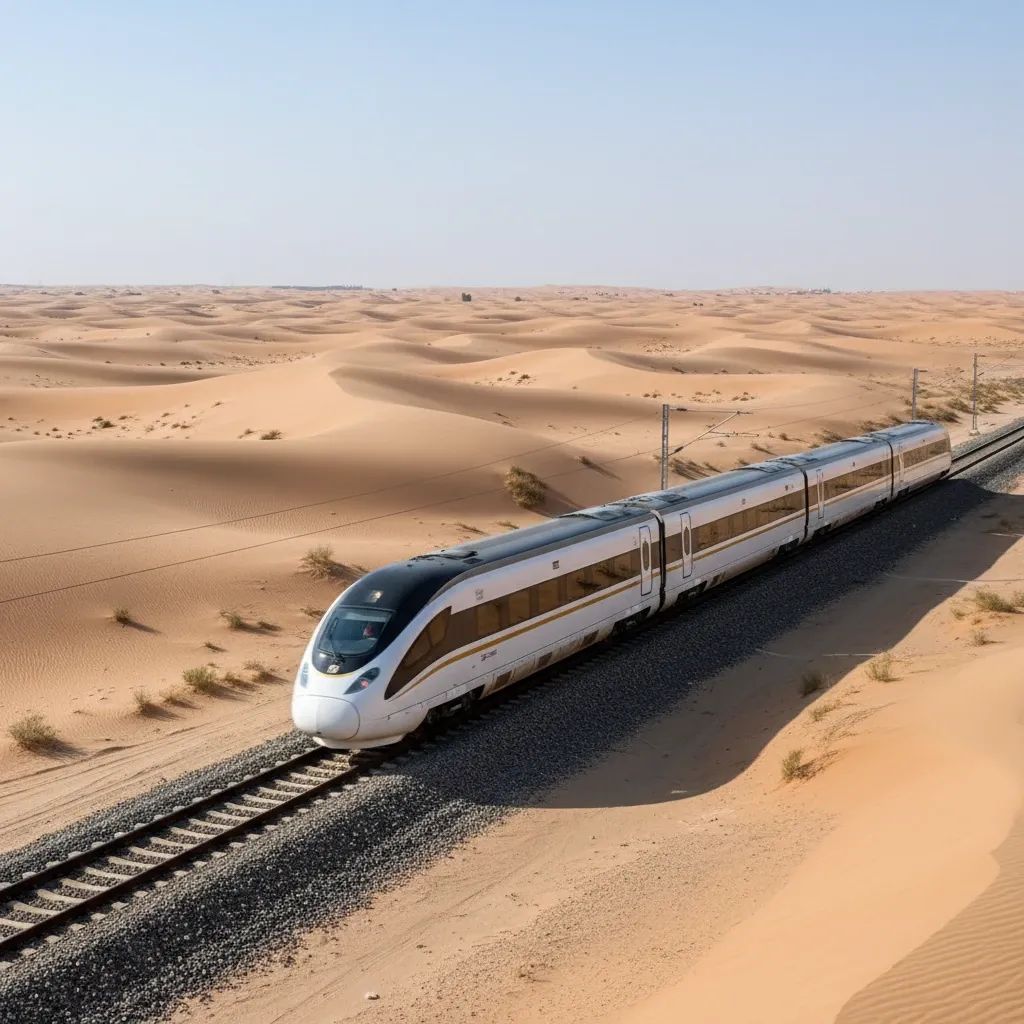
When the first Etihad Rail passenger train departed Fujairah Station on June 30, 2026, it wasn't just a transport milestone—it marked a subtle reordering of how residents across the United Arab Emirates will spend their weekends, plan their investments, and think about distance itself. A 105-minute journey that previously demanded three hours of highway monotony has compressed the map. For a nation built on car culture, that shift carries real weight.
Why This Matters
• Time compression fundamentals: Abu Dhabi to Fujairah drops from 180 minutes (car) to 105 minutes (rail)—a genuine behavioral prompt, not marketing language.
• Network expansion timeline: Additional stations are projected to open at Dubai and Al Dhaid by late 2026, with Sharjah anticipated by early 2027, creating a 900-kilometer spine across all seven emirates.
• Economic projections: The rail network is projected to contribute AED 145 billion to the economy over 50 years, with tourism revenues alone reaching AED 21 billion over four decades.
• Immediate ridership proof: More than 10,000 tickets sold before operations launched; first-day trains carried 400 passengers each at full capacity.
The First Month: What the Numbers Actually Reveal
Early demand statistics deserve scrutiny rather than celebration. The Etihad Rail passenger network sold 10,000 tickets pre-launch, yet this represents early adopter enthusiasm, not necessarily sustained ridership patterns. The broader context: each train seats 400 passengers at speeds reaching 200 km/h, operating across 13 initial services between Mohamed Bin Zayed City in Abu Dhabi and Al Hilal City in Fujairah.
The annual ridership target of 10 million passengers once operations stabilize represents roughly 27,400 daily travelers—achievable only if adoption maintains momentum through the summer slowdown and into the critical phase when additional stations introduce competitive route options. The United Arab Emirates Federal Transport Authority projects 36.5 million passengers annually by 2030, a figure requiring behavior change at scale in a population traditionally wedded to private vehicles.
What This Changes for Daily Life in the Emirates
For residents commuting or traveling regularly between emirates, the calculus shifts immediately. An Abu Dhabi professional no longer contemplates the psychological drain of rush-hour traffic toward Fujairah; the rail option becomes reflexive. For expatriate families, weekend accessibility transforms. The Al Aqah beaches, Al Bithnah Fort, and Fujairah's quieter tourist zones—previously requiring logistical commitment—become casual excursion destinations.
The practical benefit extends to hotel economics. Saeed Abdullah Al Samahi, Director of the Fujairah Department of Tourism and Antiquities, articulated the occupancy thesis: easier rail access drives higher hotel night usage and commercial spending in related sectors. Tour operators are already structuring multi-emirate itineraries that were cumbersome when road travel dominated. A Dubai-based hotel can now market a same-day Fujairah cultural excursion, reducing package friction.
For real estate investors, the strategic implications merit attention. The projected opening of train stations at Dubai and Al Dhaid will catalyze development activity in station precincts. Property developers are positioning residential and commercial clusters around these hubs, calculating that reduced travel friction will stimulate demand for both primary residences and investment units in previously peripheral zones. Station-adjacent developments typically command 8-12% premiums over comparable properties further afield.
Fujairah's Moment: Rebalancing the Tourism Map
Fujairah occupies a peculiar position in the UAE tourism hierarchy. The emirate possesses legitimate attractions—mountainous terrain, heritage sites, less-crowded beaches—that historically competed poorly against Dubai's megastructures and Abu Dhabi's capital investment because accessibility friction deterred casual visitors. Etihad Rail eliminates that friction.
The railway doesn't create new destinations; it redistributes traveler patterns. A family arriving at Abu Dhabi International Airport can now board a rail connection to Fujairah within two hours, enjoying beaches and cultural sites without the rental car commitment or ride-hailing costs. This reshaping matters at scale. When tourism barriers lower systematically across lesser-promoted emirates, the entire destination ecosystem benefits. Ras Al Khaimah, Umm Al Quwain, and smaller commercial zones gain accessibility they previously lacked.
For the broader UAE tourism narrative, this represents strategic positioning. The nation received 13.6 million international visitors in 2024, but domestic and regional leisure travel—Emiratis exploring other emirates, expatriates taking weekend breaks—remains underpenetrated relative to potential. Rail connectivity directly addresses this gap by making repeat visitation economically and temporally feasible.
The Integration Blind Spot: Airports Remain Disconnected
A critical operational gap undermines the tourism upside: neither Dubai International Airport nor Abu Dhabi International Airport connects directly to the Etihad Rail network. An international visitor arriving at Abu Dhabi International Airport currently requires complex onward transfers to reach the rail system. This represents a significant constraint on tourism impact during 2026-2027.
The United Arab Emirates General Civil Aviation Authority is discussing airport integration, but no operational timeline exists. If direct rail connections from both major airports launch by early 2027, tourism impact accelerates substantially. Without them, the network captures primarily domestic and regional travelers—valuable but smaller than the addressable market. This integration decision will determine whether Etihad Rail becomes a tourism backbone or an impressive infrastructure asset serving primarily intercity commuters.
The Ridership Sustainability Question
The underlying tension: will adoption hold? The United Arab Emirates maintains private vehicle ownership at approximately 800 cars per 1,000 residents—near the global highest. Cultural preference for personal mobility runs structurally deep. Summer temperatures exceeding 45°C also complicate logistics; passengers arriving at distant stations require air-conditioned onward transport unless dedicated shuttle services or ride-hailing integration operates seamlessly.
The phased rollout through 2027 will clarify whether initial bookings reflect genuine demand or launch novelty. If ridership plateaus after the initial phase, questions about the return on the $11 billion total investment become acute. Conversely, if occupancy rates rise measurably at rail-adjacent hotels and corporate relocation into emerging station zones accelerates, the model validates.
Regional Context: Why the UAE Approach Differs
Comparable regional rail projects pursue different strategies. Saudi Arabia's expanding network (from 5,300 km toward 8,000 km by 2030) prioritizes freight logistics and pilgrimage routes; the luxury "Dream of the Desert" train launching in late 2026 serves high-end leisure, not mass transit. Qatar's Doha Metro operates at substantial scale (100,000+ daily passengers) but serves a compact urban agglomeration, not multi-emirate connectivity across 11 cities. Oman's Hafeet Rail project, still developmental, mirrors Etihad Rail's technical specifications (200 km/h, 400-seat capacity) but serves cross-border travel rather than domestic network density.
What distinguishes the UAE approach is integration velocity and frequency. By 2027, a single network will span roughly 900 kilometers, connecting 11 cities across all seven emirates with multiple daily departures. This density is unprecedented among newly launched Middle East rail systems. The competitive positioning matters: early adoption of rail culture could establish the UAE as a regional model for integrating tourism, logistics, and mass transit—a strategic narrative advantage during a period when regional transportation infrastructure increasingly influences investment and talent attraction decisions.
Infrastructure Sustainability and Emissions Impact
The environmental narrative carries genuine substance. Each Etihad Rail journey eliminates the emissions of 400 individual car journeys. Transport-related congestion currently costs the UAE economy an estimated AED 12 billion annually in lost productivity. A viable, widely-adopted rail alternative could materially shift that calculation, aligning infrastructure investment with the nation's 2030 National Climate Strategy, which targets 25% reduction in transport emissions.
Stations are designed as intermodal hubs, interfacing with bus terminals and future metro extensions. This integration is theoretically critical in a nation where road-transport friction directly impacts quality of life and economic competitiveness. Whether the intermodal vision translates operationally will depend on coordination between Etihad Rail, the Federal Authority for Land and Maritime Transport, and individual emirate transport authorities—a governance challenge separate from infrastructure itself.
The Next Six Months: Critical Inflection Points
The period from July through December 2026 will establish Etihad Rail's trajectory. Ridership data will clarify whether initial bookings reflect genuine demand or launch novelty. The projected opening of additional stations will test whether the network retains appeal as expansion occurs beyond the initial Fujairah route.
Tourism occupancy data from Fujairah properties will signal sector confidence. If hotels rapidly introduce rail-inclusive packages and occupancy visibly rises, the model validates operationally. If adoption plateaus, questions about demand assumptions become difficult to ignore.
Airport integration announcements will reveal whether the United Arab Emirates Federal Government prioritizes connecting international travelers to the network—a capability that could substantially amplify tourism impact and justify the infrastructure investment more completely.
For residents making practical travel decisions, the immediate benefit is tangible: faster intercity movement, reduced stress, and weekend options previously impractical. Whether Etihad Rail becomes a foundational infrastructure backbone or an impressive but underutilized asset depends entirely on operational performance during this critical period.


