
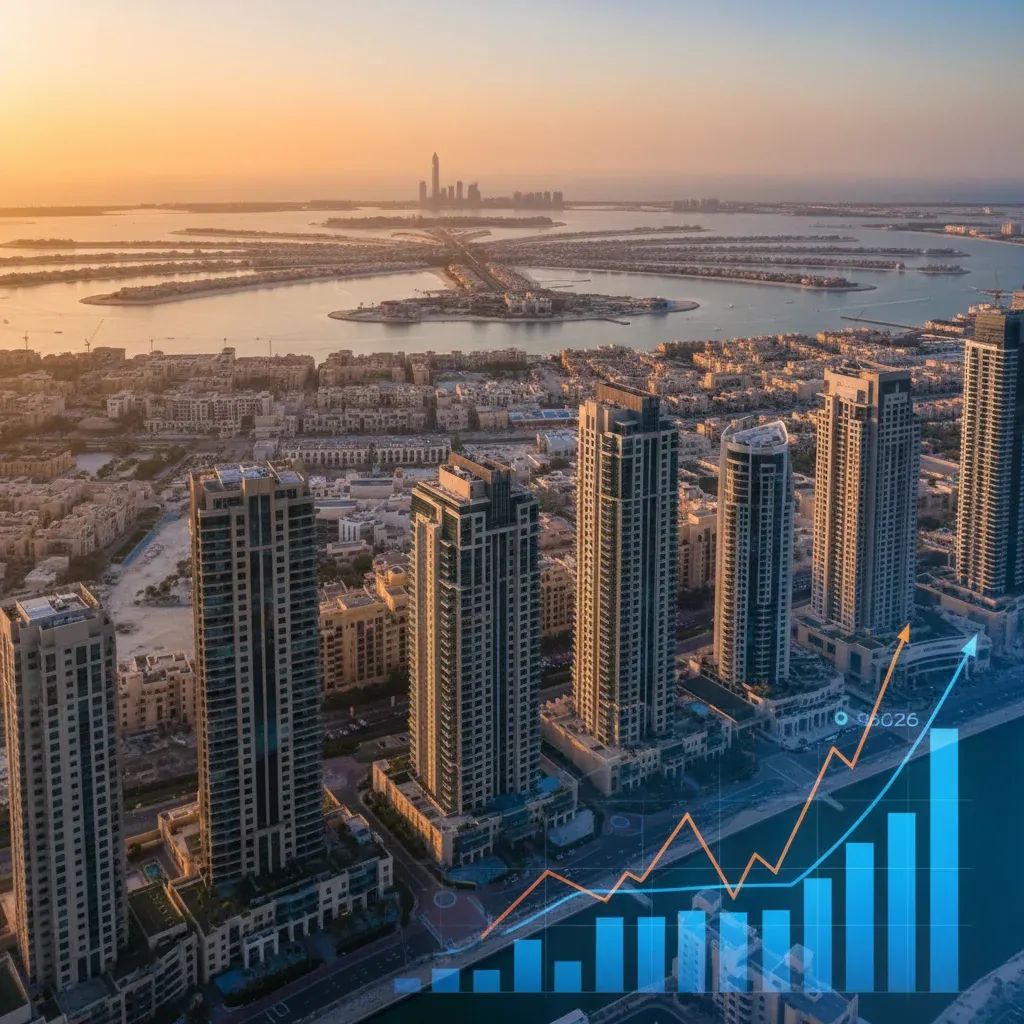
Shareholders in the United Arab Emirates-based TECOM Group PJSC have just unlocked a windfall: AED 1.72 billion in cash returns comprising the H2 2025 dividend (AED 440 million) and proposed 2026 dividends (AED 880 million) earmarked for distribution through mid-2027. The company's board presented the figures during its annual meeting at Dubai Internet City, signaling that Dubai's premium commercial and industrial real estate engine remains robust enough to fund aggressive capital returns while simultaneously plowing AED 2.5 billion into expansion. For anyone watching the United Arab Emirates' real estate sector, the message was unmistakable—operators managing specialized zones believe demand momentum will hold.
Why This Matters
• Payment certainty: AED 440 million for H2 2025, followed by two AED 440 million installments in August 2026 and March 2027 under the 2026 policy—totaling AED 880 million for 2026. Ex-dividend dates announced in advance represent a rarity among Middle Eastern zone operators where many payouts remain opaque.
• Predictable yield: At 4.93% annual dividend yield against a 40.75% payout ratio, TECOM offers quantifiable income in a region where most comparable zone ventures operate without public market discipline.
• Market tightness signal: 95% occupancy in commercial assets and 98% in industrial portfolios suggests rents can move higher, but new supply arriving through 2028 introduces uncertainty about whether momentum can persist.
Revenue Engine Running at Full Throttle
The numbers behind TECOM's confidence tell a straightforward story. The company generated AED 2.9 billion in revenue during 2025, a 19% jump year-over-year, with EBITDA expanding 20% to AED 2.2 billion while holding a fortress-like 78% margin. Recurring net profit climbed 20% to AED 1.5 billion, and cash flow metrics favored by institutional real estate investors—Funds from Operations—jumped 19% to AED 2 billion.
For the United Arab Emirates, this marks the fourth consecutive year of double-digit growth for a company that manages some of the nation's most strategically important commercial ecosystems. Chairman Malek Al Malek framed the performance as validation that TECOM sits at the intersection of UAE Digital Economy Strategy and Dubai's 'D33' Economic Agenda, both government-backed blueprints prioritizing knowledge-based sectors over commodity exposure. Essentially, the company is not riding temporary luck; it is positioned inside structural economic policy.
Three Forces Lifting Rents and Occupancy
Behind TECOM's financial acceleration lie three mechanical drivers that remain in place heading into 2026. First, office rental rates have climbed measurably. Premium Grade-A office space reached AED 225 per square foot in Q4 2025, a notable year-over-year jump that flows straight to the bottom line during lease renewals. Second, tenant occupancy reaches near-saturation—commercial assets sit at 95% occupancy, industrial at 98%, and land holdings at 98% through the first half of 2025. This means minimal vacancy absorption and pricing leverage when existing leases expire. Third, the tenant mix provides buffer against sector-specific downturns: technology firms cluster in Dubai Internet City and Dubai Media City, manufacturers and logistics operators fill Dubai Industrial City, and design studios populate Dubai Design District. No single industry collapse would cripple profitability.
However, near-full occupancy carries an implicit warning. When 95% to 98% of available space is leased, revenue growth depends almost entirely on rate increases rather than volume expansion. TECOM's capital deployment strategy suggests management knows this constraint intimately.
Betting AED 2.5 Billion on Industrial Expansion
In August 2025, TECOM committed AED 1.6 billion to acquire 138 industrial land plots covering 33 million square feet across Dubai Industrial City. This move addresses a genuine supply gap. Regional supply-chain consolidation and localization efforts—pushed by both government policy and global companies reducing Asia-dependent manufacturing—have flooded Dubai's industrial zones with demand. Available industrial land parcels in designated free zones remain expensive and scarce. By securing 33 million square feet, TECOM essentially positioned itself to capture the next phase of Dubai's industrial absorption cycle, assuming regional economic momentum doesn't falter.
The second deployment came in December when TECOM allocated AED 615 million toward Phase 4 of the Innovation Hub in Dubai Internet City. The project will deliver 263,000 square feet of Grade-A office space targeting multinational technology and media companies. Total Innovation Hub investment now stands at AED 2 billion, with handover targeted for 2028. Phases 2 and 3 filled ahead of schedule, indicating strong appetite for the product—yet Phase 4 will arrive in a different macroeconomic environment, introducing execution risk. If global tech hiring slows or media consolidation accelerates, the new space could face absorption headwinds.
Across TECOM's 10 business districts—spanning technology, media, education, science, design, and manufacturing—this capital deployment reflects a deliberate alignment with United Arab Emirates government diversification efforts away from hydrocarbon dependency.
What This Means for Tenants and Operators
For businesses and startups occupying TECOM assets, the dividend story matters less than what it signals operationally. Management believes supply additions at a managed cadence will prevent acute shortages while avoiding catastrophic oversupply. Tenants renewing leases in late 2026 or 2027 should anticipate moderate rent creep, particularly for premium Grade-A space where replacement cost justifies higher pricing. However, Phase 4 supply hitting the market in 2028 could ease pressure on cost-conscious operators willing to occupy newly delivered buildings, potentially creating a two-tier market—premium older stock commanding premium prices, and new-delivery space at competitive rates.
For individual investors and institutional shareholders evaluating TECOM stock, the dividend framework provides a roadmap. The 2026 policy commits to AED 880 million split equally into two AED 440 million installments—paid in August 2026 and March 2027—representing a 5% increase over the 2025 H2 dividend level, anchoring shareholder expectations while testing management's confidence in sustainability. Any disappointment on occupancy, rental rates, or tenant credit quality could force guidance down, so quarterly earnings reports and occupancy updates warrant close attention.
TECOM also formalized its Corporate Social Responsibility and Charitable Contributions Policy, anchoring ESG commitments in governance. The company has expanded LEED-certified buildings and installed solar generation capacity, moves that satisfy institutional investors increasingly focused on sustainability while reducing long-term operating costs—a win-win that also aligns with Dubai's net-zero carbon aspirations.
How Dubai's Zones Stack Against Middle Eastern Competitors
The United Arab Emirates free-zone ecosystem—of which TECOM is the largest publicly listed operator—offers 100% foreign ownership, zero corporate income tax on qualifying income (with a 9% rate on non-qualifying income exceeding AED 375,000 in certain zones), and unrestricted capital repatriation. These structural advantages rival most Middle Eastern jurisdictions, though peer comparison remains difficult because few regional competitors disclose dividends with TECOM's transparency.
Saudi Arabia's special economic zones—King Abdullah Economic City, Jazan, Ras Al-Khair—provide a 5% corporate tax rate for up to 20 years and exempt dividend withholding taxes for licensed activities, yet publicly listed zone operators with detailed dividend histories remain sparse. Bahrain's Bahrain International Investment Park offers zero corporate tax outside hydrocarbons and full profit repatriation, but comparable publicly traded companies publishing quarterly dividends are uncommon. Oman's Duqm and Sohar zones grant up to 30-year tax holidays and full capital repatriation, yet lack investor disclosure standards matching TECOM. Qatar's free zones permit 20-year corporate tax exemptions and full repatriation, with 2024 reforms enabling interim dividends for listed firms—yet actual yield data from such entities remains limited.
The distinction shapes investment strategy. TECOM offers an established payout track record and granular financial disclosure, reducing speculation about hidden obligations or wealth transfers to insiders. Other regional zones may pencil out better on tax optimization alone, but investors must independently validate occupancy claims, tenant quality, and financial stability. With TECOM, publicly available quarterly results and dividend payment history provide empirical grounding unavailable elsewhere in the region.
What Happens Next: 2027 and Beyond
TECOM's AED 880 million 2026 dividend commitment assumes steady operational performance without heroic occupancy jumps—current rates already support it. What could break the model? A global economic downturn reducing demand for Dubai commercial real estate, competitor supply flooding the market with cheaper alternatives, or tenant sector bankruptcies concentrated in technology or finance. None pose imminent risks based on current momentum, yet Innovation Hub Phase 4 completion in 2028 represents the next critical inflection point. If leasing velocity slows or rents plateau, the company's ability to fund dividends at current levels could face pressure heading into 2029.
For professionals and entrepreneurs evaluating lease decisions in TECOM assets, the stability message is clear: expect measured rent increases through 2027 before potential plateauing as new supply lands in 2028. Premium Grade-A office will command premium pricing, but second-generation industrial space in Dubai Industrial City could provide cost relief for manufacturers and logistics operators managing tight margins. The underlying signal remains consistent: United Arab Emirates specialized zones represent genuine infrastructure investments with durable underlying demand, not speculative real estate vehicles betting on perpetual price appreciation.


